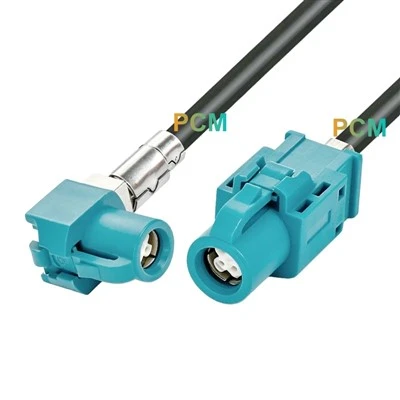


Automotive cameras, vision-processing units, communication modules and control equipment may use different connector layouts. Some projects require a dual-cavity HSD interface on one side and two separate single-cavity HSD ports on the other. Using two entirely independent cables may increase harness count, routing complexity and installation-management effort.
This HSD branch cable integrates one dual-cavity connector and two single-cavity connectors into a single assembly, providing a consolidated connection option for equipment with compatible interface definitions. It is suitable for custom harness development, equipment integration, engineering tests and dedicated interconnection projects.

Product Features

- One Dual-Cavity End with Two Branches
The assembly combines one dual-cavity HSD female connector with two single-cavity HSD female connectors, creating a clearly defined main interface and branch layout. This configuration helps identify the main end, branch ends and their respective connection positions in assembly drawings and production documentation.
- Four Signal Contacts per Cavity
The reference connectors provide four signal contacts per cavity. The main connector contains two cavities, while each branch connector contains one. Actual signal assignments must follow the approved cable drawing; contact count alone does not define the communication protocol or transmission capability.
- Consistent Z-Coded Interfaces
The dual-cavity main connector and both single-cavity branches use Z-coded configurations in the specified reference part numbers. Consistent coding simplifies interface verification.
Key Performance Advantages
◆ Centralized Management of Two Branch Connections
Integrating both branches into one finished assembly allows the main end and two branch ends to be identified, assembled and inspected as a single unit. For projects with clearly defined interfaces, this approach can reduce the identification and coordination work associated with separate cables.
◆ Supports More Organized Equipment Routing
Planning the lengths and directions of the main cable and both branches in advance helps organize routing within the equipment while accounting for fixation points and service clearance. A well-planned layout can reduce unnecessary crossings, excessive routing and interference with adjacent components.
◆ Helps Standardize Assembly Procedures
Documenting the dual-cavity main end and both single-cavity branches in one assembly drawing helps standardize connector part numbers, coding, branch definitions and termination requirements. For repeat orders, a controlled specification revision provides a common reference for manufacturing, acceptance and future procurement.
◆ Facilitates Separate Verification of Both Branches
The inspection plan can separately define continuity relationships, pin mapping and connection status for both branches, alongside complete-assembly checks at the main interface. For high-speed data applications, relevant signal-integrity parameters should also be validated according to project requirements; continuity results alone do not establish complete cable transmission performance.
Product FAQ
Does a Dual-to-Two-Single HSD Cable Automatically Split One Signal into Two Outputs ?
Not necessarily. Dual-to-two-single describes the connector arrangement and physical cable layout: the main end contains two cavities, while the other end branches into two single-cavity interfaces. It does not independently specify whether the internal wiring is straight-through, separately routed, intended for signal distribution or designed for a particular equipment interconnection.
In high-speed differential data applications, signal paths generally need to maintain the required differential routing, impedance and termination relationships defined by the system. A differential data pair should not simply be paralleled to two receivers without an appropriate design.
How Should Branch Lengths and Routing Be Evaluated for an Automotive HSD Cable ?
When planning branch lengths, first identify the mounting positions of the main interface and both destination devices, then determine the required lengths along the actual routing paths. Also consider connector mating clearance, cable fixation points, bend radius and clearance from moving components. The two branches do not necessarily need to be the same length; specify them according to the equipment layout.
If the branch area is exposed to sustained tension, vibration or repeated bending, evaluate strain relief and fixation during the design stage. An overly short branch may increase mechanical loading at the connector exit, while an excessively long branch can complicate routing and space management. Final routing should be confirmed against equipment drawings and actual installation validation.
Can the Two Single-Cavity Branches Have Different Lengths ?
Different branch lengths can be evaluated according to the project layout. Provide the mounting positions of both destination devices, actual routing paths and fixation points to determine the required length and exit orientation of each branch, then confirm the design through sample evaluation before production.
Does Premier Cable Offer Wholesale and OEM Services ?
Premier Cable can evaluate connector integration, custom cable assemblies, OEM manufacturing, and volume procurement according to project requirements.
Get In Touch

Hot Tags: hsd dual to 2 single hsd cable, China hsd dual to 2 single hsd cable manufacturers, suppliers, factory