

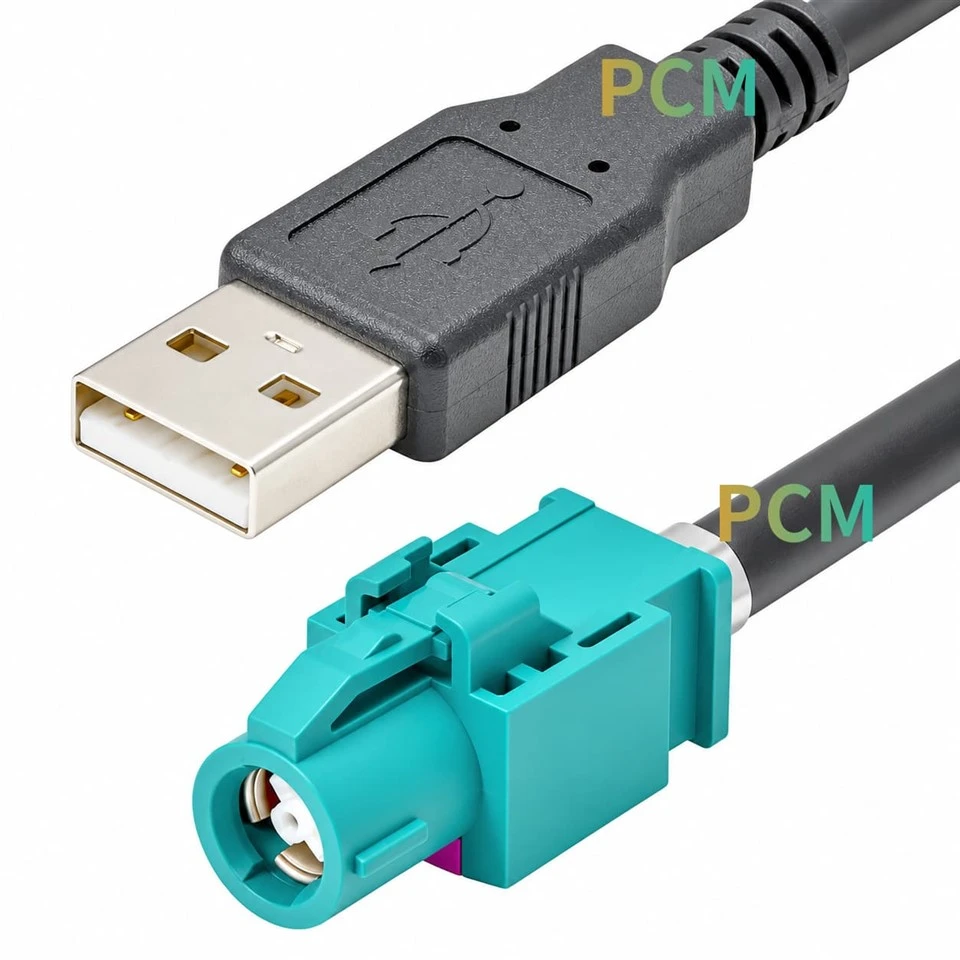


This HSD Automotive Data Cable Series is developed for automotive electronics, in-vehicle infotainment, USB interfaces, display systems and engineering test environments, with three physical interface configurations:
- HSD Straight Jack ↔ HSD Straight Jack
- HSD Jack ↔ USB 2.0 Type A Male
- HSD Jack ↔ USB 2.0 Type A Female
Although all three assemblies are based on a four-contact HSD interface, each serves a different system function.
◆ The HSD Jack to Jack Straight Cable provides direct interconnection between compatible HSD interfaces and is suitable for automotive displays, head units, camera modules, infotainment systems and laboratory module to module connections. The drawing specifies a 26AWG × 4 core construction, black TPU jacket, approximately 4.6mm outer diameter and continuous shield connection.
◆ The HSD Jack to USB 2.0 A Male Cable transitions the physical interface from HSD to a standard USB Type A male connector. It is particularly useful where an HSD based internal automotive USB link must connect to a standard USB Type A female port on a host, test platform or compatible device.
◆ The HSD Jack to USB 2.0 A Female Cable provides a standard USB Type A female receptacle, allowing an OEM HSD USB interface to be extended to an accessible consumer or service port for compatible USB devices, flash drives, diagnostic tools or other peripherals.
These assemblies provide physical connectivity rather than active protocol conversion. The HSD side equipment must already implement a compatible USB or other intended electrical interface for the HSD to USB assemblies to function correctly.

HSD Cable, Jack to Jack, Straight
This version uses straight HSD jacks on both ends for direct interconnection between compatible HSD equipped automotive devices.
According to the drawing, the cable uses:
26AWG × 4 cores + AE construction
Approx. 4.6mm OD
Black TPU jacket
Operating temperature: -40°C to +105°C
The specified pin mapping is crossed:
Pin 1 → Pin 4
Pin 2 → Pin 3
Pin 3 → Pin 2
Pin 4 → Pin 1
Shield → Shield
It should therefore not be assumed to be a conventional 1:1 HSD extension cable. Device side pinout must be verified before replacement or integration.
Available in multiple length versions ranging from approximately 1 meter to 10 meters, it is more suitable for platform based devices and varying in vehicle wiring distances.
HSD Jack to USB 2.0 A Type Male
This version combines an HSD straight jack with a USB 2.0 Type A male connector, providing a physical interface transition where the HSD side device already carries a defined USB link.
Drawing specifications include:
USB cable OD: approx. 4.5mm
USB 2.0 Type-A Male
Operating temperature: -40°C to +85°C
Standard length options: approx. 1m / 2m
Pin mapping:
HSD Pin 1 Green → USB Pin 3
HSD Pin 2 Red → USB Pin 1
HSD Pin 3 White → USB Pin 2
HSD Pin 4 Black → USB Pin 4
Shield → USB Shell
This configuration is well suited to USB 2.0 physical-interface adaptation between automotive head units, USB hubs, test computers and development platforms.


HSD Jack to USB 2.0 A Type Female
The third version uses an HSD straight jack to USB 2.0 Type A female configuration, allowing an internal HSD form USB interface to be extended to a standard accessible USB A receptacle.
According to the drawing:
USB 2.0 cable
26AWG × 4-core construction
Approx. 4.5mm OD
Black PVC jacket
Operating temperature: -40°C to +105°C
The pin mapping follows the corresponding USB configuration:
HSD Pin 1 → USB Pin 3
HSD Pin 2 → USB Pin 1
HSD Pin 3 → USB Pin 2
HSD Pin 4 → USB Pin 4
Shield → Shell
This configuration is especially suitable for center consoles, glove boxes, head units, dashboards and rear seat entertainment systems where a USB port must be positioned within convenient user reach.
Quick Product Comparison:

Typical Applications


Product Features:
Three Interface Configurations
The series includes HSD to HSD, HSD to USB male and HSD to USB female versions for device, host and user interface connections with fewer adapters.
4-Conductor + Shield Design
Four conductors with shielding support USB 2.0 differential data, power and ground paths while providing shielding for automotive data connections.
Defined Pin Mapping
Each harness uses a defined pin mapping, reducing wiring errors caused by assuming that visually identical 4 pin interfaces share the same OEM pinout.
Multiple Length & Jacket Options
TPU or PVC jackets and multiple lengths, including 250mm, 1m and 2m, support center consoles, dashboards, head units and test system routing.
Product Advantages
● Reduced Interface Conversion Layers
HSD to USB male and female assemblies directly integrate automotive HSD with standard USB A, reducing extra adapters, intermediate PCBs and temporary wiring for simpler system integration.
● Optimized for OEM Volume Assembly
Predefined connectors, cables, lengths and pin mappings simplify OEM BOM management and provide better consistency for volume assembly than field built wiring.
● Reduced USB Differential Wiring Risk
USB 2.0 requires correct routing of D+, D−, VBUS, GND and Shield. Factory controlled pinout helps reduce reversed differential pairs and inconsistent shield termination.
● Improved In Vehicle Cable Management
Multiple cable lengths and USB male female options allow flexible interface placement according to equipment architecture, reducing excess cable loops and additional extension cables.
Stable Connection
The HSD connector is not an ordinary 4 pin plastic interface; its value lies in mechanical Coding, locking, and full shielded data connection structure. Rosenberger describes HSD as a 100% fully shielded interconnect system,using Mechanical Keying, Latching, and Coding to reduce misinsertion and enhance retention force.
For these three products, stable connection also depends on:
- Correct HSD Coding
- Correct Pin Assignment
- USB D +/D-Polarity
- VBUS and Ground definition
- Shield to Shell continuity
- Connector fully locked
Vehicle electronics do not always expose a conventional USB A interface internally.
Head units, infotainment controllers and other automotive modules may use HSD because it provides shielding, mechanical coding, locking and a connector architecture better suited to automotive installations.
The user, service or test side, however, may still require standard USB.
A typical connection therefore becomes:
Head Unit USB Interface
↓
HSD Automotive Connector
↓
HSD Cable
↓
USB Type-A Male/Female
↓
USB Device / Service Port
The role of an HSD to USB cable is to provide this physical interface transition.
Product FAQ
Is the HSD Jack to Jack Straight Cable Wired 1:1 ?
No. The drawing specifies 1→4, 2→3, 3→2 and 4→1, so the electrical mapping is crossed. "Straight" refers to the connector geometry, not a 1:1 pinout.
What Is the Difference Between HSD to USB Male and Female ?
USB Male plugs into a standard USB A female receptacle, while USB Female provides a receptacle for connecting a USB device. Selection depends on the equipment-side interface.
Do HSD-to-USB Cables Require a Conversion Chip ?
When the HSD-side interface already carries USB 2.0, the assembly is normally passive and does not require protocol-conversion electronics. LVDS, Ethernet or other HSD signals cannot be converted to USB by the cable alone.
Do All Three Products Have the Same Operating Temperature ?
No. The HSD Jack-to-Jack and HSD to USB Female versions specify -40°C to +105°C, while the HSD-to-USB Male version specifies -40°C to +85°C.
Can These Cables Be Used With Automotive Cameras ?
HSD can be used for camera and high speed display applications, but compatibility with a specific camera depends on coding, pinout and protocol. HSD to USB versions can operate as USB links only when the connected equipment actually uses USB signaling.

Hot Tags: HSD to USB 2.0 Automotive Cable, China HSD to USB 2.0 Automotive Cable manufacturers, suppliers, factory


