

Mini FAKRA Dual Vertical HFM to FAKRA SMA Test Cable Family
The Mini FAKRA Dual Vertical HFM to FAKRA SMA Test Cable family is built around the Rosenberger AMK16C-1M4Z5-Z dual cavity vertical HFM interface. Two independent coaxial channels are broken out to FAKRA or SMA interfaces, providing a flexible physical interconnection platform for automotive electronics development, camera-link testing, ECU validation, RF measurement and bench level debugging.
Rather than providing only one fixed termination, this cable family keeps the same Mini FAKRA HFM equipment side interface while offering different output connector genders, orientations and test interface formats. Engineers can therefore select the appropriate FAKRA or SMA termination without rebuilding the complete test connection whenever the DUT or laboratory instrument changes.
Five configurations are available:
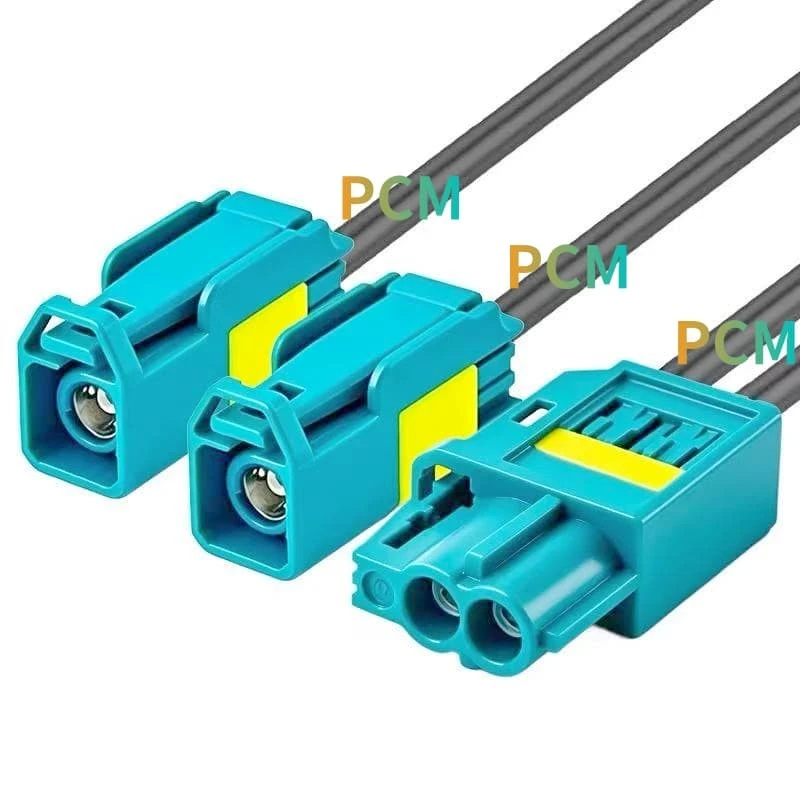
Dual Vertical HFM Female to 90° FAKRA Female;
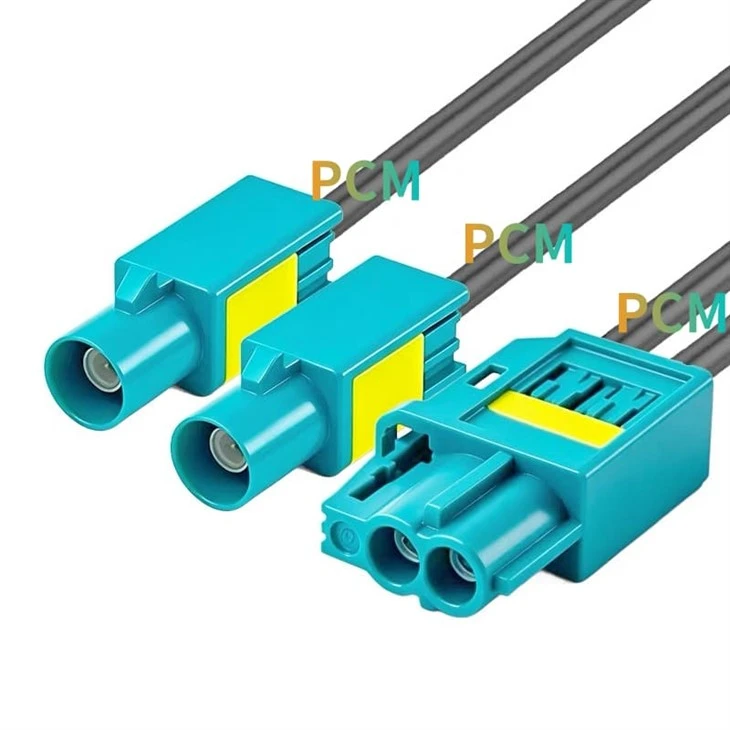
Dual Vertical HFM Female to Straight FAKRA Male;
Dual Vertical HFM Female to Straight FAKRA Female;
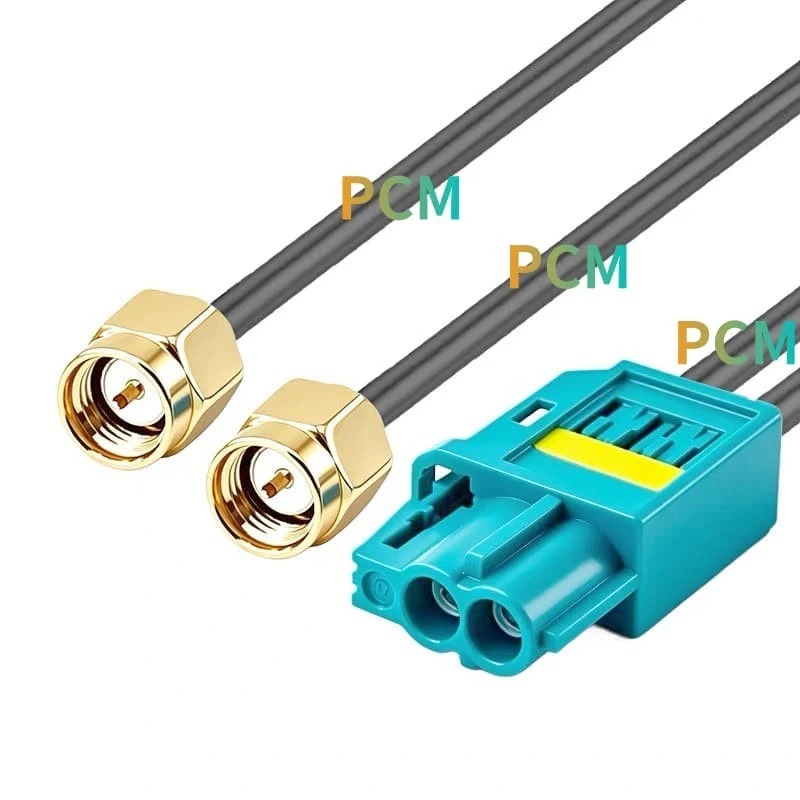
Dual Vertical HFM Female to SMA Male, internal thread with male pin;
Dual Vertical HFM Female to SMA Female, external thread with female contact.
This makes the Mini FAKRA HFM test cable family particularly useful when engineers frequently move between automotive connectors, test instruments, camera modules, ECUs, development boards and production test fixtures.
One HFM Platform, Five Breakout Options
Five configurations are available: Dual Vertical HFM Female to Straight FAKRA Male, Straight FAKRA Female, 90° FAKRA Female, SMA Female and SMA Male.
This makes the family useful when engineers frequently move between automotive connectors, test instruments, camera modules, ECUs, development boards and production test fixtures.

Dual Vertical HFM Female to Straight FAKRA Male
This version converts the AMK16C-1M4Z5-Z dual vertical HFM interface into two independent straight FAKRA male connectors. It is suitable for camera modules, ECUs, automotive electronic modules or test adapters equipped with mating FAKRA female interfaces.
The straight connector geometry allows the cables to extend naturally along the connector axis and is particularly useful where sufficient rear clearance is available. It provides a straightforward dual-channel automotive coaxial connection for development and validation setups.
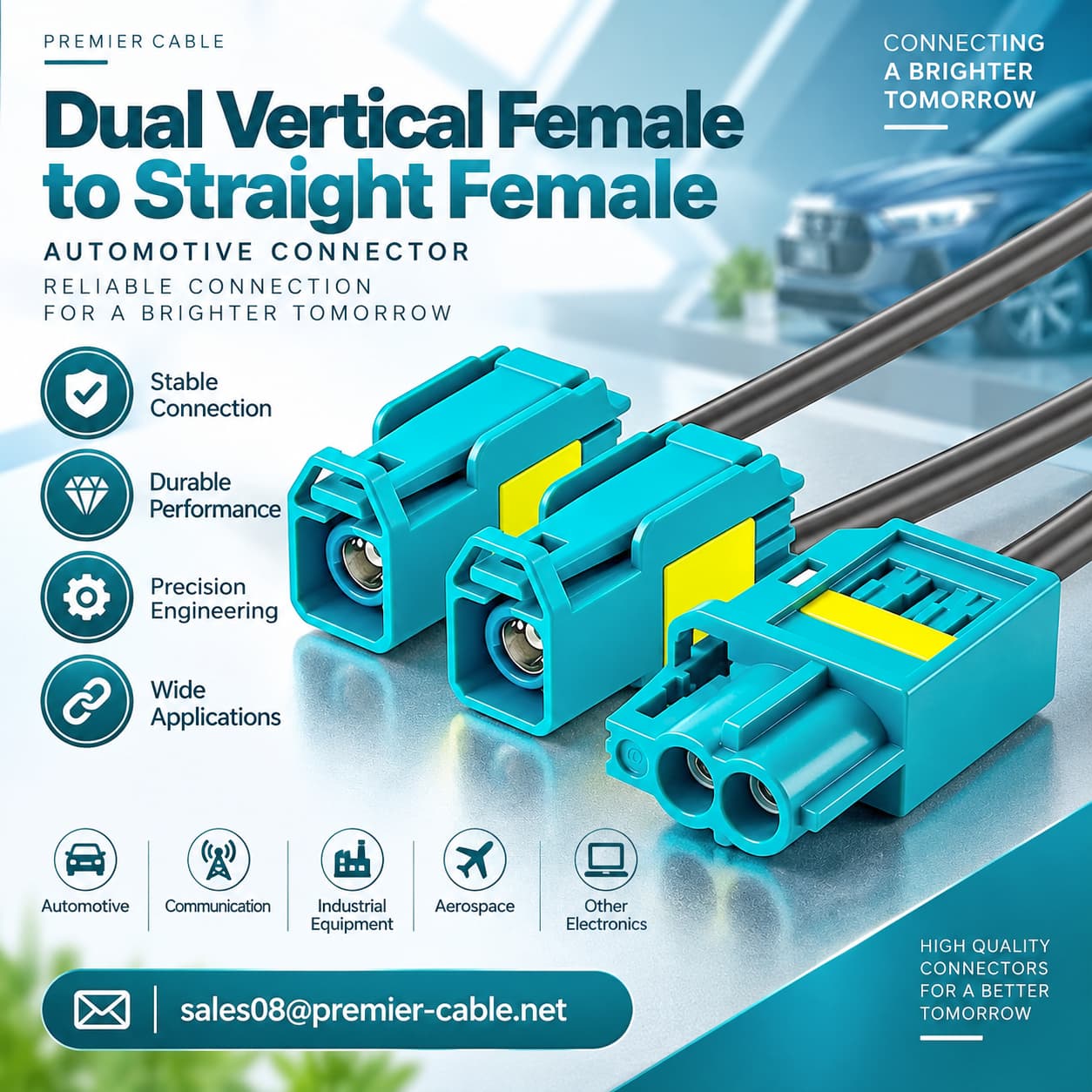
Dual Vertical HFM Female to Straight FAKRA Female
This configuration converts the dual-cavity HFM interface into two straight FAKRA female connections for mating with FAKRA male cable assemblies, module interfaces or test leads.
Its main distinction from the straight-male version is the mating gender rather than the fundamental signal purpose. In laboratories where FAKRA male test cables or male module interfaces are already standardized, the female version can reduce unnecessary gender adapters and simplify the signal path.

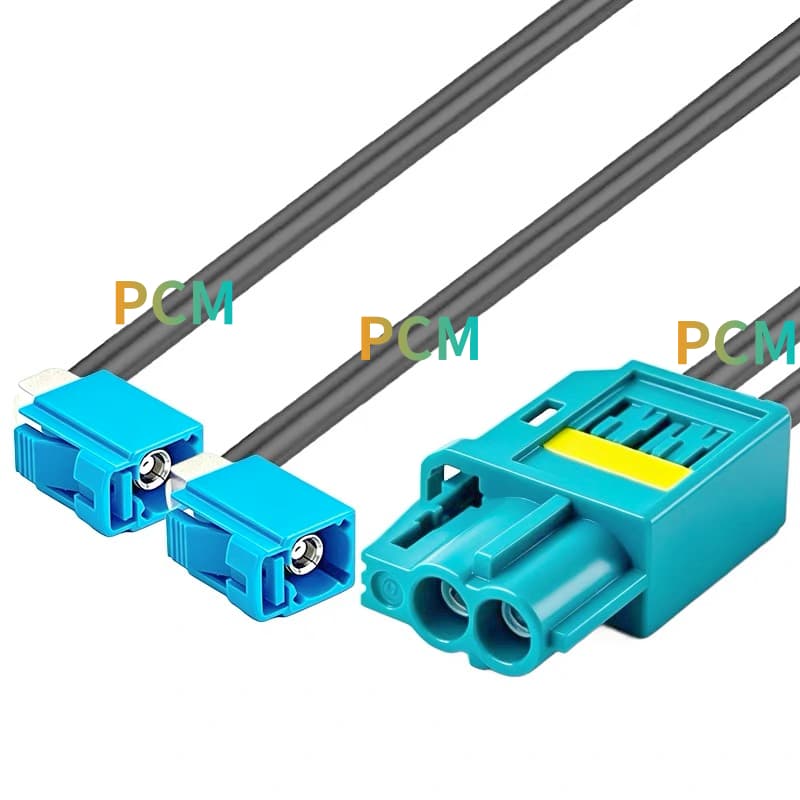
Dual Vertical HFM Female to 90° FAKRA Female
The 90-degree FAKRA female version is intended for installations where rear clearance is limited or where the cable cannot exit directly along the connector axis.
The angled termination redirects the cable immediately after the connector, reducing the need for large cable loops around nearby mechanical structures. This can improve cable routing in ECU benches, camera validation fixtures, compact control modules and vehicle prototype installations.
The required 90-degree orientation should always be defined from a consistent mating-face reference. Left, right, upward or downward exit requirements should therefore be confirmed before production.
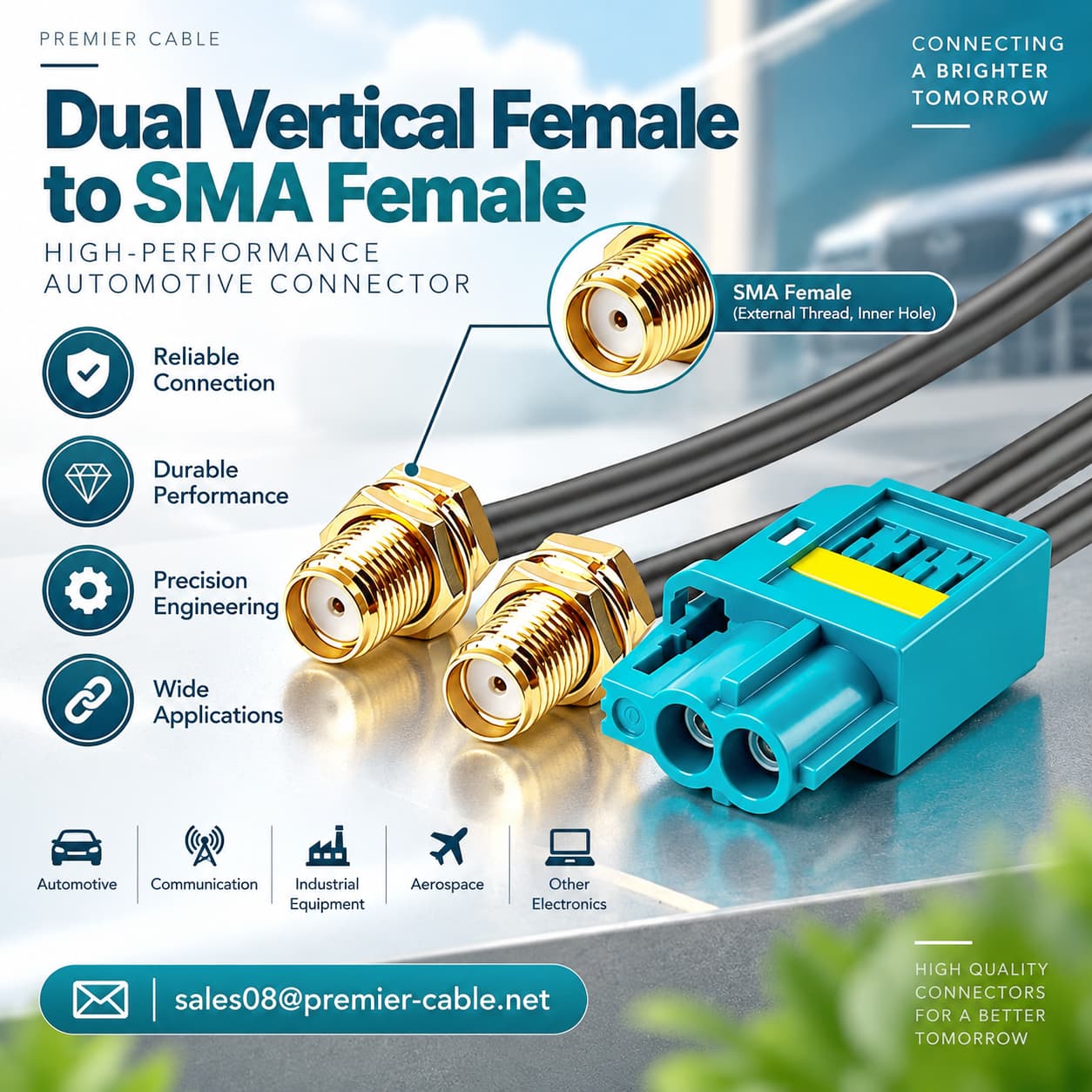
Dual Vertical HFM Female to SMA Female
This version breaks out the automotive Mini FAKRA HFM dual channel interface into two SMA female connectors featuring external threads and female center contacts.
Its primary value is in development environments where automotive modules use HFM Mini FAKRA interfaces while RF instruments, test boards and laboratory adapters use SMA connections. The assembly provides a practical physical bridge between these two connector ecosystems for prototype development, signal-path evaluation and laboratory measurements.
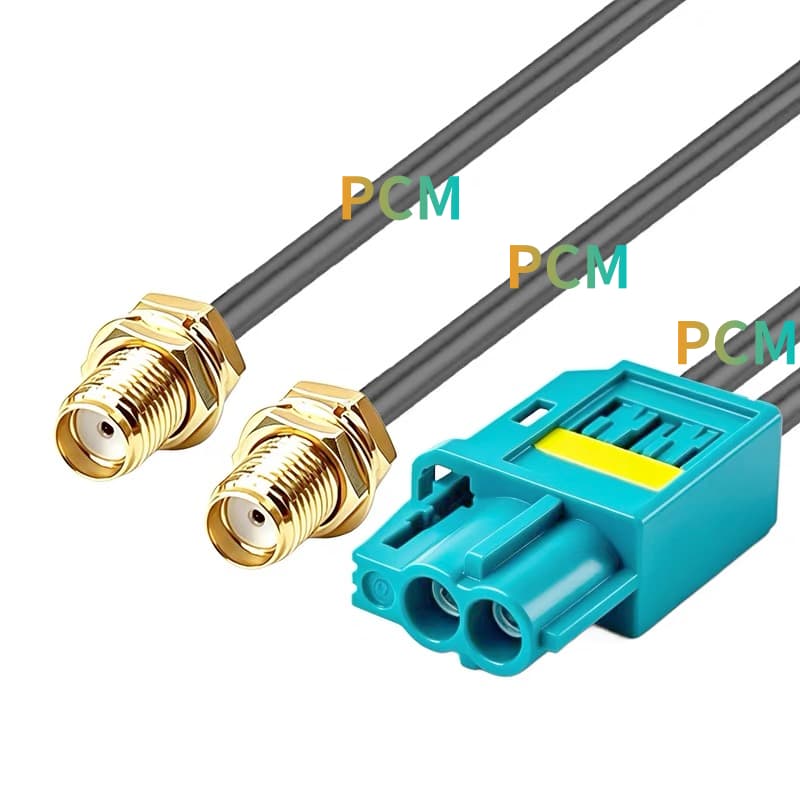

Dual Vertical HFM Female to SMA Male
The SMA male version uses an internal-thread body with a male center pin and is suitable for direct connection to RF modules, adapters or laboratory instruments equipped with SMA female interfaces.
Together with the SMA female version, it covers different laboratory mating requirements. Engineers can select the required SMA gender according to the instrument interface, reducing the need for additional adapter stacks during validation.
Typical Applications



Product Features
Independent Dual-Channel Breakout
One dual-cavity Mini FAKRA HFM interface is separated into two independent coaxial branches, allowing each channel to be connected, routed and evaluated individually in dual-camera, dual-RF or two-channel validation systems.
Multiple FAKRA and SMA Terminations
The family includes FAKRA male, FAKRA female, 90 degree FAKRA female, SMA male and SMA female terminations, allowing the same HFM equipment interface to serve automotive modules, test harnesses and RF laboratory equipment.
Straight and Angled Cable Exit Options
Straight and 90-degree termination options allow the connector geometry to follow equipment clearance, enclosure depth and cable-routing requirements instead of forcing the coaxial cable into an unnecessarily tight bend.
Modular Configuration for Engineering Tests
Multiple termination versions share the same AMK16C HFM-side architecture, creating a standardized cable family that allows laboratories to select the appropriate assembly according to the DUT interface.
Product Advantages
● Reduced Adapter Stacking
Selecting the required FAKRA or SMA termination directly can eliminate unnecessary multi-stage conversions such as Mini FAKRA to FAKRA to adapter to SMA, producing a cleaner and more controlled test path.
● Consolidated Dual Channel Interface
The dual cavity HFM interface consolidates two coaxial channels at the equipment side, making it useful for systems requiring two signal paths within limited connector-panel space.
● Designed Around Validation Workflows
Five termination options cover different combinations between vehicle-side, harness-side and instrument-side interfaces, making the series useful as an engineering test toolkit rather than a cable for only one fixed device.
● Project-Specific Configuration
Cable length, FAKRA SMA termination, coding, branch length, labeling, heat-shrink identification and validation requirements can be configured around project specific test and production needs.
Five-Version Quick Comparison
| HFM Side | Output Port | Key Application |
| AMK16C Dual Chamber Vertical Female Connector | 2 x FAKRA straight male connector | Female port device connection, ECU test |
| AMK16C Dual Chamber Vertical Female Connector | 2 x FAKRA straightfemale connector | Male device harness compatibility |
| AMK16C Dual Chamber Vertical Female Connector | 2 x FAKRA bent female | Narrow space, side wiring |
| AMK16C Dual Chamber Vertical Female Connector | 2 x SMA mother | Instrument testing, RF interface output |
| AMK16C Dual Chamber Vertical Female Connector | 2 x SMA male | SMA Female Port Instrument Adapter Device |
↕ One Equipment Interface, Multiple Test Ends
By keeping the AMK16C dual-cavity HFM interface consistent and selecting different FAKRA or SMA test-end versions, the cable can accommodate different devices under test (DUTs) and test instruments, reducing the need for multiple harness configurations at the equipment end.
□ Clearly Defined Connector Gender to Reduce Mating Errors
The FAKRA options include straight male, straight female, and 90° right-angle female versions, while SMA options are available with male and female connectors. Clearly defined connector gender and configuration help purchasing, engineering, and testing teams select the appropriate version according to the actual mating interface, reducing the risk of connector mismatch.
◉ Mechanical Orientation Optimized for Installation Space
Straight connectors are suitable for conventional test benches, equipment interfaces, and standard cable-routing layouts, while 90° right angle connectors are better suited to installations with limited rear clearance or specific cable exit requirements. Selecting the appropriate connector orientation in advance makes mechanical layout part of the cable design rather than a compromise made during installation.
Product FAQ
What is AMK16C-1M4Z5-Z ?
It belongs to the Rosenberger HFM High-Speed FAKRA Mini family and uses a double-vertical cable-jack configuration for automotive high-speed coaxial connections.
Why are both male and female FAKRA versions offered ?
ZH23 can serve as a Chinese equivalent and replacement option for the СНЦ23 series, but direct replacement should never be based solely on the series name. Verify the complete P/N, shell size, contact arrangement, gender, key position, pinout, rear accessory, and electrical and environmental requirements before selection.
Why choose the right-angle FAKRA version ?
The right angle version is designed for limited rear clearance, enclosure-adjacent ports and test fixtures where a straight cable exit is impractical.
How are SMA male and SMA female identified ?
For this series, SMA female uses an external thread with center socket, while SMA male uses an internal coupling thread with center pin. Verify both thread style and center contact when ordering.
Can cable length and connectors be customized ?
Yes. Cable length, FAKRA coding, gender, straight/right-angle configuration, SMA termination, channel labels, coaxial cable and packaging can be customized according to project drawings and test requirements.

Hot Tags: Rosenberger Dual HFM to FAKRA SMA Cable, China Rosenberger Dual HFM to FAKRA SMA Cable manufacturers, suppliers, factory