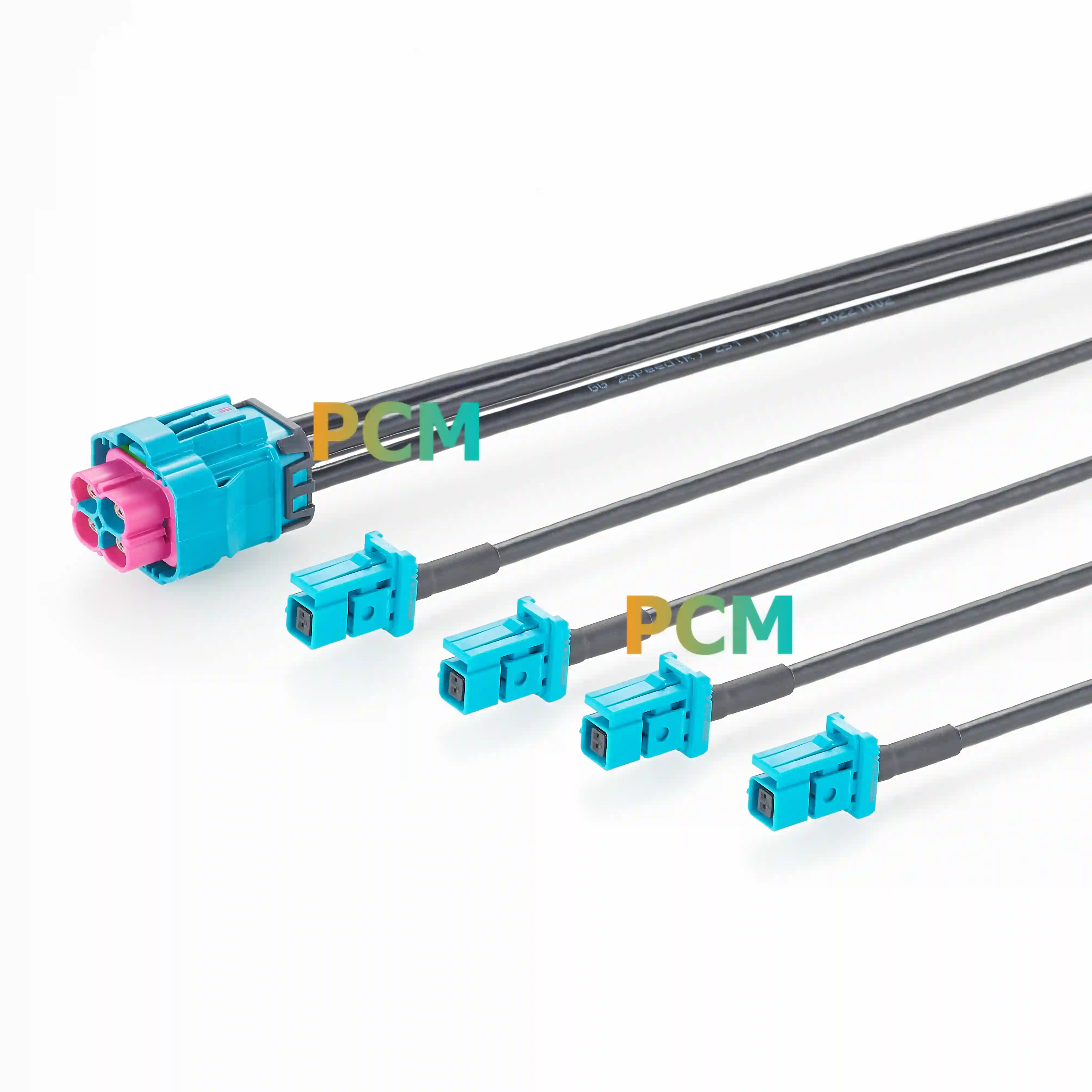


Twin FAKRA to SMA Automotive RF Cable
The Twin FAKRA series is a dual coax cable assembly designed for two channel automotive high frequency connectivity. Compared with two completely separate single FAKRA connectors, a Twin Double FAKRA housing consolidates two independent 50 ohm coaxial links into one housing, creating a more organized interface around cameras, ECUs, antenna modules, and test equipment.
This series further bridges the dual channel automotive FAKRA interface with widely used SMA RF interfaces, enabling configurations such as Twin FAKRA to 2 × SMA Male, Twin FAKRA to 2× SMA Female, as well as Twin FAKRA to Twin FAKRA dual channel extension assemblies.
RG174 is a compact 50 ohm coaxial cable commonly used for corresponding RF cable assemblies, and Rosenberger's FAKRA portfolio includes connectors specified for RG174. However, the actual operating frequency of the finished assembly should not be inferred solely from the maximum FAKRA family rating or the RG174 cable designation. Connector P/N, cable length, SMA specification, termination, insertion loss, return loss, and complete RF link validation must also be considered.
Importantly, "1-to-2" in this product family means that two originally independent FAKRA coax channels are routed separately to two SMA connectors. It does not mean that one RF signal is passively divided into two identical outputs.

Twin FAKRA Female to 2 × SMA Male
This version routes the two channels of a Twin FAKRA female interface through separate RG174 coax branches terminated with two SMA male connectors.
It is suitable for test equipment equipped with SMA female ports. The configuration provides convenient access from an automotive dual channel interface to independent laboratory RF ports, allowing CH1 and CH2 to connect separately to RF instruments or dedicated validation equipment.
Clear CH1/CH2 identification is recommended to prevent channel interchange during camera or RF-link testing.
Twin FAKRA Female to 2 × SMA Female
This product retains the Twin FAKRA female main interface while terminating the two coaxial channels with SMA female connectors.
It is better suited to test boards, RF modules, panel feedthroughs, or equipment already equipped with SMA male interfaces. Selecting the correct SMA gender directly reduces intermediate connections compared with adding two gender adapters later and creates a cleaner dual-channel test topology.
SMA impedance, target frequency, and equipment-side coaxial requirements should still be verified before testing.


Twin FAKRA Male to 2 × SMA Male
This version combines a Twin FAKRA male automotive interface with two SMA male test connectors for DUTs, camera ECUs, RF modules, or fixtures using the corresponding Twin FAKRA female interface.
The two coax channels remain independently routed for Channel A / Channel B measurements, prototype debugging, and laboratory interface adaptation.
It is a passive RF adapter cable and does not alter the original signal type or convert camera video into USB, Ethernet, or another protocol.
Twin FAKRA Male to 2 × SMA Female
This configuration retains the automotive interface characteristics of a Twin FAKRA male connector while providing two independent SMA female access points for laboratory use.
It is suitable for temporary or fixed test links among prototype ECUs, camera modules, telematics modules, and RF development platforms. SMA female ports can interface with corresponding male test leads or instrument accessories, providing flexibility when bench configurations change frequently.
FAKRA coding and dual-channel mapping must be confirmed during selection.


Twin FAKRA Female to Twin FAKRA Female
Instead of converting to SMA, this version retains Twin FAKRA female interfaces at both ends for dual-channel extension, test-port relocation, or module rearrangement between compatible male equipment interfaces.
Two 50-ohm coaxial links can be installed as one harness module for cleaner routing of dual cameras, dual RF channels, or related automotive high-frequency equipment.
CH1→CH1 and CH2→CH2 straight-through mapping must be confirmed from the formal channel drawing rather than assumed from the housing orientation.
Twin FAKRA Male to Twin FAKRA Male
This configuration uses Twin FAKRA male interfaces at both ends to establish two coaxial links between compatible female device interfaces.
In ECU benches, camera test fixtures, or prototype platforms, a male-to-male structure can reduce additional adapters when equipment-side genders are fixed.
Engineering should focus on cable-length consistency, coding, channel identification, and mechanical strain across both channels rather than treating the product as two ordinary FAKRA extension cables placed together.


Twin FAKRA Male to Twin FAKRA Female
The male-to-female version is suitable for extending an existing Twin FAKRA device interface to a new installation position, including camera ECUs, antenna modules, ADAS test equipment, or automotive RF modules.
Compared with installing two separate single FAKRA extension cables, the Twin housing helps maintain the positional relationship and assembly consistency of both channels.
For vehicle-system extensions, verify FAKRA coding, housing keying, center contacts, cable type, and target link-loss requirements.
Typical Applications


Product Features
Integrated Dual Channel Housing
Twin FAKRA integrates two independent coaxial interfaces into one dual housing, reducing scattered connectors around camera ECUs, RF modules, and test equipment while improving dual-channel harness organization.
50 Ohm Automotive Coax Architecture
FAKRA uses a nominal 50 ohm impedance, while SMA and RG174 are also commonly used in 50 ohm RF systems, making the series suitable for corresponding automotive high frequency test and coaxial interconnect applications.
Independent CH1 CH2 Signal Paths
Two separate coaxial cables carry independent signal paths and can be identified as Camera Left Right, Channel A/B, or other device defined channels without combining the signals into one conductor.
Multiple Gender Combinations
FAKRA and SMA sides can be configured with male female interfaces according to the DUT, instrument, or vehicle module, reducing the need for additional gender adapters.
Product Advantages
● Two RF Links Managed Together
Both signal paths can be mated and secured through one Twin housing, reducing the handling required for two separate FAKRA connectors and benefiting paired camera or RF channels.
● Convenient SMA Test Access
SMA is widely used in RF laboratory and test equipment. Breaking a Twin FAKRA interface directly into two SMA ports makes automotive coaxial channels easier to access during engineering validation.
● Reduced Adapter Stacking
Selecting the correct FAKRA and SMA genders for the target equipment reduces gender changers and intermediate pigtails, creating a cleaner test topology.
● Customizable Dual Channel Branch Lengths
The two RG174 branches can be engineered with project specific lengths, breakout positions, and labels to improve bench or vehicle routing while meeting RF performance requirements.
Is Twin FAKRA to 2 × SMA an RF Power Splitter ?
No.
A Twin FAKRA interface generally represents two independent coaxial channels. In this series:
FAKRA Channel 1 → SMA Channel 1
FAKRA Channel 2 → SMA Channel 2
The two signal paths remain independent.
The harness contains no RF power divider, so it does not split one input into two outputs with a 3 dB division, nor does it amplify, duplicate, or actively process the RF signal.
For technical SEO, more accurate terms include:
Dual FAKRA Breakout Cable
Twin FAKRA to Dual SMA Cable
rather than simply "1-to-2 RF splitter."
FAKRA colors are not merely cosmetic.
The FAKRA system uses mechanical keying and color coding to help prevent incorrect mating between interfaces serving different functions. Camera, GPS, radio, or telematics projects may use different codings.
A customized Twin FAKRA cable should therefore specify:
Exact Connector P/N
Gender
Coding
Housing Configuration
Mating Connector
A request such as "blue FAKRA" or "Twin FAKRA" alone is not sufficient for engineering selection.
Product FAQ
Does Twin FAKRA Contain Two FAKRA Channels ?
It is a dual channel architecture. A Twin Double FAKRA housing consolidates two coaxial interfaces, while each remains an independent signal path. The exact housing and connector definition should be verified by P/N.
Is Twin FAKRA to Dual SMA a 1 to 2 Signal Splitter ?
"1-to-2" may describe the physical breakout from one dual housing to two connectors, but electrically it does not duplicate one signal. CH1 and CH2 remain connected to their respective SMA interfaces.
Does FAKRA to SMA Change the Camera Protocol ?
No. FAKRA to SMA only adapts the physical coaxial interface and does not actively convert GMSL, FPD Link, or another device protocol.
Can the Two Twin FAKRA Channels Be Swapped ?
Not automatically. If the equipment defines left right camera, Channel A/B, or other functions, CH1 and CH2 must follow the device definition and be clearly identified.
What Information Is Most Important for a Custom Twin FAKRA Harness ?
At minimum, provide the exact FAKRA P/N, coding, gender, mating connector, CH1/CH2 definition, SMA gender, cable type, length, frequency range, and validation requirements.

Hot Tags: twin fakra to sma automotive rf cable, China twin fakra to sma automotive rf cable manufacturers, suppliers, factory