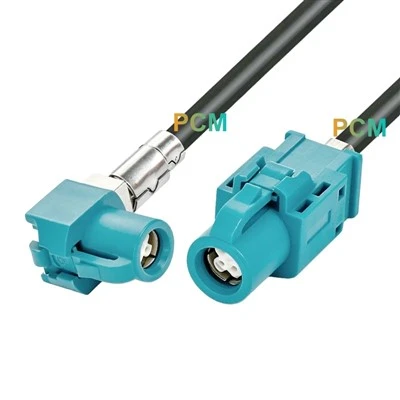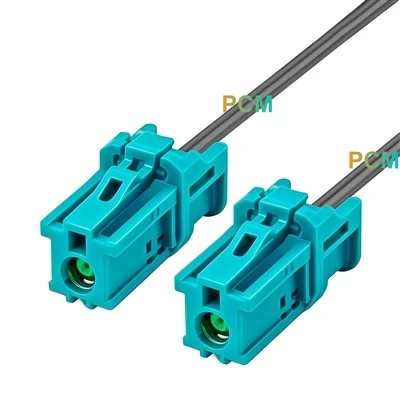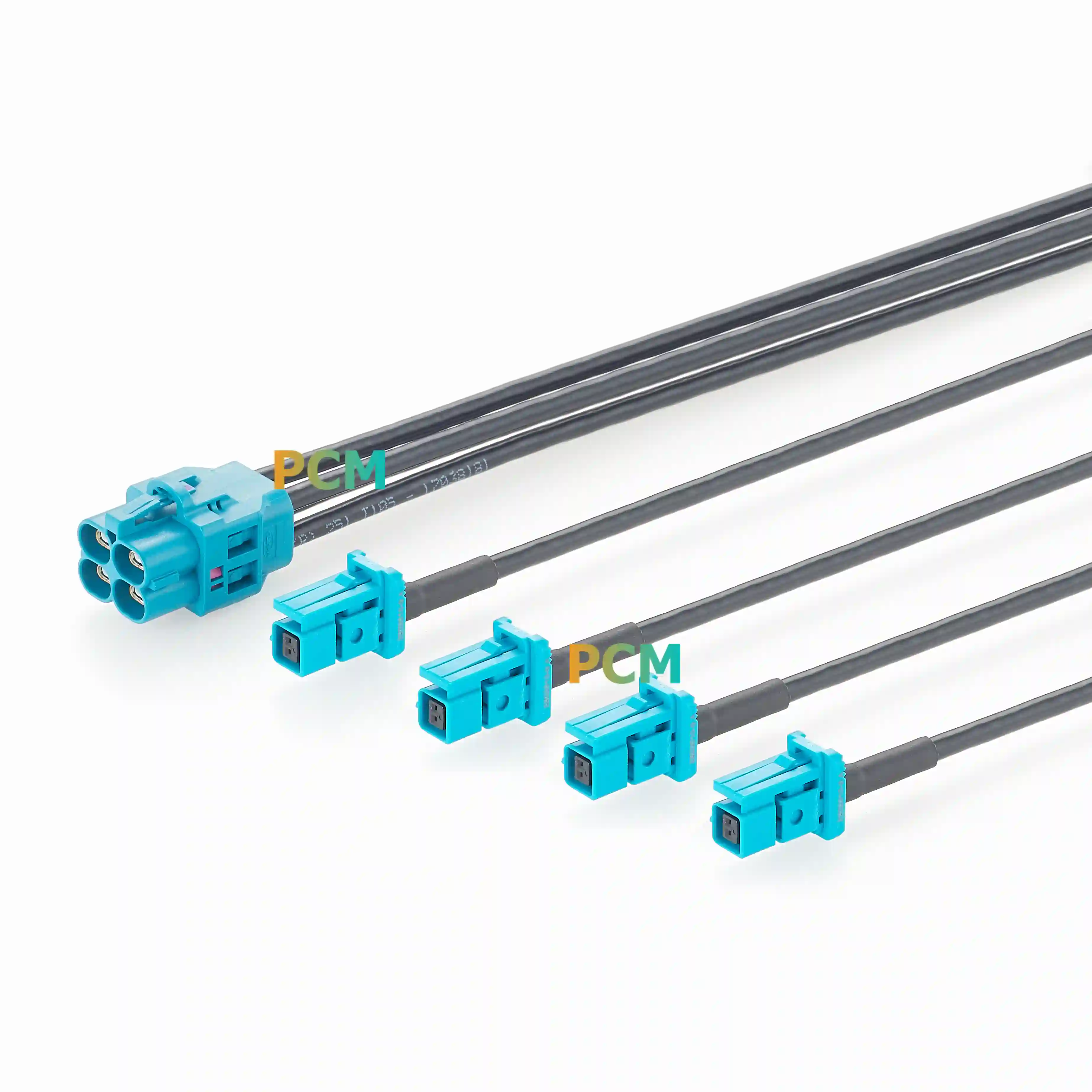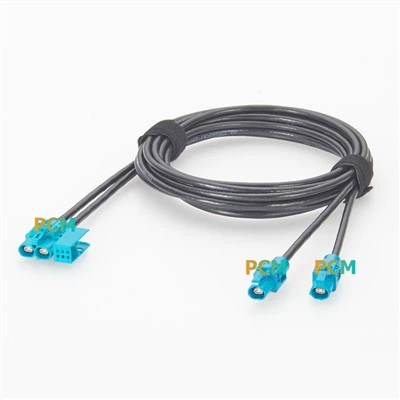



Quad Mini FAKRA to SMA Cable
This product family is built around the Rosenberger AMS11D-1M4Z5-Z Quad HFM Mini FAKRA plug, providing four independent 50 ohm coaxial paths from one high density four cavity interface to FAKRA, SMA, or another Mini FAKRA interface.
Unlike a conventional one-to-four RF splitter, "4-in-1" here means that four interfaces are consolidated within one housing. It does not mean that one signal is duplicated or power-divided into four outputs. Each HFM cavity maintains an independent coaxial path that can be mapped to a corresponding FAKRA or SMA branch. Existing AMS11D-1M4Z5-Z cable architectures from Premier Cable use the same independent four-channel principle.
This architecture is particularly useful for ADAS ECUs, camera ECUs, central computing units, telematics, infotainment and HIL platforms, allowing a high density Quad HFM interface on the controller side while retaining FAKRA or SMA connectivity on peripheral modules, legacy harnesses or laboratory instruments.

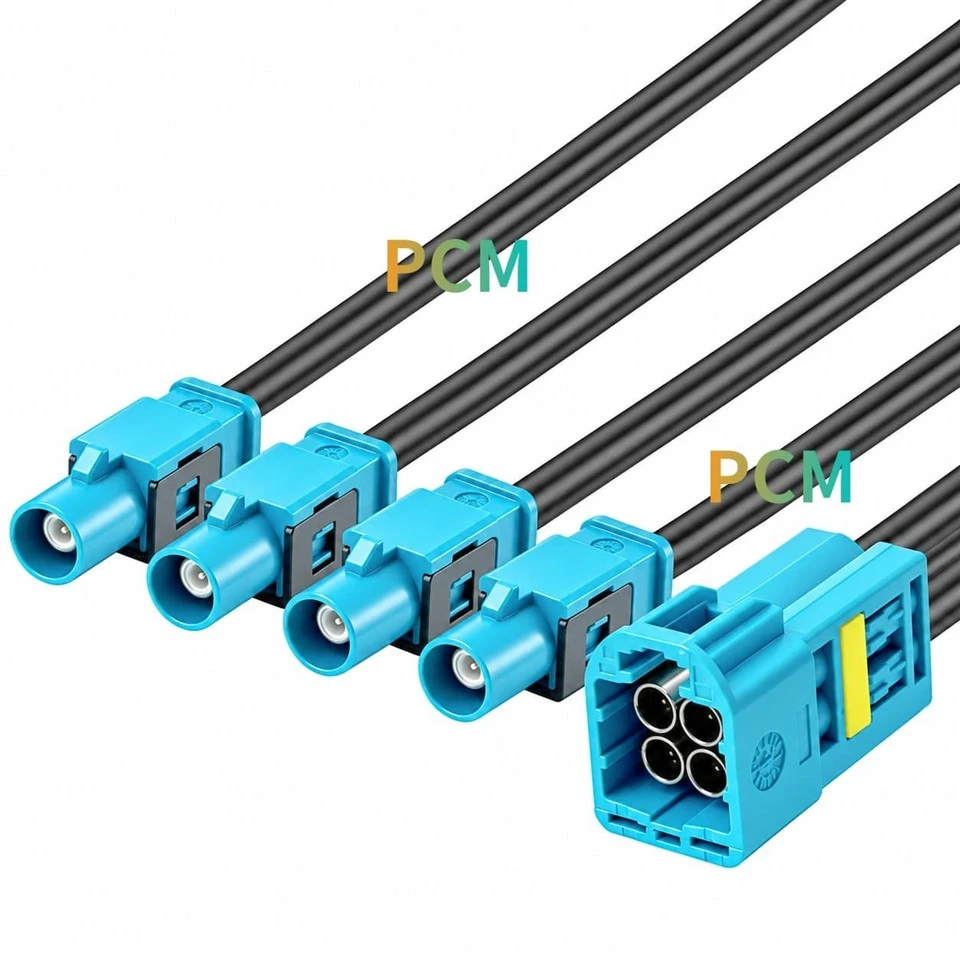
Quad Mini FAKRA Male to 4× FAKRA Male Cable
This configuration uses the AMS11D-1M4Z5-Z quad Mini-FAKRA / HFM male connector as the consolidated interface and breaks out its four independent coaxial channels to four FAKRA male connectors. Each FAKRA branch corresponds to an individual channel without signal combining, duplication, or active conversion.
It is suitable for cameras, RF modules, test adapter boards, ECUs, and other equipment with FAKRA female ports. Compared with using four individual FAKRA interfaces on the controller side, the Quad HFM architecture consolidates four coaxial links into a more compact connection area, improving interface density and simplifying multi-channel harness routing.
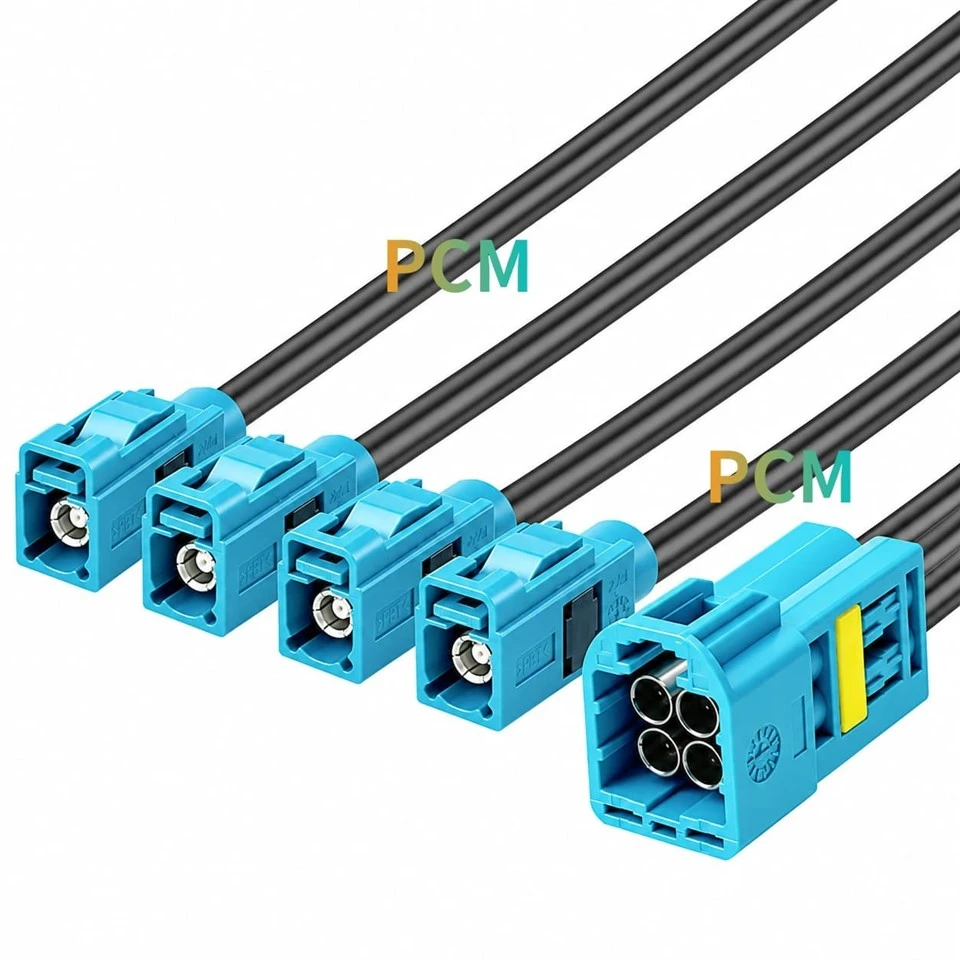
Quad Mini FAKRA Male to 4 × FAKRA Female Cable
This configuration converts the AMS11D-1M4Z5-Z quad Mini-FAKRA / HFM male interface into four independent FAKRA female connectors. It is designed for applications where the destination equipment, camera harness, or existing vehicle harness uses FAKRA male interfaces.
All four coaxial paths remain independent and can be assigned to Channels A/B/C/D according to the project architecture. The primary benefit of the FAKRA female configuration is direct mating with the equipment-side connector, reducing additional gender adapters and intermediate connection points.
FAKRA gender, coding, mechanical key, cable type, and exact equipment-side P/N should all be verified rather than relying on housing color alone.


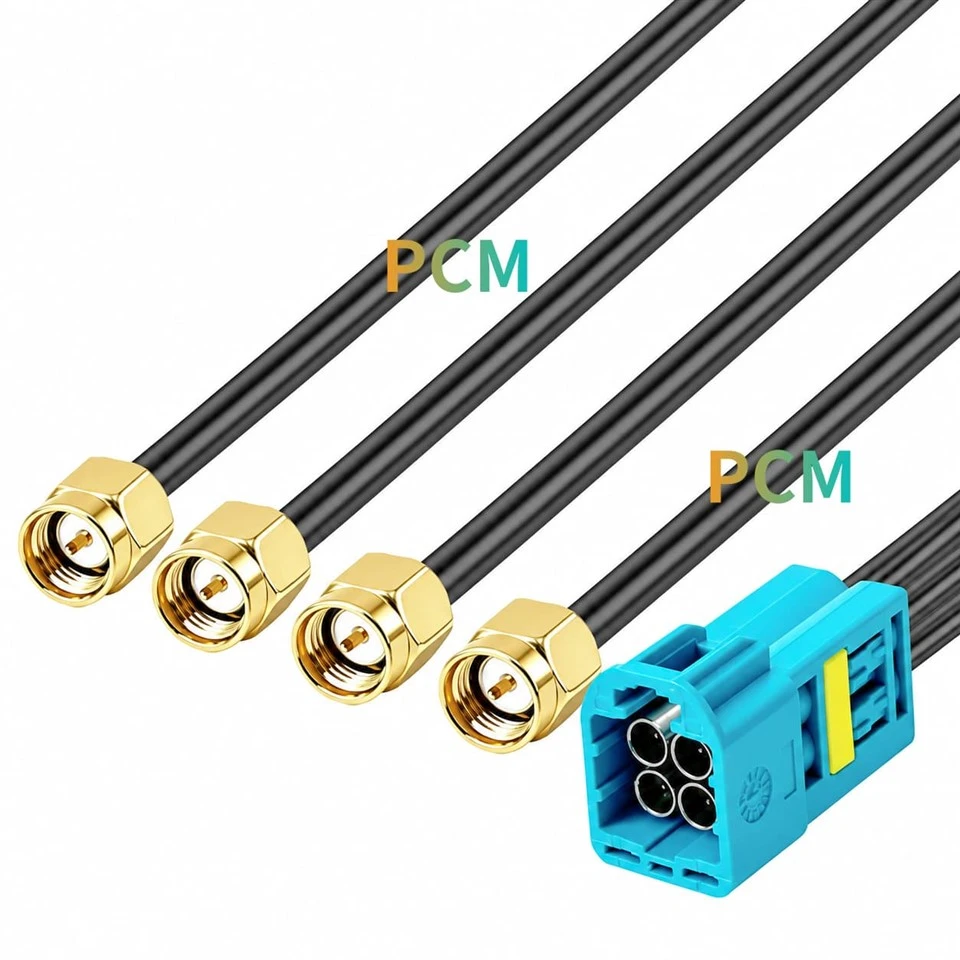
Quad Mini FAKRA Male to 4 × SMA Male Cable
This configuration routes the four coaxial channels of the consolidated Mini-FAKRA / HFM interface to four SMA male connectors, primarily for development, measurement, validation, and laboratory testing.
SMA interfaces are widely used on RF test instruments, evaluation boards, prototype platforms, measurement equipment, and RF modules, making this architecture useful for connecting automotive high-density interfaces to common RF test environments.
Each SMA channel can be connected, measured, and managed independently for ECU bench testing, camera-link validation, and signal debugging. The assembly remains a passive cable assembly and contains no SerDes, PHY, or active protocol-conversion circuitry.
Quad Mini FAKRA Male to 4 × SMA Female Cable
This configuration breaks out the AMS11D-1M4Z5-Z quad interface into four independent SMA female connectors, allowing direct connection to commonly used SMA male test cables, RF modules, measurement equipment, or adapters.
Compared with the SMA male version, SMA female connectors accommodate a different range of existing laboratory cables and measurement setups, providing greater connection flexibility for ECU bench testing, HIL, camera-link validation, RF debugging, and prototype development. All four channels remain independent for individual testing, identification, and troubleshooting.
SMA interface configuration, impedance, cable type, frequency range, and complete link performance should be verified during selection.


Quad Mini FAKRA Male to Quad Mini FAKRA Male Cable
This configuration uses a Quad Mini-FAKRA / HFM male-to-male architecture that maintains four coaxial channels within a high-density consolidated connection from end to end, without converting them into four separate FAKRA or SMA interfaces.
It is particularly suitable for interconnecting compatible test equipment, adapter modules, prototype ECUs, vehicle-network test platforms, or custom interface systems.
Because all four signal paths remain within the multi-cavity architecture, breakout sections and individual branch management can be reduced for a more consolidated harness layout. Before use, verify that both mating devices require male interfaces and confirm the exact P/N, coding, cable group, and channel mapping.
Quad Mini FAKRA Male to Quad Mini FAKRA Female Cable
This configuration uses a Quad Mini-FAKRA / HFM male-to-female architecture and follows the typical connection logic of a four-channel extension cable. It extends the installation distance between existing equipment and harnesses without breaking the four coaxial channels into individual connectors.
Typical applications include prototype vehicles, ECU validation benches, HIL test fixtures, ADAS test systems, and equipment relocation. Compared with a four-branch breakout design, the high-density interface format keeps installation and channel management more consolidated.
Before production, verify the exact P/N, gender, coding, cable group, channel mapping, cable length, and electrical performance requirements of the target system.

Typical Applications


Product Features
Four Independent Physical Channels
Four HFM channels use individually defined center-conductor and shielding paths, making the cable suitable for systems that need to manage multiple camera, RF, or high-speed coaxial links simultaneously.
Three Interface Systems Available
FAKRA, SMA, and HFM/Mini-FAKRA terminations can be configured within the same product family, providing flexible connectivity for in-vehicle electronics, laboratory instruments, test equipment, and development platforms.
Customizable Male and Female Configurations
FAKRA, SMA, and HFM connector genders can be configured according to the actual mating interface, helping reduce connection complexity and additional intermediate adapters.
Designed for Automotive High-Frequency Coaxial Applications
HFM is Rosenberger's 50-ohm high-frequency connectivity system developed for automotive applications. Typical application areas include autonomous driving, ADAS, navigation, and infotainment systems.
Product Advantages
● Reduce Wiring Dispersion in Multi-Interface Areas
The Quad HFM architecture consolidates four coaxial interfaces into one compact connection area, reducing scattered connectors around the ECU and improving multi-channel harness organization, installation, identification, and maintenance.
● Support New and Existing Interface Architectures
The HFM side connects newer high-density ECUs or controllers, while FAKRA branches retain compatibility with existing cameras, antennas, and vehicle modules, supporting flexible interface migration during electronic architecture upgrades.
● SMA Versions Improve Engineering and Validation Access
Breaking four HFM channels out to individual SMA interfaces provides easier access to RF instruments, measurement cables, evaluation boards, and laboratory equipment for ECU bench testing, signal measurement, and link validation.
● Support Complete Link Level Customization
Cable type, overall length, branch length, gender, coding, and channel mapping can be defined around the complete system, enabling the harness to match equipment layout, link performance, and installation requirements beyond simple connector adaptation.
Why can HFM be converted to both FAKRA and SMA ?
HFM, FAKRA and SMA can all be used in 50-ohm coaxial connection systems, allowing passive inter-series cable assemblies when impedance, frequency, cable and connector requirements are properly matched.
However, mechanical adaptation does not automatically guarantee system compatibility. For GMSL or FPD-Link camera systems, the SerDes implementation, frequency range, insertion loss, return loss and complete link budget must still be evaluated.
↕ Confirm Interface and Gender
First identify whether the equipment uses FAKRA, SMA or Mini-FAKRA, then verify gender, coding and exact connector P/N. Similar appearance does not guarantee mateability, so the correct mating interface is the first selection priority.
□ Select the Output Interface by Application
FAKRA versions are generally suited to automotive cameras, ADAS and production harnesses; SMA versions fit HIL, ECU bench and RF testing; Mini-FAKRA male-to-male or male-to-female versions are suitable for four-channel extension and device interconnection.
◉ Verify Complete Link Performance
Do not select a high-speed harness by connector type alone. Verify 50-ohm impedance, cable type, length, frequency range, insertion loss and channel mapping. For GMSL or FPD-Link, also validate the SerDes generation and complete link budget.
Product FAQ
What Type of Interface Is AMS11D-1M4Z5-Z ?
AMS11D-1M4Z5-Z belongs to Rosenberger's HFM / High-Speed FAKRA-Mini family and uses a quad cable-plug architecture that consolidates four automotive coaxial connections within one compact interface area. Rosenberger identifies the AMS11D series as a Quad Cable Plug.
Does Quad HFM Male to 4× FAKRA Split One Signal into Four ?
No. In a standard breakout architecture, the four HFM cavities map individually to four FAKRA branches, creating four independent coaxial signal paths. The harness is not a 1-to-4 RF splitter and does not actively duplicate or distribute one input signal across four outputs.
How Do I Choose Between FAKRA Male and FAKRA Female ?
FAKRA male or female should be selected according to the actual mating interface of the destination equipment. Before production, confirm the FAKRA gender, coding, mechanical key, exact P/N, and equipment-side connector rather than determining compatibility from housing color or appearance alone.
Is HFM to SMA a Protocol Converter ?
No. An HFM-to-SMA harness is a passive coaxial cable assembly that provides physical-interface adaptation and coaxial signal connectivity between HFM and SMA. It does not contain a PHY, SerDes, protocol converter, or other active signal-processing circuitry.
Can the Overall and Individual Branch Lengths Be Customized ?
Yes. The overall length and four individual branch lengths can be customized according to the ECU, cameras, test equipment, and available installation space. For high-speed camera and SerDes links, insertion loss, channel loss, and remaining system margin should be re-evaluated when cable length is increased.

Hot Tags: quad mini fakra to sma cable, China quad mini fakra to sma cable manufacturers, suppliers, factory