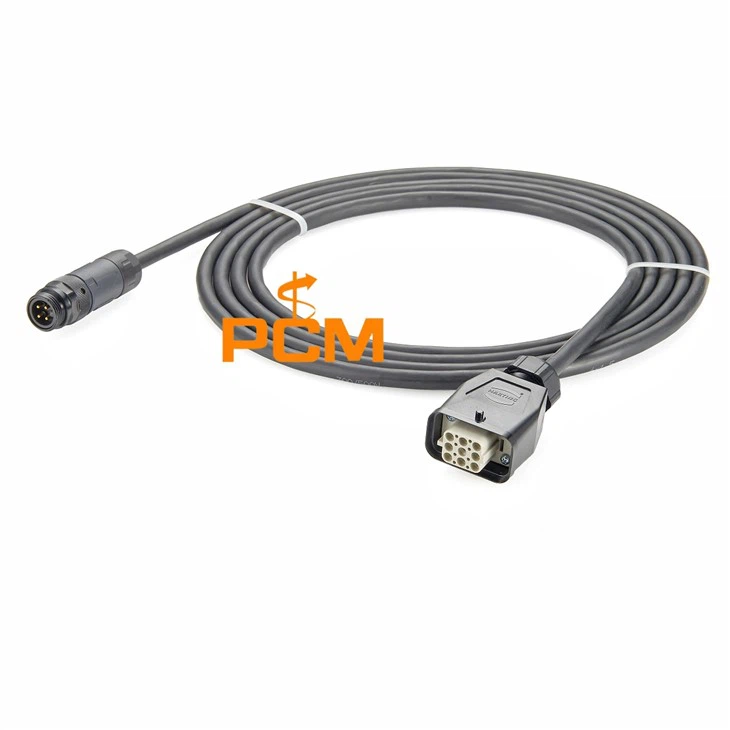

In the dynamic landscape of industrial connectivity, the M23 T-splitter adapter has emerged as a crucial component for enhancing the efficiency and flexibility of various systems. As a leading supplier of M23 T-splitter adapters, I am often asked whether these adapters can be used with USB devices. This blog post aims to provide a comprehensive answer to this question, exploring the technical aspects, compatibility issues, and practical applications of using M23 T-splitter adapters with USB devices.
Understanding the M23 T-Splitter Adapter
Before delving into the compatibility with USB devices, it's essential to understand what an M23 T-splitter adapter is. The M23 circular connector is a standard in industrial environments, known for its robustness, reliability, and high-performance capabilities. The T-splitter adapter, as the name suggests, has a T-shaped design that allows a single connection point to be split into two or more branches. This feature is particularly useful in scenarios where multiple devices need to be connected to a single source.
The M23 Circular Connector T-Splitter 12 Poles is a prime example of such an adapter. With 12 poles, it provides multiple connection points, enabling the transmission of various signals, including power, data, and control signals. Another notable product is the M23 Tee Connector for Profibus Module, which is specifically designed for use with Profibus modules, a popular fieldbus system in industrial automation.
Compatibility with USB Devices
The compatibility of M23 T-splitter adapters with USB devices is a complex issue that depends on several factors. At first glance, the M23 connector and the USB connector have different physical characteristics and electrical specifications. The M23 connector is a circular connector commonly used in industrial applications, while the USB connector is a rectangular connector primarily used in consumer electronics and computer systems.
Physical Compatibility
The most obvious difference between the M23 and USB connectors is their physical shape. The M23 connector has a circular shape with a threaded locking mechanism, which provides a secure and reliable connection in harsh industrial environments. In contrast, the USB connector is rectangular and typically uses a plug-and-socket design. This physical difference means that a direct connection between an M23 T-splitter adapter and a USB device is not possible without an appropriate adapter.
Electrical Compatibility
In addition to the physical differences, the electrical specifications of the M23 and USB connectors also vary. The M23 connector is designed to handle a wide range of voltages and currents, depending on the specific application. It can be used for power transmission, signal transmission, or a combination of both. On the other hand, the USB connector has a standardized voltage of 5V and is mainly used for data transmission and low-power charging.
To use an M23 T-splitter adapter with a USB device, it is necessary to ensure that the electrical signals are compatible. This may require the use of a converter or an interface module that can translate the signals between the M23 and USB standards. For example, if the M23 T-splitter adapter is used to transmit data, the converter must be able to convert the data format from the M23 protocol to the USB protocol.
Practical Applications
Despite the challenges of compatibility, there are several practical applications where M23 T-splitter adapters can be used with USB devices. One such application is in industrial automation systems. In these systems, USB devices such as cameras, sensors, and data loggers are often used to collect and transmit data. By using an M23 T-splitter adapter, multiple USB devices can be connected to a single industrial controller or data acquisition system, reducing the number of connection points and simplifying the wiring.
Another application is in the field of robotics. Robots often require a large number of sensors and actuators to operate effectively. By using M23 T-splitter adapters, these sensors and actuators can be connected to the robot's control system using a single M23 cable. If some of these sensors or actuators are USB devices, appropriate converters can be used to ensure compatibility.
Overcoming Compatibility Issues
To overcome the compatibility issues between M23 T-splitter adapters and USB devices, several solutions are available. One solution is to use a custom-designed adapter or converter. These adapters can be designed to match the physical and electrical specifications of both the M23 and USB connectors, ensuring a seamless connection between the two.
Another solution is to use a universal interface module. These modules can support multiple communication protocols, including M23 and USB, and can be configured to convert the signals between the two standards. This approach provides a flexible and cost-effective solution for integrating M23 T-splitter adapters with USB devices.


Conclusion
In conclusion, while there are challenges in using M23 T-splitter adapters with USB devices due to physical and electrical compatibility issues, these challenges can be overcome with the right solutions. With the increasing demand for connectivity in industrial and consumer applications, the ability to integrate different types of connectors and devices is becoming increasingly important.
As a supplier of M23 T-splitter adapters, we are committed to providing our customers with high-quality products and solutions that meet their specific needs. If you are interested in using M23 T-splitter adapters with USB devices or have any other questions about our products, please feel free to contact us for more information and to discuss potential procurement opportunities. We look forward to working with you to find the best connectivity solutions for your applications.
References
- Industrial Connectivity Handbook: A comprehensive guide to industrial connectors and communication protocols.
- USB Specification: The official specification for USB connectors and devices, which provides detailed information on the electrical and physical characteristics of USB.
- M23 Connector Standards: The industry standards for M23 circular connectors, which define the mechanical, electrical, and environmental requirements for these connectors.