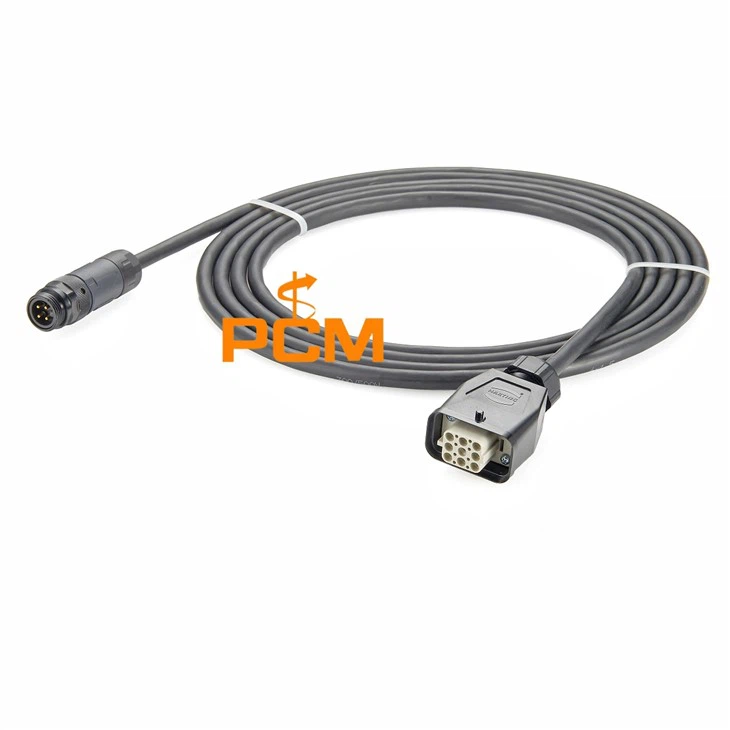

As a supplier of RJ45 to M12 adapters, I often get asked about how to check the compatibility of these adapters with different cables. It's a crucial question, especially for those who are looking to set up reliable network connections in industrial or commercial settings. In this blog, I'll walk you through the steps to ensure that your RJ45 to M12 adapter works seamlessly with your cable.
Understanding the Basics: RJ45 and M12 Connectors
Before we dive into compatibility checks, let's quickly go over what RJ45 and M12 connectors are. RJ45 is a standard connector used for Ethernet networks. You've probably seen it on your home router or computer network card. It has eight pins and is commonly used for high - speed data transfer in local area networks (LANs).


On the other hand, M12 connectors are circular, industrial - grade connectors. They come in different coding types like A, B, D, and X, each designed for specific applications such as power, signal, or Ethernet transmission. M12 connectors are known for their robustness, making them ideal for harsh industrial environments.
Step 1: Check the Connector Types
The first thing you need to do is to make sure that the adapter's RJ45 and M12 connector types match your cable's connectors. For the RJ45 side, it's usually straightforward. Most Ethernet cables use standard RJ45 connectors. But you still need to check if the cable is a Cat5e, Cat6, or Cat6a cable, as different categories support different data transfer speeds.
For the M12 side, you need to pay close attention to the coding type. For example, if you're using an Industrial Ethernet Adaptor M12 To RJ45 D - Coding, you need to ensure that your M12 cable also has a D - coded connector. Using the wrong coding type can lead to connection failures or poor performance.
Step 2: Verify the Data Transmission Speed
Another important aspect of compatibility is the data transmission speed. Different cables and adapters support different speeds. For instance, a Cat5e cable can support up to 1 Gigabit per second (Gbps), while a Cat6 cable can go up to 10 Gbps.
When you're choosing an RJ45 to M12 adapter, make sure that its speed rating is at least as high as your cable's speed rating. If your cable supports 10 Gbps, but your adapter only supports 1 Gbps, you won't be able to take full advantage of your cable's capabilities.
Step 3: Consider the Environmental Conditions
The environment where the cable and adapter will be used also plays a significant role in compatibility. In industrial settings, factors such as temperature, humidity, and vibration can affect the performance of the connectors.
If you're going to use the adapter and cable in a harsh environment, look for adapters that are designed to withstand these conditions. For example, some adapters are IP67 rated, which means they are dust - proof and can be submerged in water up to a certain depth. You can find suitable adapters like the M12 X - Coded To RJ45 for Control Cabinet, which are built to handle tough industrial environments.
Step 4: Check the Electrical Characteristics
The electrical characteristics of the cable and adapter, such as impedance and capacitance, also need to be compatible. Impedance is the opposition to the flow of alternating current in the cable and adapter. A mismatch in impedance can cause signal reflections, which can lead to data loss or errors.
Most Ethernet cables and adapters are designed to have an impedance of 100 ohms. Make sure that both your cable and adapter have this impedance to ensure a smooth and reliable connection.
Step 5: Test the Connection
Once you've checked all the above factors and everything seems to be compatible, it's time to test the connection. Connect the adapter to your cable and then to the appropriate devices, such as a router or a network switch.
Check if the devices are able to detect the connection. You can also run some basic network tests, such as a ping test, to see if data is being transmitted correctly. If you encounter any issues, double - check the compatibility factors and make sure that all the connections are secure.
Why Choose Our RJ45 to M12 Adapters?
As a supplier, we take pride in offering high - quality RJ45 to M12 adapters. Our products are designed to meet the highest industry standards and are rigorously tested for compatibility and performance.
We have a wide range of adapters to choose from, including the Ethernet Control Cabinet M12 To RJ45 Adapter, which is perfect for control cabinet applications. Whether you need an adapter for a small - scale project or a large - scale industrial installation, we've got you covered.
Contact Us for Your Adapter Needs
If you're in the market for a reliable RJ45 to M12 adapter, don't hesitate to reach out. We're here to help you find the right adapter for your specific requirements. Whether you have questions about compatibility, need technical support, or are ready to place an order, we're just a message away. Let's work together to ensure your network connections are top - notch.
References
- Ethernet standards documentation
- M12 connector industry specifications
- Cable manufacturing guidelines