CC-Link and Ethernet cables are used in different types of industrial communication networks. Here's a breakdown of their differences:
1. Protocol and Purpose
CC-Link:
Protocol: CC-Link (Control and Communication Link) is a high-speed industrial network protocol used for real-time control and automation in factory environments. It is designed to handle discrete, analog, and complex communication with various devices such as PLCs, sensors, and actuators.
Purpose: Primarily used in industrial automation for connecting and controlling devices within a manufacturing environment.
Ethernet:
Protocol: Ethernet is a standard networking protocol used for local area networks (LANs) that facilitates data communication between computers and other devices. It operates at multiple layers of the OSI model, including the data link and physical layers.
Purpose: Used for general network connectivity, including office networks, data centers, and increasingly in industrial environments for Ethernet-based protocols like EtherNet/IP.
2. Communication Speed and Structure
CC-Link:
Speed: CC-Link operates at speeds of up to 10 Mbps for the standard version and up to 1 Gbps for CC-Link IE (Industrial Ethernet).
Structure: Uses a master-slave architecture where a central controller (master) communicates with various field devices (slaves).
Ethernet:
Speed: Ethernet speeds vary widely, from 10 Mbps (Ethernet) to 100 Mbps (Fast Ethernet), 1 Gbps (Gigabit Ethernet), and up to 100 Gbps (High-Speed Ethernet).
Structure: Uses a more flexible, peer-to-peer architecture where devices can communicate with each other directly.
3. Cabling and Connectors
CC-Link:
Cable Type: Typically uses twisted-pair cables specifically designed for industrial environments. The cabling may be shielded to protect against electromagnetic interference.
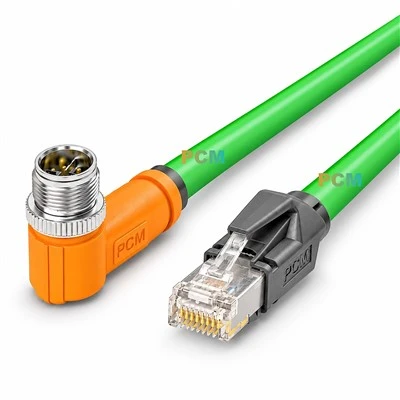
Connectors: Can use various connectors, such as M12, RJ45, or custom connectors designed for robustness and reliability in harsh environments.
Ethernet:
Cable Type: Commonly uses twisted-pair cables (Cat5e, Cat6, Cat6a) or fiber optic cables, depending on the speed and distance requirements.
Connectors: Typically uses RJ45 connectors for twisted-pair cables and SC, LC, or ST connectors for fiber optics.


4. Network Integration and Compatibility
CC-Link:
Integration: Designed specifically for industrial control applications. While it can be integrated into Ethernet-based systems using CC-Link IE, it is not inherently compatible with standard Ethernet networks without adapters.
Compatibility: Primarily used in environments where industrial control and real-time performance are critical.
Ethernet:
Integration: Widely used and compatible with various networking standards and protocols. It supports numerous industrial protocols like EtherNet/IP, Profinet, and Modbus TCP.
Compatibility: Easily integrates with other Ethernet-based systems and general IT infrastructure.
5. Environmental Considerations
CC-Link:
Environment: Often used in harsh industrial environments where durability and resistance to noise and interference are crucial.
Design: Designed to operate reliably in manufacturing and automation settings.
Ethernet:
Environment: While standard Ethernet is used in office and data center environments, industrial Ethernet variants are designed to withstand industrial conditions similar to CC-Link.
Design: Standard Ethernet can be vulnerable to industrial noise, which is why industrial-grade Ethernet cables and connectors are used in such settings.
In summary, CC-Link is tailored for real-time industrial control, whereas Ethernet is a general-purpose networking protocol that also supports industrial applications through various protocols and adaptations.