What Is Robotaxi? Automotive Ethernet Cable Solutions Behind Driverless Taxi Platforms
Robotaxi is a driverless taxi service based on autonomous driving technology. Behind every robotaxi platform is a high-speed vehicle data network that connects cameras, sensors, ECUs, gateways, domain controllers and zonal controllers through reliable automotive Ethernet cable assemblies.
📋 Contents
What Is Robotaxi?
Robotaxi is a combination of "robot" and "taxi." It refers to a driverless taxi service that uses autonomous driving technology to transport passengers without a human driver inside the vehicle.
In simple terms, a robotaxi is an autonomous vehicle used for ride-hailing. A passenger can request a ride through an app, similar to using a traditional ride-hailing service, but the vehicle is operated by an autonomous driving system instead of a human driver.
For passengers, a robotaxi is a driverless taxi. For engineers, it is also a complex connected vehicle platform. Cameras, sensors, ECUs, gateways, domain controllers and zonal controllers must exchange data in real time. This is why automotive Ethernet cable assemblies play an important role in robotaxi system design.
Robotaxi as a Mobility Service
A robotaxi combines autonomous driving technology with on-demand transportation. It is designed to carry passengers within defined service areas such as cities, airports, campuses, business parks or mapped urban zones.
Robotaxi as a Data Network
From an engineering perspective, a robotaxi is a moving data network. Multiple cameras, sensors and controllers need stable, low-latency and high-bandwidth connections inside the vehicle.
How Does a Robotaxi Work?
A robotaxi works by collecting data from the vehicle's surroundings, processing that data through autonomous driving computers, and sending control commands to the vehicle systems.
- Cameras detect lanes, traffic lights and road users
- Radar helps detect object distance and speed
- LiDAR supports 3D environment sensing
- GNSS and RTK modules support positioning
- IMU modules support motion tracking
- ADAS domain controllers process sensor data
- Gateways connect different vehicle networks
- Automotive Ethernet links transmit high-speed data
In many robotaxi architectures, automotive Ethernet is used to connect cameras, sensors, ECUs, Ethernet switches, gateways, domain controllers and zonal controllers. Depending on the platform design, the vehicle may use H-MTD cables, MATEnet cables, NETBridge cables, adapter cables and breakout cable assemblies.
Why Robotaxi Platforms Need Automotive Ethernet Cable Assemblies
Robotaxi platforms need reliable in-vehicle data connections because autonomous driving depends on continuous sensor data and fast decision-making. If the data link between a camera, sensor, ECU or controller is unstable, the system may lose important information.
High-Bandwidth Data
Robotaxi vehicles usually carry multiple cameras, sensors and positioning systems. High-resolution video and sensor data require stable high-speed transmission between vehicle endpoints and computing units.
Low-Latency Communication
Autonomous driving decisions depend on real-time data. Connections between sensors, ECUs, gateways and controllers need low-latency and stable communication.
Modular Wiring
As autonomous vehicles move toward domain-based and zonal architecture, extension cables, adapter cables and breakout cables can help simplify routing between controllers and distributed endpoints.
Four Automotive Ethernet Cable Assemblies Used in Robotaxi Networks
Different robotaxi connection problems require different cable solutions. Instead of choosing one cable for every connection, engineers usually select cable assemblies according to connector interface, routing distance, data rate and endpoint layout.
Natural product insertion logic: MATEnet to NETBridge cables solve connector compatibility, H-MTD extension cables solve link extension, H-MTD adapter cables solve multi-channel routing, and H-MTD 6-to-1 breakout cables solve high-density zonal connectivity.
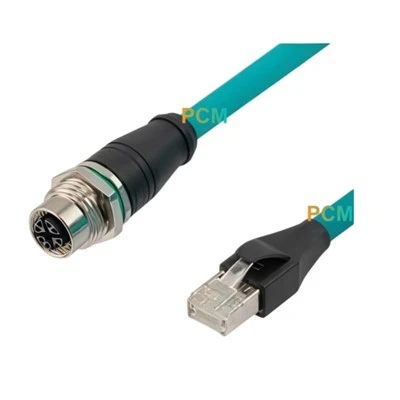
MATEnet to NETBridge Vehicle Ethernet Cable
In a robotaxi platform, ECUs, gateways, telematics modules and ADAS controllers may come from different suppliers. These devices may not always use the same automotive Ethernet connector system.
A MATEnet to NETBridge Vehicle Ethernet Cable can be used when a vehicle platform needs to connect MATEnet and NETBridge interfaces within an automotive Ethernet network. It is suitable for mixed connector platforms and 100BASE-T1 or 1000BASE-T1 links.
Typical robotaxi use: ECU to gateway links, telematics module connection, ADAS module integration and mixed connector platform development.

MATEnet to NETBridge Vehicle Ethernet Cable

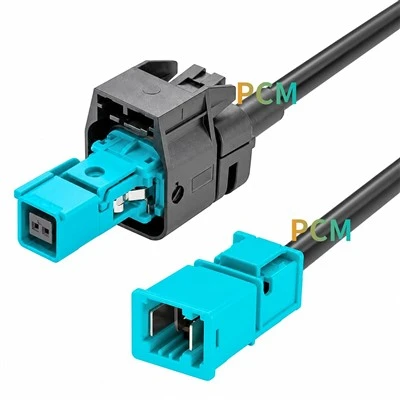
Automotive Ethernet H-MTD Extension Cable
Automotive Ethernet H-MTD Cable H-MTD Extension Cable
Robotaxi sensor placement may change during vehicle development. Engineers may adjust camera positions, sensor locations, controller packaging or Ethernet switch placement to improve field of view, serviceability and vehicle layout.
An H-MTD Extension Cable can be used when a high-speed H-MTD link needs to be extended between cameras, sensors, Ethernet switches, ADAS ECUs, domain controllers or zonal controllers.
Typical robotaxi use: camera-to-domain-controller links, sensor-to-switch links, prototype harness adjustment and high-speed vehicle Ethernet extension.
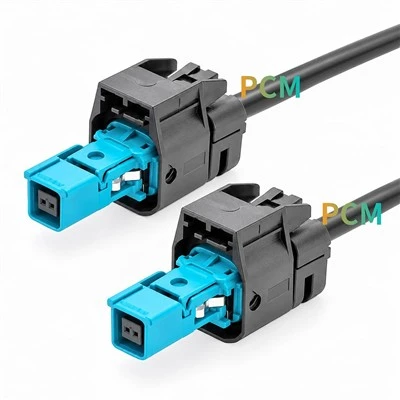
H-MTD Connection Cable Ethernet Single Double Four-Chamber Adapter Cable
A robotaxi is not a single-sensor system. It may use several cameras, sensors and Ethernet endpoints around the vehicle body, which creates a need for multi-channel routing between compact connector areas and distributed devices.
An H-MTD single, double or four-chamber adapter cable can help route signals from high-density H-MTD interfaces to single, double or four-channel endpoints in multi-camera and multi-sensor systems.
Typical robotaxi use: multi-camera ADAS systems, multi-sensor routing, domain controller to distributed endpoint links and high-density H-MTD connections.

H-MTD Single / Double / Four-Chamber Adapter Cable

H-MTD 6-to-1 Automotive Ethernet Breakout Cable
H-MTD 6-to-1 Automotive Ethernet Breakout Cable
In a zonal robotaxi architecture, one Ethernet switch, domain controller or zonal controller may need to connect several sensors or ECUs in the same vehicle area.
An H-MTD 6-to-1 Automotive Ethernet Breakout Cable can route one multi-port H-MTD interface to six single H-MTD links, making it suitable for switch-to-multi-endpoint and ECU-to-sensor connections.
Typical robotaxi use: zonal controller to multiple sensors, Ethernet switch to multiple endpoints, domain controller to camera modules and vehicle backbone branch connections.
Selection Guide for Robotaxi Cable Design
The right automotive Ethernet cable depends on the connection problem, not only the connector name. Engineers should first confirm the vehicle architecture, connector interface, data rate, routing distance and endpoint layout.
| Robotaxi Design Need | Suitable Cable Assembly |
|---|---|
| Connecting MATEnet and NETBridge interfaces | MATEnet to NETBridge Vehicle Ethernet Cable |
| Extending a high-speed H-MTD link | Automotive Ethernet H-MTD Extension Cable |
| Routing multi-channel camera or sensor connections | H-MTD Single / Double / Four-Chamber Adapter Cable |
| Connecting one high-density interface to multiple endpoints | H-MTD 6-to-1 Automotive Ethernet Breakout Cable |
| Supporting zonal architecture | H-MTD 6-to-1 Breakout Cable or H-MTD Adapter Cable |
| Developing prototype robotaxi wiring | H-MTD Extension Cable and H-MTD Adapter Cable |
For early-stage development, extension and adapter cables can make prototype changes easier. For more mature platform design, breakout cables and mixed-interface Ethernet cables can help organize the vehicle network architecture.
Key Technical Factors for Robotaxi Ethernet Cable Design
Before selecting an automotive Ethernet cable assembly for a robotaxi project, engineers should confirm the electrical, mechanical and environmental requirements of the link.
- 100BASE-T1, 1000BASE-T1 or higher-speed data requirement
- Connector interface, such as H-MTD, MATEnet or NETBridge
- Controlled impedance and signal integrity
- Shielding and EMI resistance
- Cable length and routing path
- Connector locking and coding
- Vehicle vibration and installation environment
- Prototype or production harness requirement
Note: Final connector type, wire definition, cable length, data rate and test requirements should be confirmed according to the robotaxi platform architecture and project drawings.
FAQ
What is a robotaxi?
A robotaxi is a driverless taxi service that uses autonomous driving technology to transport passengers without a human driver inside the vehicle.
Why does a robotaxi need automotive Ethernet cables?
A robotaxi needs automotive Ethernet cables to connect cameras, sensors, ECUs, gateways, domain controllers and zonal controllers. These links support high-speed data transmission and low-latency communication inside the vehicle.
What is an H-MTD cable used for in robotaxi applications?
An H-MTD cable can be used for high-speed automotive Ethernet links between cameras, sensors, Ethernet switches, ADAS ECUs, domain controllers and zonal controllers.
When should engineers choose a MATEnet to NETBridge cable?
A MATEnet to NETBridge cable is suitable when a vehicle platform needs to connect MATEnet and NETBridge interfaces, especially in mixed connector platforms involving ECUs, gateways, telematics modules or ADAS controllers.
What is the purpose of an H-MTD 6-to-1 breakout cable?
An H-MTD 6-to-1 breakout cable routes one multi-port H-MTD interface to six single H-MTD links. It is useful for zonal architecture, Ethernet switch connections and multi-endpoint robotaxi wiring.
Can these cable assemblies be customized?
Yes. Cable length, connector type, pin assignment, wire definition, labeling, shielding structure and drawing requirements can be customized according to the robotaxi platform design.
Conclusion: Robotaxi Is a Driverless Taxi and a Moving Data Network
A robotaxi is a driverless taxi service, but from an engineering perspective it is also a high-speed data network on wheels. Cameras, sensors, ECUs, gateways, domain controllers and zonal controllers must be connected through stable automotive Ethernet links.
Different cable assemblies solve different problems in a robotaxi Ethernet network. A MATEnet to NETBridge Vehicle Ethernet Cable helps connect mixed connector platforms. An H-MTD Extension Cable supports flexible high-speed link routing. An H-MTD Single / Double / Four-Chamber Adapter Cable helps manage multi-channel sensor and camera connections. An H-MTD 6-to-1 Automotive Ethernet Breakout Cable supports high-density zonal connectivity.
Custom Automotive Ethernet Cable Assemblies for Robotaxi Projects
Premier Cable provides automotive Ethernet cable assembly solutions for ADAS, autonomous vehicles, robotaxi platforms, vehicle gateways, sensors, ECUs and zonal architecture applications. Cable length, connector interface, pin assignment, labeling and drawings can be customized according to project requirements.