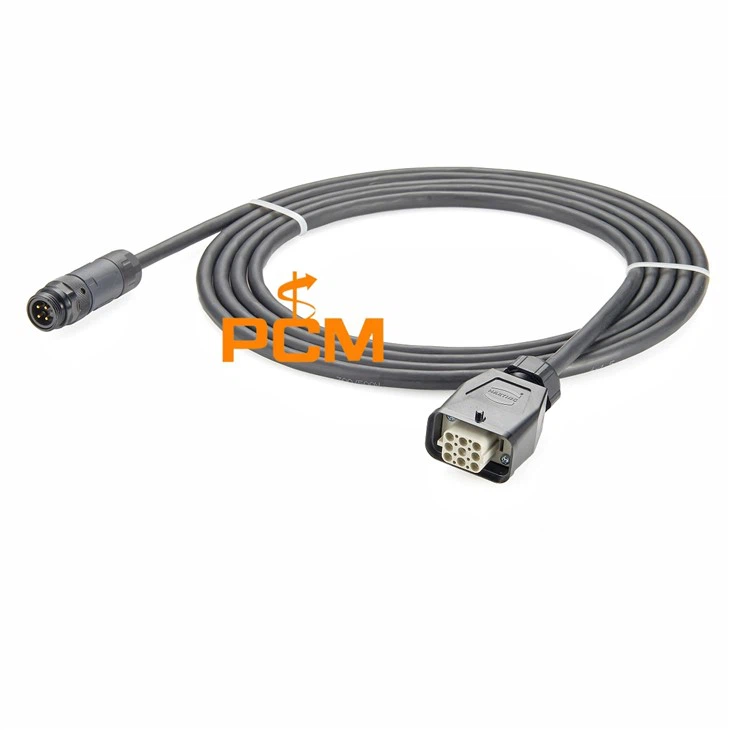

As a supplier of M16 cable adapters, I've often been asked about the suitability of our products in diverse industries, especially aerospace. The aerospace sector has incredibly stringent requirements for all components, including cable adapters. This blog will delve into the possibility of using M16 cable adapters in aerospace applications, considering factors such as performance, standards, and potential challenges.


Understanding M16 Cable Adapters
Before we assess their usability in aerospace, let's first understand what M16 cable adapters are. M16 cable adapters are a type of circular connector commonly used in industrial automation, sensor, and actuator applications. They are designed to provide a reliable electrical connection between cables and devices. These adapters come in various pin configurations, such as 2, 3, 4, 5, 6, 7, and 8 pins, to meet different application needs. For instance, our M16 Right Angle Connetor 2 3 4 5 6 7 8 Pin offers flexibility in terms of pin count and connection orientation.
The M16 cable adapters are known for their compact size, which makes them suitable for applications where space is limited. They also have a threaded locking mechanism that ensures a secure connection, preventing accidental disconnection due to vibrations or movements. Additionally, these adapters are often designed to be resistant to environmental factors such as dust, water, and chemicals, which is crucial for many industrial applications.
Aerospace Requirements for Cable Adapters
The aerospace industry has some of the most demanding requirements for cable adapters. Safety is the top priority, as any failure in the electrical system can have catastrophic consequences. Cable adapters in aerospace must be able to withstand extreme environmental conditions, including high and low temperatures, high altitudes, radiation, and intense vibrations.
Temperature and Altitude Tolerance
In aerospace applications, cable adapters may be exposed to temperatures ranging from -55°C to 125°C or even more extreme in some cases. At high altitudes, the atmospheric pressure is significantly lower, which can affect the performance of electrical components. The materials used in cable adapters must be able to maintain their electrical and mechanical properties under these conditions.
Radiation Resistance
Spacecraft and high - altitude aircraft are exposed to various forms of radiation, including cosmic rays and solar flares. Radiation can damage the insulation and conductors of cable adapters, leading to electrical failures. Therefore, cable adapters used in aerospace must be radiation - resistant.
Vibration and Shock Resistance
During takeoff, landing, and flight, aerospace vehicles experience intense vibrations and shocks. Cable adapters must be able to withstand these mechanical stresses without losing their electrical connection. The locking mechanism of the adapter is crucial in ensuring a stable connection under such conditions.
Compliance with Standards
The aerospace industry is highly regulated, and cable adapters must comply with a variety of international and national standards. For example, the Society of Automotive Engineers (SAE) and the International Electrotechnical Commission (IEC) have established standards for electrical connectors used in aerospace applications. These standards cover aspects such as performance, safety, and environmental compatibility.
Assessing the Suitability of M16 Cable Adapters for Aerospace
Now let's evaluate whether M16 cable adapters can meet the aerospace requirements.
Environmental Resistance
Our M16 cable adapters are designed to be resistant to common environmental factors such as dust and water. However, the extreme temperature and radiation conditions in aerospace are challenging. Specialized materials may need to be used to enhance the temperature and radiation resistance of M16 cable adapters. For example, radiation - resistant polymers can be used for insulation, and materials with high thermal conductivity can be used to dissipate heat effectively.
Mechanical Strength
The threaded locking mechanism of M16 cable adapters provides a certain level of resistance to vibrations and shocks. However, aerospace applications may require additional reinforcement. We can explore the possibility of adding shock - absorbing components or improving the mechanical design of the adapter to enhance its vibration and shock resistance.
Standard Compliance
As a supplier, we are committed to ensuring that our products meet relevant industry standards. However, the standards for aerospace applications are more stringent. We need to work closely with aerospace customers to understand the specific standards they require and conduct rigorous testing to ensure compliance.
Potential Applications of M16 Cable Adapters in Aerospace
Despite the challenges, there are potential applications for M16 cable adapters in aerospace.
Ground Support Equipment
Ground support equipment used in airports and aerospace facilities can benefit from M16 cable adapters. This equipment is not exposed to the extreme conditions of flight but still requires reliable electrical connections. Our Remote Electrical Tilt Power Supply Cable can be used in ground - based systems for antenna adjustment, where the compact size and secure connection of M16 cable adapters are advantageous.
Non - Critical On - Board Systems
In some non - critical on - board systems of aircraft or spacecraft, such as interior lighting or entertainment systems, M16 cable adapters may be suitable. These systems do not have the same high - risk requirements as critical flight control systems, and the cost - effectiveness and flexibility of M16 cable adapters can be an advantage.
Challenges and Future Developments
Challenges
The main challenges in using M16 cable adapters in aerospace are related to meeting the extreme environmental and safety requirements. The high - cost of specialized materials and testing can also be a barrier. Additionally, the certification process for aerospace components is complex and time - consuming.
Future Developments
To overcome these challenges, we are constantly researching and developing new technologies. We are exploring the use of advanced materials that can improve the temperature, radiation, and mechanical performance of M16 cable adapters. We are also working on streamlining the certification process to reduce the time and cost of bringing our products to the aerospace market.
Conclusion
In conclusion, while there are significant challenges in using M16 cable adapters in aerospace applications, there are also potential opportunities, especially in ground support equipment and non - critical on - board systems. As a supplier, we are committed to working with aerospace customers to develop solutions that meet their specific needs. If you are interested in exploring the use of M16 cable adapters in your aerospace projects, we invite you to contact us for a detailed discussion. Our team of experts can provide you with more information about our products and how they can be customized to meet your requirements. For more details on our M16 cable adapter products, you can also visit our website and explore the AISG to DB9 Ret Control Cable RCU RRU RRH PCM - CJ - 002 and other related products.
Let's work together to find the best cable adapter solutions for your aerospace applications!
References
- Society of Automotive Engineers (SAE) standards related to electrical connectors in aerospace applications.
- International Electrotechnical Commission (IEC) standards for electrical connectors.
- Technical literature on aerospace environmental conditions and their impact on electrical components.