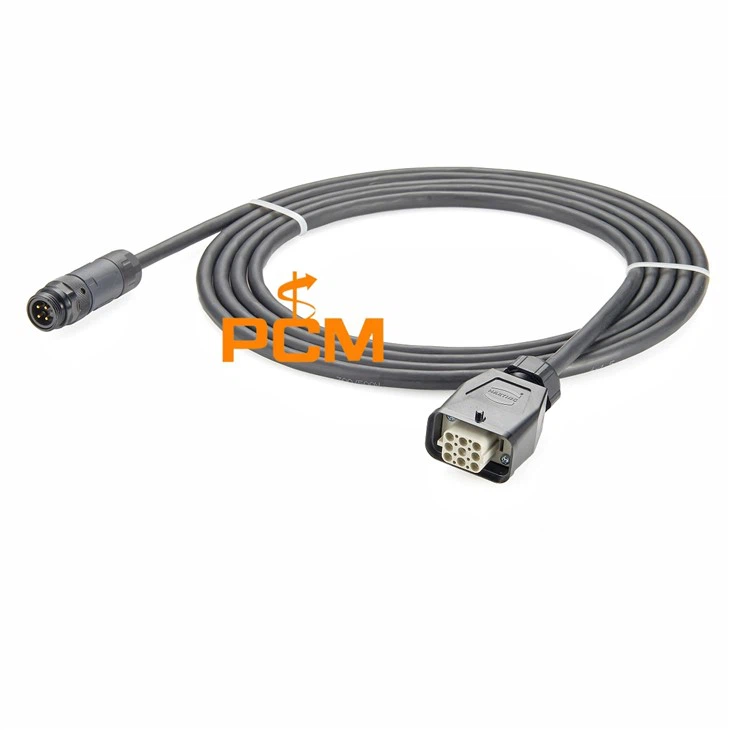

As a supplier of M23 encoder cables, I often get asked about the feasibility of using these cables in wind turbines. This is a crucial question considering the unique and demanding environment of wind turbines. In this blog, I'll explore whether the M23 encoder cable can be used in a wind turbine, analyzing its technical aspects, advantages, and potential challenges.
Technical Specifications of M23 Encoder Cables
M23 encoder cables are known for their robust design and reliable performance in various industrial applications. These cables typically feature a circular connector with a 23 - pin configuration, which is designed to transmit signals accurately and efficiently. They are commonly used to connect encoders, sensors, and other devices that require high - precision signal transmission.
The construction of M23 encoder cables includes high - quality conductors, insulation materials, and shielding. The conductors are usually made of copper, which offers excellent electrical conductivity. The insulation materials are carefully selected to provide protection against environmental factors such as moisture, heat, and chemicals. The shielding helps to reduce electromagnetic interference (EMI), which is essential for accurate signal transmission.
Suitability for Wind Turbines
Environmental Conditions
Wind turbines operate in harsh environmental conditions. They are exposed to extreme temperatures, high humidity, strong winds, and even lightning strikes. M23 encoder cables are designed to withstand a wide range of temperatures, typically from - 40°C to 85°C. This temperature range allows them to function properly in different climates, from cold arctic regions to hot desert areas.
In terms of humidity, the insulation materials used in M23 encoder cables are resistant to moisture penetration. This helps to prevent short - circuits and other electrical problems that can be caused by water ingress. Additionally, the cables are often coated with protective materials to further enhance their resistance to environmental factors.
Mechanical Stress
Wind turbines are subject to significant mechanical stress due to the rotation of the blades and the movement of the nacelle. The cables inside the turbine need to be able to withstand bending, twisting, and vibration without breaking or losing their electrical performance. M23 encoder cables are designed with flexibility in mind. They have a certain degree of bend radius that allows them to be installed in tight spaces and withstand repeated bending without damage.
The connectors of M23 encoder cables are also designed to be secure. They have a locking mechanism that prevents them from coming loose due to vibration. This ensures a stable connection between the encoder and other devices, even in a high - vibration environment.
Signal Transmission Requirements
Wind turbines rely on accurate sensor data for control and monitoring purposes. Encoders play a crucial role in providing information about the position, speed, and direction of the turbine blades. M23 encoder cables are capable of transmitting high - speed and high - precision signals. The shielding in these cables helps to maintain the integrity of the signals by reducing EMI. This is essential for the proper operation of the wind turbine control system.
Advantages of Using M23 Encoder Cables in Wind Turbines
Compatibility
M23 encoder cables are widely used in industrial automation applications, and many encoder manufacturers design their products to be compatible with M23 connectors. This means that it is relatively easy to find the right encoder and cable combination for a wind turbine application. For example, if you need to replace an encoder in a wind turbine, you can easily find an M23 - compatible encoder and connect it using an M23 encoder cable.
Cost - Effectiveness
Compared to some other types of specialized cables, M23 encoder cables are relatively cost - effective. They offer a good balance between performance and price. This is important for wind turbine operators, who need to keep their costs under control while ensuring the reliable operation of their turbines. The availability of M23 encoder cables in the market also means that you can easily source them at a competitive price.
Ease of Installation
M23 encoder cables are easy to install. The circular connectors are designed to be plug - and - play, which means that they can be quickly connected and disconnected. This reduces the installation time and labor costs. In a wind turbine, where maintenance and repair work need to be done quickly, the ease of installation of M23 encoder cables is a significant advantage.
Potential Challenges
Long - Term Durability
Although M23 encoder cables are designed to be durable, the long - term operation of a wind turbine can still pose challenges. The continuous exposure to harsh environmental conditions and mechanical stress may cause wear and tear on the cables over time. Regular inspection and maintenance are required to ensure the long - term reliability of the cables. This may include checking for signs of damage, such as cracks in the insulation or loose connectors.


Compatibility with Specific Turbine Systems
Some wind turbine systems may have specific requirements for the encoder cables. For example, they may require a certain type of shielding or a specific signal transmission protocol. It is important to ensure that the M23 encoder cables you choose are compatible with the specific turbine system. This may involve consulting with the turbine manufacturer or an electrical engineer.
Product Offerings
As a supplier, we offer a range of M23 encoder cables to meet different needs. Our Sensor Transducer Encoder Cable M23 To D - Sub is suitable for applications where you need to connect an M23 - equipped encoder to a D - Sub connector. This cable provides a reliable connection for signal transmission between different devices.
Our Servo Motor Encoder Cable M23 To DB25 is designed for servo motor applications. It offers high - quality signal transmission and is compatible with many servo motor systems.
We also have the M23 To DB9 Servo Motor Encoder Cable, which is ideal for applications that require a connection between an M23 encoder and a DB9 connector.
Conclusion
In conclusion, M23 encoder cables have the potential to be used in wind turbines. Their technical specifications make them suitable for the harsh environmental conditions and mechanical stress of wind turbine applications. They offer advantages such as compatibility, cost - effectiveness, and ease of installation. However, there are also potential challenges that need to be addressed, such as long - term durability and compatibility with specific turbine systems.
If you are considering using M23 encoder cables in your wind turbine, we encourage you to contact us for more information. Our team of experts can help you choose the right cable for your specific application and provide you with technical support. Whether you are a wind turbine operator, a maintenance technician, or an engineer, we are here to assist you in ensuring the reliable operation of your wind turbine.
References
- "Industrial Encoder Cables: A Technical Overview", Industrial Cable Association
- "Wind Turbine Electrical Systems and Components", Wind Energy Research Institute