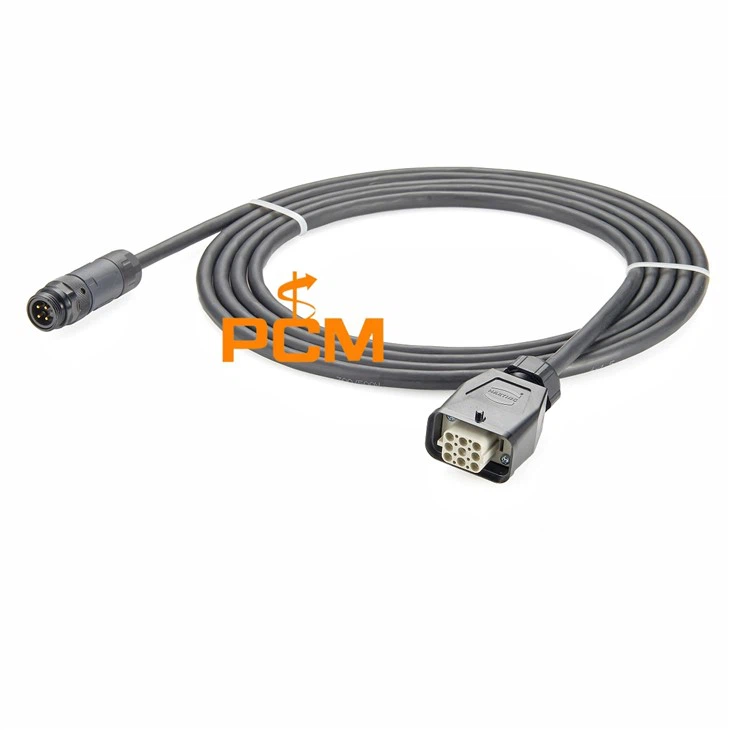

As a supplier of m23 servo motor cables, I often get asked how to measure the length of these cables accurately. It might seem like a straightforward task, but there are actually quite a few things to keep in mind to get the most precise measurement. In this blog post, I'll share some tips and tricks that I've picked up over the years in the business.


First off, why is it so important to measure the cable length accurately? Well, for starters, if the cable is too short, it won't reach where it needs to go, and you'll have a real headache on your hands trying to extend it or re - route the whole setup. On the other hand, if it's too long, you'll end up with a bunch of excess cable that can create a messy installation, and it might even lead to signal interference or power loss due to the longer path the electricity or signals have to travel.
Tools Needed for Measuring
The first thing you'll need is a good measuring tool. A tape measure is the most common choice, and it's a great option for short to medium - length cables. Make sure the tape measure is in good condition, with clear markings and no kinks or bends that could throw off your measurement. For longer cables or when you need really high precision, you might want to use a measuring wheel. This is especially handy if you're measuring a cable that has to run along a long, straight path like in a large industrial facility.
Preparing the Cable for Measurement
Before you start measuring, you've got to make sure the cable is in a proper state. If it's been coiled up for a while, it's likely to have some kinks. You need to straighten it out as much as possible. You can do this by gently pulling the cable along a flat surface. If there are any stubborn kinks, you can try using your hands to carefully work them out. Just be careful not to damage the cable in the process.
Measuring a Straight Cable
Measuring a straight cable is the easiest scenario. Simply lay the cable out on a flat surface. Start the tape measure or measuring wheel at one end of the cable, right at the tip of the connector. Then, run it along the length of the cable until you reach the other end. Make sure to follow the centerline of the cable as closely as possible. If you're using a tape measure, hold it taut so that it doesn't sag, which could add extra length to your measurement.
Measuring a Cable with Bends and Curves
Things get a bit trickier when the cable has bends and curves. In this case, you can't just measure in a straight line. One way to deal with this is to use a flexible measuring tape. Wrap it around the bends and curves, following the path of the cable exactly. Another option is to measure each straight section of the cable separately and then add up the lengths. When you're measuring around curves, try to estimate the arc length as accurately as you can. You can use a bit of geometry knowledge here. For example, if the curve is close to a semi - circle, you can use the formula for the circumference of a circle (C = 2πr) and divide by 2 to get the arc length.
Measuring Cables in an Installation
If you're measuring a cable that's already installed, you might face some challenges. You can't always lay it out straight, and there might be obstacles in the way. In this situation, you can use a combination of methods. First, measure the visible straight sections of the cable. Then, for the parts that are hidden or have to go around obstacles, estimate the lengths as best as you can. You can use reference points like the distance between two brackets or the height of a wall that the cable runs along to help with your estimations.
Accounting for Connectors
Don't forget to account for the connectors at the ends of the cable when you're measuring. The length of the connectors can vary, and they need to be included in the total length. Usually, you can measure the length of the connector from the tip to the point where it attaches to the cable. Add this length to the length of the cable itself.
Using Technology for Measurement
In modern times, there are also some high - tech options for measuring cable length. There are cable length measuring devices that use time - domain reflectometry (TDR). These devices work by sending a signal down the cable and measuring the time it takes for the signal to bounce back. Based on the speed of the signal in the cable, the device can calculate the length. This is a very accurate method, especially for longer cables, but it can also be quite expensive.
Our Product Range
At our place, we offer a wide variety of M23 Connector Inverter Spindle Cable. These cables are designed to meet the high - performance requirements of servo motor systems. We also have M23 Servo Motor Power Cable that can handle high - power applications with ease. And if you're looking for a comprehensive solution, check out our M23 Multifunctional Connectors And Cables Product Range.
Final Thoughts
Measuring the length of an m23 servo motor cable accurately might take a bit of time and effort, but it's definitely worth it. By following these tips, you can ensure that you get the right length of cable for your application. If you have any questions about measuring or about our products, don't hesitate to reach out. We're here to help you make the best choice for your servo motor system. Whether you're a small - scale DIY enthusiast or a large industrial enterprise, we've got the cables and the knowledge to meet your needs. So, if you're in the market for high - quality m23 servo motor cables, let's start a conversation and see how we can work together.
References
- General knowledge from years in the m23 servo motor cable supply business.
- Industry standards and best practices for cable measurement.