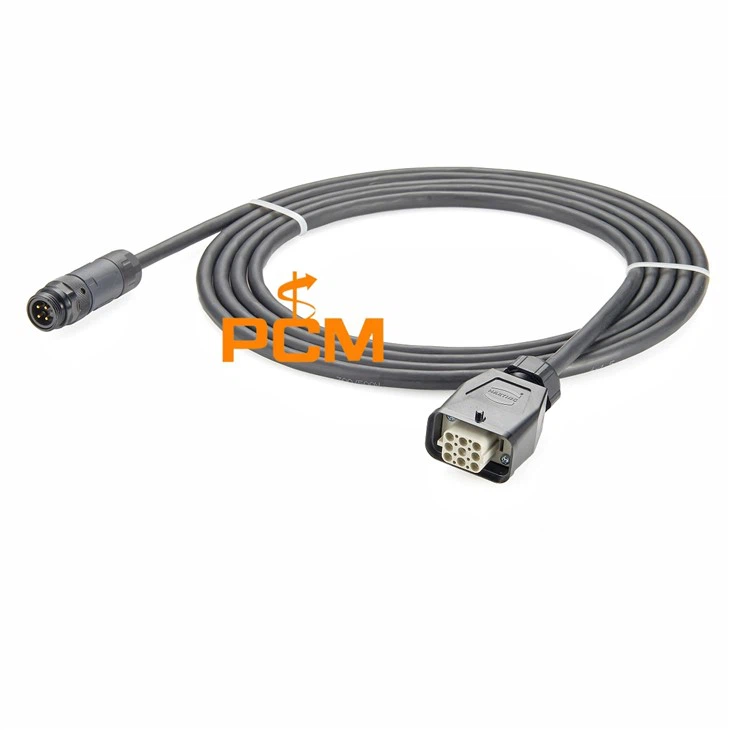

In the realm of modern telecommunications, AISG RET cables play a pivotal role in ensuring seamless communication between various components of a cellular network. As a dedicated AISG RET cable supplier, I've witnessed firsthand the significance of cable length in determining performance. In this blog, I'll delve into how the length of an AISG RET cable can impact its performance and what considerations are essential for optimal usage.
Signal Attenuation
One of the most significant factors affected by cable length is signal attenuation. As electrical signals travel through a cable, they gradually lose strength due to resistance and other electrical properties of the cable material. The longer the cable, the more significant the attenuation becomes.
In the case of AISG RET cables, which are used to transmit control signals between Remote Radio Units (RRUs), Remote Control Units (RCUs), and other network components, signal attenuation can lead to a degradation in the quality of the transmitted data. For instance, if the signal strength drops below a certain threshold, the receiving end may not be able to accurately interpret the data, resulting in communication errors or even complete signal loss.
Research shows that signal attenuation in coaxial cables, which are commonly used in AISG RET applications, increases exponentially with cable length. This means that doubling the length of the cable can more than double the amount of signal loss. To mitigate this issue, it's crucial to select cables with low attenuation characteristics. High - quality cables with better insulation and conductor materials can help reduce signal loss over longer distances. For example, cables with a lower loss rating, such as those made with high - purity copper conductors and foam - polyethylene insulation, can maintain signal integrity over greater lengths.
Propagation Delay
Another aspect affected by cable length is propagation delay. Propagation delay refers to the time it takes for a signal to travel from the transmitting end of the cable to the receiving end. As the length of the cable increases, so does the propagation delay.
In a network where real - time communication is essential, such as in cellular base stations, propagation delay can have a significant impact on system performance. For example, in a system that requires rapid adjustment of antenna tilt using AISG RET cables, a long propagation delay can result in a delay in the execution of control commands. This can lead to sub - optimal antenna performance, affecting the coverage area and signal quality of the base station.
To address propagation delay issues, network designers may need to consider using shorter cables or implementing signal repeaters or amplifiers. Signal repeaters can regenerate the weakened signals, reducing the overall propagation delay and improving the reliability of the communication link. However, adding repeaters also adds complexity and cost to the system, so it's a trade - off that needs to be carefully evaluated.
Impedance Mismatch
Cable length can also influence impedance mismatch. Impedance is a measure of the opposition that a circuit presents to the flow of alternating current. In an ideal scenario, the impedance of the cable should match the impedance of the connected devices to ensure maximum power transfer and minimal signal reflection.
As the length of the cable changes, the impedance characteristics of the cable can deviate from the ideal values. This is especially true for longer cables, where small variations in the cable's physical properties can accumulate over the length, leading to impedance mismatch. When there is an impedance mismatch, a portion of the signal is reflected back towards the transmitting end, which can cause interference and degrade the overall performance of the system.
To minimize impedance mismatch, it's important to use cables that are properly matched to the impedance of the connected devices. Most AISG RET systems operate at a standard impedance, such as 50 ohms or 75 ohms. Ensuring that the cable and all the connected components have the same impedance rating can help reduce signal reflections and improve the quality of the communication link.
Capacitance and Inductance
The length of an AISG RET cable also affects its capacitance and inductance. Capacitance is the ability of a cable to store electrical energy in an electric field, while inductance is the ability to store energy in a magnetic field.
As the cable length increases, the capacitance and inductance values of the cable also increase. Higher capacitance can cause the signal to slow down and can also lead to increased power consumption. Inductance, on the other hand, can cause voltage spikes and interference in the signal.
These electrical properties can have a significant impact on the performance of the AISG RET system. For example, in a system that requires high - speed data transmission, the increased capacitance and inductance of a long cable can limit the data rate and cause signal distortion. To counteract these effects, cables with low capacitance and inductance values should be selected, especially for applications where high - speed communication is required.
Practical Considerations for Cable Selection
When selecting AISG RET cables, it's important to take into account the specific requirements of the application. If the distance between the connected devices is relatively short, say less than 10 meters, a standard cable with moderate attenuation and impedance characteristics may be sufficient. However, for longer distances, such as those exceeding 50 meters, high - performance cables with low attenuation, proper impedance matching, and low capacitance and inductance values are essential.
As an AISG RET cable supplier, I offer a wide range of cables to meet different application needs. For example, our RET AISG Y Splitter Cable 8 Pin Male To Female is designed for applications where signal splitting is required. It provides reliable signal transmission and is available in different lengths to suit various installation scenarios. Our RCU RRU RRH Radio Head Cable AISG DB9 is specifically tailored for connecting radio heads and control units, ensuring high - quality communication in base station environments. And our Remote Electrical Tilt Power Supply Cable is designed to provide stable power supply for remote electrical tilt systems, with features that minimize signal interference.


Conclusion
In conclusion, the length of an AISG RET cable has a profound impact on its performance. Signal attenuation, propagation delay, impedance mismatch, and changes in capacitance and inductance are all factors that need to be carefully considered when selecting cables for a particular application. By understanding these effects and choosing the right cables, network operators can ensure reliable and efficient communication in their cellular networks.
If you're in the market for high - quality AISG RET cables, I invite you to reach out to discuss your specific requirements. Whether you need a short cable for a small - scale installation or a long cable for a large - scale base station project, I can provide you with the right solutions. Let's work together to optimize your network performance with the best AISG RET cables available.
References
- "Telecommunication Cabling Installation and Maintenance Handbook"
- "Coaxial Cable Technology: Principles and Applications"
- Industry whitepapers on AISG RET cable performance and specifications