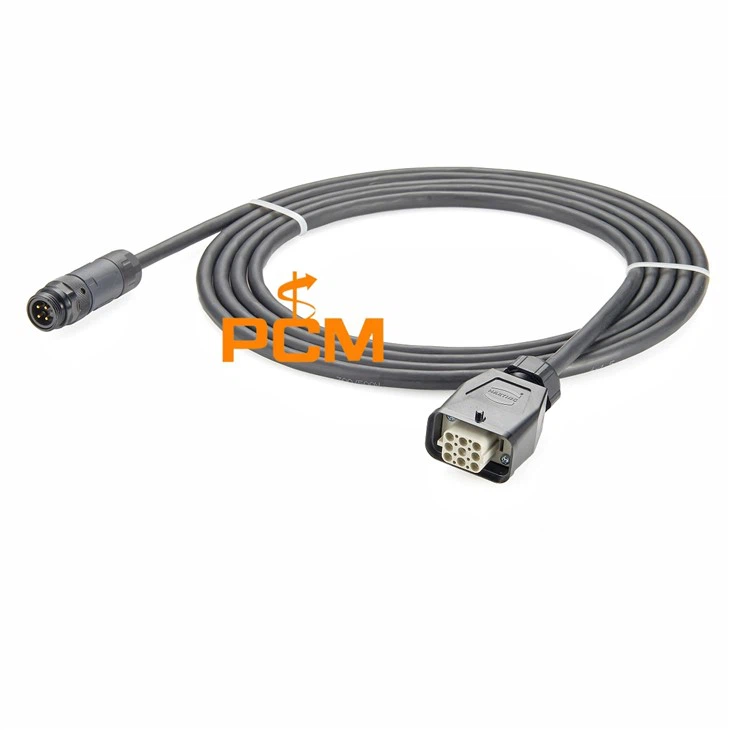

Hey there! As a supplier of Devicenet trunk cables, I often get asked about the color code of these cables. It's a pretty important topic, especially if you're in the business of setting up or maintaining industrial automation systems. So, let's dive right into it and break down what the color code of a Devicenet trunk cable is all about.
First off, what exactly is a Devicenet trunk cable? Well, Devicenet is a network protocol used in industrial automation to connect various devices like sensors, actuators, and controllers. The trunk cable is the main cable that runs through the network, providing power and data transmission to all the connected devices. It's like the backbone of the entire system.
Now, onto the color code. The color code of a Devicenet trunk cable is standardized to ensure consistency and ease of installation. Typically, a Devicenet trunk cable has two main conductors for power and two for data. The power conductors are usually colored red and black, while the data conductors are colored blue and white.
The red conductor is used for the positive power supply, usually at 24 volts DC. This provides the energy needed to operate all the devices connected to the network. The black conductor, on the other hand, is the negative or ground connection. It completes the electrical circuit and helps to maintain a stable power supply.
The blue and white conductors are used for data transmission. The blue conductor is the data + (positive) line, and the white conductor is the data - (negative) line. These two lines work together to carry the digital signals that allow the devices on the network to communicate with each other.
But why is it so important to follow the color code? Well, for starters, it makes installation a whole lot easier. Electricians and technicians can quickly identify which conductor is which, reducing the risk of wiring errors. This is crucial in industrial settings where a single wiring mistake can lead to system failures, downtime, and potentially costly repairs.
Another reason is compatibility. Since the color code is standardized, any Devicenet device or cable that adheres to the standard can be easily integrated into the network. This means you don't have to worry about whether a new device will work with your existing cable infrastructure.


Now, let's talk about some of the products we offer as a Devicenet trunk cable supplier. We have a wide range of high-quality cables that are designed to meet the specific needs of industrial applications. For example, our DeviceNet Trunk LineTerminator Resistor is an essential component for terminating the trunk cable and ensuring proper signal transmission. It helps to prevent signal reflections and interference, which can degrade the performance of the network.
We also offer the N2K NMEA2000 7/8" H-Type Cable for Marine Ship Yacht. This cable is specifically designed for marine applications, where it needs to withstand harsh environmental conditions such as saltwater, humidity, and vibration. It's a reliable choice for any marine automation system.
And if you need to split the trunk cable to connect multiple devices, our Mini-Change T-Splitter Circular Connector Cable is the perfect solution. It allows you to easily add or remove devices from the network without having to rewire the entire system.
In addition to these products, we also provide excellent customer service and technical support. Our team of experts is always ready to answer any questions you may have about our products or the installation process. We understand that every customer's needs are unique, and we're committed to finding the best solution for you.
If you're in the market for Devicenet trunk cables or any related products, we'd love to hear from you. Whether you're a small business looking to upgrade your automation system or a large industrial manufacturer in need of a reliable cable supplier, we have the products and expertise to meet your requirements.
Don't hesitate to reach out to us for a quote or to discuss your specific needs. We're here to help you get the most out of your Devicenet network.
References
- DeviceNet Specification, Allen-Bradley
- Industrial Ethernet and Fieldbus Technology Handbook, Peter Welander