Ethernet is a computer network technology used to achieve data transmission between devices in local area networks (LANs) and metropolitan area networks (MANs). It is currently the most common and widely used wired network technology. The Ethernet standard is developed and maintained by the IEEE 802.3 working group.
Ethernet cable categories are usually divided into different categories according to their performance and application environment. Each category has a specific bandwidth and transmission speed. The following are the main Ethernet cable categories and their corresponding interfaces:
Our products picture

1.
CAT5 cable
- Features:
Maximum bandwidth: 100 MHz
Transmission rate: 100 Mbps
Typical use: 10BASE-T and 100BASE-T networks
Suitable for basic home and small office networks
- Corresponding interface:
RJ45 interface: Standard 8P8C (8 Position 8 Contact) interface, which is the most widely used Ethernet interface.

2.
CAT5e cable (enhanced CAT5)
- Features:
Maximum bandwidth: 100 MHz
Transmission rate: 1 Gbps
Typical use: 1000BASE-T (Gigabit Ethernet)
Improved anti-interference performance, suitable for higher bandwidth requirements
- Corresponding interface:
RJ45 interface: Suitable for Gigabit Ethernet connection, backward compatible with CAT5 cable.

3.
CAT6 cable
- Features:
Maximum bandwidth: 250 MHz
Transmission rate: 10 Gbps (short distance)
Typical use: 10GBASE-T (short distance) and 1000BASE-T
Provides higher bandwidth and better signal quality
- Corresponding interface:
RJ45 interface: Suitable for Gigabit and 10 Gigabit Ethernet connections, using standard 8P8C plugs.

4.
CAT6a cable (enhanced CAT6)
- Features:
Maximum bandwidth: 500 MHz
Transmission rate: 10 Gbps
Typical use: 10GBASE-T
Provides higher anti-interference and longer distance 10 Gigabit connection compared to CAT6
- Corresponding interface:
RJ45 interface: Suitable for higher performance network connections.

5.
CAT7 cable
- Features:
Maximum bandwidth: 600 MHz
Transmission rate: 10 Gbps
Typical use: 10GBASE-T
With shielding layer (STP or SSTP), it provides better anti-interference performance
- Corresponding interface:
GG45 interface: backward compatible with RJ45, suitable for high-
frequency and high-bandwidth network applications.
Tera interface: high-performance interface, providing higher bandwidth and anti-interference ability.
RJ45 interface: in some applications, enhanced RJ45 connectors are used.

6.
CAT7a cable (enhanced CAT7)
- Features:
Maximum bandwidth: 1000 MHz
Transmission rate: 10 Gbps
Typical use: 10GBASE-T
Provides higher frequency and better anti-interference performance
- Corresponding interface:
GG45 interface: high-frequency and high-bandwidth applications.
Tera interface: higher-performance network connection.
RJ45 interface: use high-quality RJ45 connectors.

7.
CAT8 cable
- Features:
Maximum bandwidth: 2000 MHz
Transmission rate: 25 Gbps or 40 Gbps
Typical use: High-speed connection in data centers
Mainly used in high-bandwidth demand environments within short distances
- Corresponding interface:
RJ45 interface: Designed for high-speed connections, supports 25GBASE-T and 40GBASE-T.
GG45 interface: Suitable for high-frequency and high-bandwidth applications.
Tera interface: High-performance interface.

7.1
Fiber optic Ethernet cable (for Gigabit and 10 Gigabit Ethernet)
Features:
Uses optical fiber to transmit data, suitable for long-distance and high-speed transmission
Typical use: Data centers, high-speed network connections
Corresponding interface:
LC interface: Compact design, suitable for high-density optical fiber connections, commonly found in data centers.
SC interface: Larger, easy to plug and unplug, widely used in the fields of network and telecommunications.
FC interface: Used in telecommunications and data communication networks, especially in single-mode optical fiber connections.

7.2
Industrial Ethernet Cable
Features:
Resistant to vibration, shock and harsh environment
Typical applications: industrial automation and control systems
Corresponding interface:
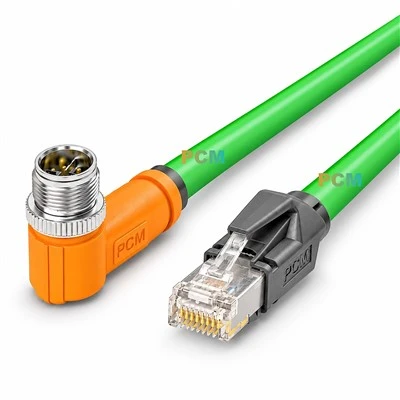
M12 interface: commonly used for Ethernet connection in industrial environment, suitable for CAT5e and CAT6 cables.
In addition to the common Ethernet cable categories (such as CAT5, CAT5e, CAT6, CAT6a, CAT7, CAT7a, CAT8), there are some less common Ethernet cable categories. These cables are usually for specific applications or early network standards. Here are some of the less common Ethernet cable categories:
CAT1 cable
Features:
Mainly used for voice transmission (telephone line), not suitable for data transmission.
The earliest type of cable, which has been basically eliminated.
Corresponding interface:
Telephone plug (RJ11).
CAT2 cable
Features:
Maximum bandwidth: 1 MHz
Transmission rate: 4 Mbps
Typical use: early Token Ring network and telephone system.
It has been replaced by higher performance cables.
Corresponding interface:
BNC interface (for Token Ring network).
CAT3 cable
Features:
Maximum bandwidth: 16 MHz
Transmission rate: 10 Mbps
Typical use: 10BASE-T network and early telephone system.
Still seen in some old buildings and telephone systems.
Corresponding interface:
RJ45 interface: used for early Ethernet connection.
RJ11 interface: used for telephone system.


CAT4 cable
Features:
Maximum bandwidth: 20 MHz
Transmission rate: 16 Mbps
Typical use: early Token Ring network (16 Mbps).
Hardly used in modern networks.
Corresponding interface:
RJ45 interface: used in early networks.
CAT9 cable (rare and not yet standardized)
Features:
There are rumors or cables under development, but there is no clear standard or widespread application yet.
The goal may be higher bandwidth and transmission rate than CAT8.
Corresponding interface:
Unclear, enhanced RJ45 or new high-performance interface may still be used.
Twisted pair fiber hybrid cable
Features:
Combines the advantages of twisted pair and optical fiber, suitable for specific high-performance applications.
Provides power and data transmission, suitable for devices that need to provide power and data at the same time.
Corresponding interface:
Composite interface, which may include RJ45 and fiber optic connectors.


Waterproof M12 A-coded to RJ45 Adapter
Industrial Ethernet cable
Features:
Designed for harsh environments, with higher durability and anti-interference performance.
Typical uses: industrial automation, military applications, ships and aviation, etc.
Corresponding interface:
M12 interface: rugged connection for industrial environments.
IP67 level interface: special interface that is dustproof and waterproof.
Premier Cable offers a wide range of RJ45 connectors and cables. We also offer OEM services, welcome your purchase!