

一, Technical basis for response speed: performance boundary of M8 connector
1. Data transmission rate and delay control
The core tasks of high-speed sorting robots include package recognition, path planning, and robotic arm action execution, and this closed-loop control cycle needs to be completed in milliseconds. The M8 connector achieves low latency transmission through the following technologies:
Gigabit level transmission capability: supports up to 1Gb/s data rate, which can meet the real-time data stream transmission of high-resolution visual sensors (such as industrial cameras). For example, a certain e-commerce warehouse robot uses an M8 connector equipped with EtherCAT protocol to achieve a communication cycle of 200 μ s in a drag chain environment, ensuring that the robotic arm's grasping action is synchronized with the vision system.
Deterministic delay design: Through hardware timestamp and priority queue mechanism, the M8 connector can control the transmission delay of key signals (such as emergency stop instructions) within 50 μ s in multi-sensor data fusion scenarios. A test of a certain automotive parts sorting line showed that after using the optimized M8 connector, the system response time was shortened from 12ms to 3ms, and the sorting error rate decreased by 80%.
2. Power transmission efficiency and dynamic response
The servo motor of the sorting robot needs to complete start stop and torque adjustment in milliseconds, which poses a challenge to the dynamic response of the power connection:
High power density design: The M8 connector supports power transmission up to 400W, and with low impedance gold-plated contacts (contact resistance ≤ 5m Ω), it can reduce power loss and improve voltage stability. The actual test data of a 3C product sorting robot shows that after using the M8 connector, the voltage fluctuation during motor startup decreased from ± 15% to ± 3%, and the action delay was reduced by 40%.
Quick plug and hot plug support: The 3-pin/4-pin screw termination design of the M8 connector allows for quick replacement of sensor modules during robot operation without causing signal interruption during the plug and unplug process. A certain pharmaceutical sorting system has shortened the sensor replacement time from 30 minutes to 2 minutes and reduced system downtime by 90% through modular design.
二, Response speed requirements driven by application scenarios
1. Real time requirements for high-density sorting scenarios
In high-density scenarios such as e-commerce warehousing and tobacco sorting, robots need to simultaneously process the recognition and sorting of hundreds of packages. At this point, the response speed of the M8 connector directly affects the system throughput:
Multi sensor synchronization challenge: Taking a logistics center as an example, its sorting robot is equipped with 8 visual sensors and 12 force sensors, and all data needs to be aggregated to the controller through M8 connectors. By using the Time Sensitive Network (TSN) protocol and the hardware synchronization function of the M8 connector, the system can achieve 10 μ s level sensor data alignment, ensuring sorting accuracy of ± 0.1mm.
Dynamic path planning optimization: In scenarios where sorting paths frequently change, the low latency feature of the M8 connector enables the robot to adjust its motion trajectory in real-time. A food sorting line test showed that after using high-speed M8 connectors, the robot's avoidance response time to sudden obstacles was shortened from 200ms to 50ms, and the collision risk was reduced by 95%.
2. Stability requirements in extreme environments
Sorting robots often operate in a temperature range of -20 ℃ to+60 ℃, high humidity (95% RH), and strong vibration (5g) environment, which poses a dual challenge to the environmental adaptability of M8 connectors:
Chemical corrosion resistance design: In pharmaceutical sorting scenarios, M8 connectors need to resist the erosion of chemicals such as alcohol and disinfectants. By using 316L stainless steel shell and fluororubber sealing ring, the connector of a sorting robot maintains an IP68 protection level and a signal transmission error rate of less than 10 ⁻¹ ² after continuous operation for 2 years.
Anti vibration and impact performance: Under the vibration and impact generated by the high-speed movement of the robotic arm, the threaded locking structure of the M8 connector ensures contact stability. The actual test data of a certain automotive parts sorting robot shows that under a vibration acceleration of 10g, the fluctuation range of the contact resistance of M8 connector is only ± 0.2m Ω, far better than the industry standard threshold of ± 5m Ω.
三, System Collaboration: Optimization from Connectors to Overall Architecture
1. Collaborative design of hardware and software
The response speed of high-speed sorting robots not only depends on the physical performance of M8 connectors, but also needs to be deeply coordinated with the control system architecture:
Edge computing and local processing: By deploying edge computing modules near M8 connectors, data transmission distance and delay can be reduced. A certain 3C product sorting robot adopts a distributed architecture, which sinks the visual algorithm to the FPGA chip at the connector end, reducing the image processing delay from 50ms to 5ms.
Predictive maintenance and adaptive adjustment: The temperature and vibration sensors built into the M8 connector can monitor the connection status in real time and predict the risk of failure through machine learning algorithms. The system of a certain logistics center has reduced the connector failure rate from twice a month to once a year through this technology, reducing maintenance costs by 70%.
2. Standardization and modularization trends
To meet the needs of different sorting scenarios, M8 connectors are developing towards standardization and modularization:
Unified coding and interface specification: The M8 connector coding standard developed by the International Electrotechnical Commission (IEC) (such as A code for DC power supply and D code for Ethernet) enables interchangeable use of equipment from different manufacturers. A global logistics company has shortened the deployment time of its sorting system from 6 months to 2 months by unifying connector standards.
Scalable modular design: The M8 connector supports expanding I/O points through stacked modules to meet the functional upgrade needs of sorting robots. A certain pharmaceutical sorting system has increased the number of sensors from 16 to 64 by adding M8 connector modules, resulting in a 300% increase in system throughput.
Do high-speed sorting robots have requirements for the response speed of M8 connectors?
Popular Products

HFM Mini FAKRA Cable
Single channel HFM Mini-FAKRA coaxial cable with female-female, male-male and male-female options for ADAS cameras and

IP67 Waterproof HFM FAKRA Cable
IP67 waterproof HFM to FAKRA cable with 4 connector configurations for automotive cameras, ADAS sensors and RF systems.

Hirose ST Series Connector
Hirose ST Series connector cable assemblies featuring ST40X-10S-CV, ST40X-18S-CV, ST40X-24S-CV and ST40X-36S-CV

GMSL2 FAKRA Z Code Camera Cable
3 m GMSL2 cable with FAKRA Z Code female connectors for camera-to-host, ECU, ADAS and machine vision connections.
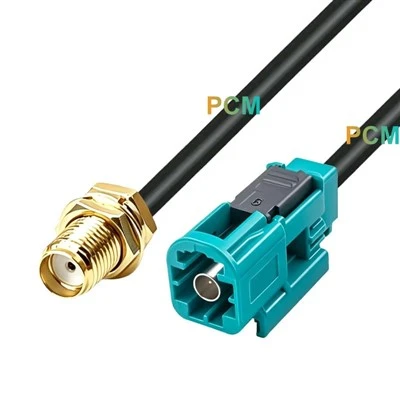
Rosenberger Fakra To SMA Cable
Rosenberger to SMA 50 Ohm coaxial cable with four connector configurations for automotive RF modules, antennas and test
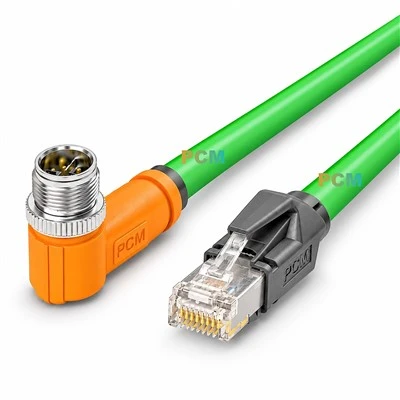
M12 X-Code To RJ45 Cable
M12 X-Code to RJ45 Cat6A cable for 10Gb industrial Ethernet, compatible with X-coded M12 devices, switches and