

1, Technical characteristics and communication capability boundaries of M8 adapter
The M8 adapter features an 8mm diameter threaded interface as its core, offering 3-8 pole optional configurations, supporting 24V-30V voltage transmission and 0.5A-4A rated current. The impact of its technical characteristics on communication performance is mainly reflected in the following three aspects:
Transmission rate and bandwidth limitations
The physical structure of the M8 adapter determines its bandwidth limit. Taking the 8-pin model as an example, its maximum transmission rate usually does not exceed 100Mbps, which is difficult to meet the gigabit bandwidth requirements of modern industrial Ethernet protocols such as EtherNet/IP and Profinet. For example, in the automotive welding production line, robots need to transmit high-resolution visual data in real-time to PLC for quality inspection. In such scenarios, M12 connectors or fiber optic connectors are required to support higher bandwidth.
Anti interference capability and signal integrity
The high-end M8 adapter is designed with a twisted pair shielding layer and a metalized plastic shell, which can increase the electromagnetic interference (EMI) attenuation at a frequency of 1MHz to 62dB, meeting the UL 2238 standard. However, in high-speed vibration scenarios at robot joints, the contact resistance fluctuation of traditional M8 adapters may exceed 5m Ω, resulting in signal distortion. Manufacturers such as Lelutong use a third-order point damping structure to control the fluctuation of contact resistance within 3m Ω, significantly improving dynamic stability. However, such technology has not yet become a standard in the industry.
Mechanical lifespan and reliability
The plugging and unplugging life of M8 adapters is usually 500-1000 times, which may become a bottleneck in frequent disassembly and maintenance scenarios. In contrast, the M12 connector has a plug-in life of over 2000 times, making it more suitable for industrial environments that require long-term stable operation.
2, Requirements for connectors in the communication protocol between robots and PLCs
The high-speed communication between robots and PLCs relies on multiple industrial protocols, and there are significant differences in the performance requirements of connectors for different protocols
EtherNet/IP protocol
This protocol is based on standard Ethernet and supports transmission rates of 100Mbps to 1Gbps. The connector needs to have high bandwidth and low latency characteristics. Although the M8 adapter can achieve compatibility through Gigabit Ethernet modules, its physical size limits its ability to integrate multiple channels, making it difficult to meet the dense wiring requirements at robot joints.
Profinet protocol
Profinet IO devices require data updates to be completed within 1ms, which imposes strict requirements on the contact stability of connectors. Test data shows that the M8 adapter may experience communication interruption due to increased contact resistance under continuous vibration, while the M12 connector maintains a more stable electrical connection through a crimped terminal design.
Modbus TCP protocol
As a lightweight protocol, Modbus TCP has low bandwidth requirements, and the M8 adapter can meet its communication needs. For example, in food packaging production lines, M8 adapters are commonly used to connect robot end effectors with PLC I/O modules, achieving low-speed control signal transmission.
3, Industry Practice: Typical Application Scenarios and Limitations of M8 Adapter
Despite technological boundaries, the M8 adapter still holds a place in specific scenarios due to its cost advantage and flexibility
Sensor signal transmission
In robot workstations, M8 adapters are widely used to connect low-power devices such as photoelectric switches and force sensors. For example, in the flexible joints of collaborative robots, the ± 0.15mm insertion accuracy of the M8 adapter can adapt to millimeter level alignment errors, ensuring accurate sensor data collection. Its IP67 protection level and 0.5A rated current can meet the requirements of sensor signal transmission, while its compact design reduces the occupation of robot motion space.
Auxiliary equipment wiring
The M8 adapter enables flexible wiring of external cables through a T-shaped head and a Y-shaped connector. For example, in the automotive welding production line, the M8 adapter connects the welding robot with auxiliary equipment such as wire feeders and cooling systems. Its 4A rated current can support the power supply requirements of the equipment, while the IP69K protection level resists welding spatter and coolant erosion.
Lightweight Robot System
For lightweight robots with a load of less than 5kg, the M8 adapter has significant advantages in weight and cost. Taking EDAC Yade Electronics' M8 adapter as an example, the combination of its PVC shell and brass nickel plated terminals reduces the weight of a single piece by 30% compared to the M12 model, while reducing costs by 25%, making it a cost-effective choice in fields such as educational robots and service robots.
Does the M8 adapter support high-speed communication between robots and PLCs?
Popular Products

HFM Mini FAKRA Cable
Single channel HFM Mini-FAKRA coaxial cable with female-female, male-male and male-female options for ADAS cameras and

IP67 Waterproof HFM FAKRA Cable
IP67 waterproof HFM to FAKRA cable with 4 connector configurations for automotive cameras, ADAS sensors and RF systems.

Hirose ST Series Connector
Hirose ST Series connector cable assemblies featuring ST40X-10S-CV, ST40X-18S-CV, ST40X-24S-CV and ST40X-36S-CV

GMSL2 FAKRA Z Code Camera Cable
3 m GMSL2 cable with FAKRA Z Code female connectors for camera-to-host, ECU, ADAS and machine vision connections.
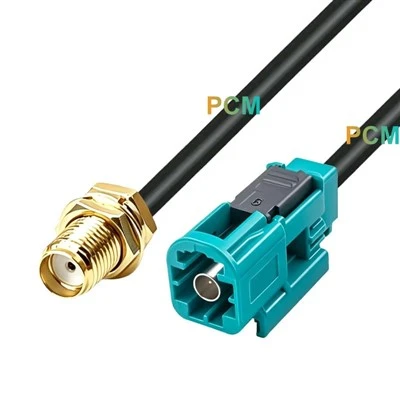
Rosenberger Fakra To SMA Cable
Rosenberger to SMA 50 Ohm coaxial cable with four connector configurations for automotive RF modules, antennas and test
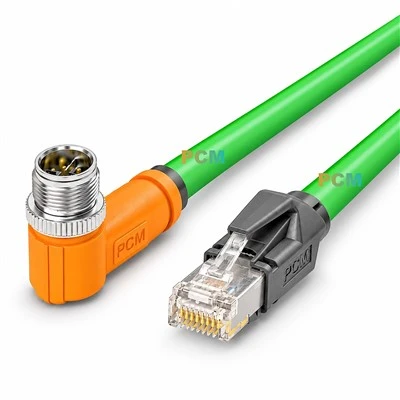
M12 X-Code To RJ45 Cable
M12 X-Code to RJ45 Cat6A cable for 10Gb industrial Ethernet, compatible with X-coded M12 devices, switches and