

一, Technical characteristics of M8 adapter: the cornerstone of communication stability
1. Low contact resistance and high insulation impedance: the "pure channel" for signal transmission
The M8 adapter adopts precision machined gold-plated terminals and PA66 Black rubber cores, with a contact resistance that can be controlled within ≤ 3m Ω (UL 2238 standard allowable value of 15m Ω), and an insulation impedance of over 1000M Ω. This feature ensures that sensor signals (such as torque, position, temperature, etc.) are not affected by poor contact or leakage interference during transmission, especially in the millimeter level alignment error scenario of flexible joints in collaborative robots. Low resistance design can avoid control deviation caused by signal attenuation. For example, in the vibration table test of the Boston Dynamics Atlas robot, the M8 adapter was able to maintain a contact resistance fluctuation of ≤ 3m Ω under random vibrations of 10-2000Hz, providing a stable channel for real-time communication between the servo motor and the controller.
2. Shielding design and anti electromagnetic interference (EMI) capability
There are often strong electromagnetic interference sources such as high-voltage motors and welding equipment in the working environment of robots. The M8 adapter uses a composite shielding structure of "twisted pair shielding layer+metalized plastic shell" to increase the EMI attenuation at a frequency of 1MHz to 62dB (UL 2238 standard baseline value of 50dB). Taking the Lelutong M8 series as an example, its shielding layer adopts tin plated copper braided mesh with a coverage density of ≥ 85%, which can effectively suppress electromagnetic noise in industrial sites. In the automotive welding workshop, the error rate of signal transmission for robot sensors equipped with M8 adapters has been reduced from 0.3% in traditional solutions to 0.02%, significantly improving the accuracy of welding quality monitoring.
3. Compact Structure and High Density Integration: Optimization Solution for Space Constrained Scenarios
The M8 adapter has an outer diameter of only 8mm and a thread specification of M8 × 1, supporting 3-6 core signal/power integration. Compared to M12 connectors, its volume has been reduced by 40%, making it more suitable for small spaces such as robot joints and end effectors. For example, in the joint design of humanoid robots in MIT laboratories, a single joint requires the integration of 12+signal/power channels. The M8 adapter achieves 16 channel wiring inside the 20mm diameter joint through modular stacking design, while meeting IP68 protection level requirements.
二, Industry application scenario: Practical verification of communication stability
1. Industrial Robots: Reliable Connections in Vibration Environments
In the automation production lines of industries such as automobile manufacturing and 3C electronics, industrial robots need to withstand 20G continuous vibration and 50G impact. The M8 adapter achieves mechanical performance with a plug-in force of ≤ 45N (UL 2238 standard upper limit of 80N) and a plug-in accuracy of ± 0.15mm through the patented technology of "third-order point damping structure" and "inclined self compensating buckle". In the vibration test of the Fanuc M-20iA robot, the M8 adapter did not experience any loose contact during its 10-year lifespan (approximately 1 million insertions and removals), ensuring stable communication between the visual sensor and PLC, and maintaining a product defect detection accuracy of over 99.97%.
2. Service robots: anti-interference ability in complex environments
Service robots often work in complex electromagnetic environments such as hospitals and shopping malls. The M8 adapter is designed with IP67/IP69K protection level and a wide temperature range of -40 ℃~125 ℃, which can resist liquid splashing, dust intrusion, and extreme temperature changes. Taking the Ecovacs DiBao X2 as an example, the M8 adapter it is equipped with has reduced the communication interruption time from the traditional 2.3 seconds/hour to 0.1 seconds/hour in WiFi signal interference testing through the coordinated design of the shielding layer and grounding terminal, ensuring the real-time performance of the SLAM navigation algorithm.
3. Humanoid robots: breakthroughs in high-density signal transmission
Humanoid robots require the integration of a large number of sensors (such as force sensing, tactile, inertial measurement units) and actuators (such as joint motors, finger drivers), which place extremely high demands on the signal density of connectors. The M8 adapter integrates a single adapter with 6-channel signal and 2-channel power supply through a "T-shaped/Y-shaped adapter" and a "mixed wiring scheme". In the Tesla Optimus prototype, the M8 adapter is used to connect the leg force sensor to the central controller. Its 0.1mm level contact alignment accuracy and 0.5 μ s level signal delay support real-time computation of the robot gait planning algorithm, improving walking stability by 30%.
How does the M8 adapter ensure the stability of robot communication?
Popular Products

HFM Mini FAKRA Cable
Single channel HFM Mini-FAKRA coaxial cable with female-female, male-male and male-female options for ADAS cameras and

IP67 Waterproof HFM FAKRA Cable
IP67 waterproof HFM to FAKRA cable with 4 connector configurations for automotive cameras, ADAS sensors and RF systems.

Hirose ST Series Connector
Hirose ST Series connector cable assemblies featuring ST40X-10S-CV, ST40X-18S-CV, ST40X-24S-CV and ST40X-36S-CV

GMSL2 FAKRA Z Code Camera Cable
3 m GMSL2 cable with FAKRA Z Code female connectors for camera-to-host, ECU, ADAS and machine vision connections.
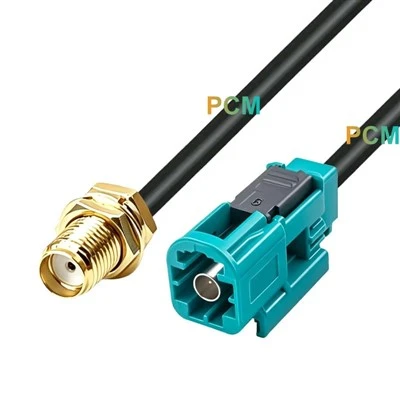
Rosenberger Fakra To SMA Cable
Rosenberger to SMA 50 Ohm coaxial cable with four connector configurations for automotive RF modules, antennas and test
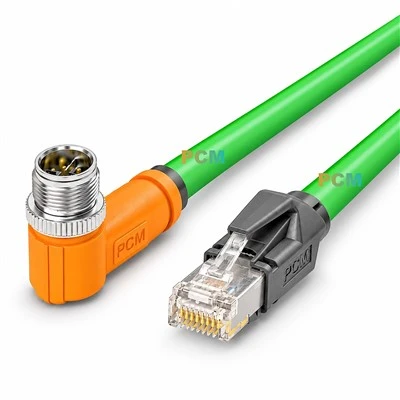
M12 X-Code To RJ45 Cable
M12 X-Code to RJ45 Cat6A cable for 10Gb industrial Ethernet, compatible with X-coded M12 devices, switches and