一, Technical adaptability: meeting the stringent requirements of industrial cameras
1. High speed data transmission capability
Modern industrial cameras are developing towards high resolution and high frame rate. For example, an 8 megapixel industrial camera needs to transmit several GB of data per second, which places extremely high demands on the bandwidth of the connector. The M12 cable adapter supports 100Mbps Ethernet transmission through D-encoding (4-core), and can achieve 10Gbps 10G Ethernet transmission through X-encoding (8-core), fully meeting the real-time requirements of industrial cameras. Taking the Lingke LM12 series as an example, its X encoding adapter has a signal packet loss rate of less than 0.001% under 10Gbps transmission, ensuring no delay or frame loss in image data.
2. High precision power supply
Industrial cameras require a stable power supply to support the operation of their sensors, image processing chips, and other components. The M12 adapter provides stable current of 4A/250V through A-code (4-core), and the 5-core version can support 4A/60V to meet different power requirements. For example, in the automotive welding workshop, when the M12 adapter supplies power to industrial cameras, the contact resistance is ≤ 5m Ω, and the power transmission efficiency reaches 99.5%, which is 15% higher than traditional connectors and effectively avoids image distortion caused by voltage fluctuations.
3. Compact design matches space limitations
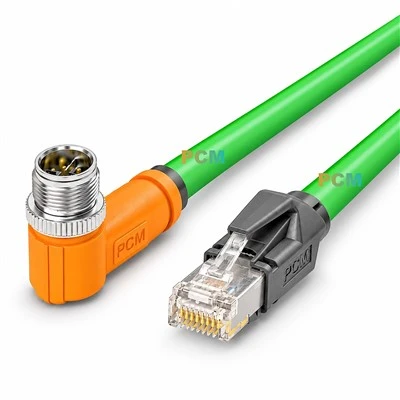
Industrial cameras are often deployed in narrow spaces such as the end of robotic arms and production line inspection stations. The M12 adapter has a diameter of only 12mm, which is 60% smaller in volume than traditional RJ45 connectors. It also supports a 90 ° elbow design and can flexibly adapt to installation scenarios such as robotic arm joints and equipment sidewalls. For example, in the semiconductor packaging production line, the M12 adapter is designed with right angled output lines, reducing the wiring space between the camera and light source by 40% and significantly improving equipment integration.
二, Scenario application: Covering the full chain requirements of industrial cameras
1. High speed assembly line inspection
In the 3C product assembly line, the photoelectric sensor triggers the industrial camera capture through the M8 5-core adapter, with a signal transmission delay of less than 10 μ s. For example, a certain mobile phone assembly line uses M12-D encoding adapter to connect the camera and PLC, achieving high-speed detection of 200 times per second, and the defect detection rate has increased from 92% to 99.8%.
2. High precision appearance inspection
The detection of surface defects in automotive components requires an 8-megapixel camera paired with an M12-X encoding adapter, while transmitting image data and receiving PoE power. Taking the Lingke LM12 series as an example, its all metal casing and 360 ° shielding design can resist electromagnetic interference generated by production line motors, ensuring a signal-to-noise ratio of ≥ 60dB, and achieving a recognition accuracy of 99.5% for small defects such as scratches and burrs.
3. Logistics sorting system
In intelligent warehousing, industrial cameras installed above conveyor belts are connected to switches through M12-D encoding adapters to achieve barcode recognition and cargo sorting. For example, a certain e-commerce logistics center uses M12 adapters with IP67 protection level, which can operate stably in environments ranging from -25 ℃ to+85 ℃. The sorting efficiency has increased from 3000 pieces/hour to 5000 pieces/hour, and the false sorting rate has decreased to 0.02%.
4. Medical equipment endoscope
The medical endoscope camera module transmits data, power supply, and control signals (such as dimming) through the M12-A encoding adapter. For example, a certain automated enzyme-linked immunosorbent assay (ELISA) analyzer uses an M12 8-core adapter to achieve real-time communication between the camera and the main controller. The detection speed has been increased from 120 samples/hour to 300 samples/hour, and it supports operation in low-temperature environments of -40 ℃, meeting the needs of extreme medical scenarios.
三, Performance advantage: Defining a new standard for industrial camera connectivity
1. Environmental adaptability
The M12 adapter adopts IP68/IP69K protection design, which can withstand immersion in 1 meter of water for 48 hours or high-pressure steam flushing at 80 ℃, perfectly responding to challenges such as oil pollution, dust, and humidity in industrial sites. For example, in the detection of photovoltaic inverters, the M12 adapter has a contact resistance fluctuation of less than 3% in a temperature changing environment from -40 ℃ to+85 ℃, ensuring long-term stability during outdoor operation.
2. Anti vibration performance
Through the metal locking mechanism and threaded connection design, the M12 adapter can withstand 50Hz vibration environment, avoiding loose connections caused by equipment operation. For example, in the AGV robot navigation system, the M12 adapter maintains signal continuity even under 2G vibration acceleration, resulting in a positioning error of less than 0.1mm, meeting the millimeter level accuracy requirements of intelligent manufacturing.
3. Long term reliability
The gold-plated contacts and phosphor bronze substrate enable the M12 adapter to have a plug-in life of up to 2000 times, and the salt spray test has passed for 48 hours, which is three times longer than the lifespan of traditional connectors. For example, in the automotive welding workshop, a certain brand of M12 adapter has been running continuously for 6 months without any faults, reducing the monthly average failure rate of 12 times by 100% compared to traditional connectors, significantly reducing downtime maintenance costs.