一, Core difference: differentiation from design logic to application scenarios
1. Physical structure and protection level
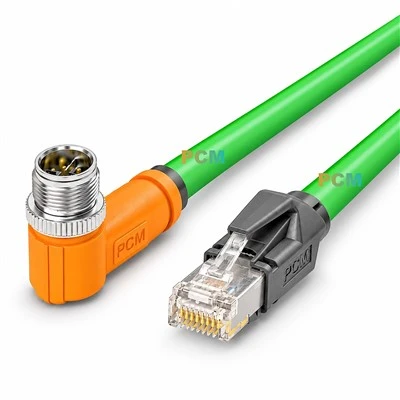
RJ45 adopts a rectangular design with dimensions of approximately 21.5mm × 11.7mm × 15mm, relying on plastic buckles for fixation. The protection level is generally IP20, making it difficult to resist dust, water, and oil erosion. Although its metal contacts have been enhanced for oxidation resistance through gold plating, they are still prone to failure in humid or corrosive environments. For example, a 3C factory experienced a 2-hour shutdown of its SMT production line due to water ingress into the RJ45 interface, exposing its shortcomings in environmental adaptability.
The M12 connector features a cylindrical design with a diameter of 12mm as its core, and achieves physical stability through a metal thread locking mechanism. Its protection level generally reaches IP67/IP69K, and it can withstand high-pressure water flushing and extreme temperature differences. For example, the LM12 cable components of Lingke Electric use integrated molding technology and have passed salt spray testing certification, demonstrating excellent performance in scenarios such as photovoltaic power plants and chemical plants. Its hexagonal arc-shaped locking outer ring design disperses the operating force, avoids slipping in narrow spaces, and further improves installation efficiency.
2. Transmission performance and anti-interference ability
RJ45 supports transmission rates from 10Mbps to 10Gbps, but long-distance high-frequency signals are susceptible to interference. In workshops with dense frequency converters and motors, the bit error rate often exceeds 10 ⁻⁶, making it difficult to meet the zero latency requirements of industrial equipment. In addition, RJ45 has poor EMC performance, limited overlap area between its metal casing and socket, high impedance at high frequencies, and cannot form effective shielding, making it a weak point for system radiation emission.
The M12 connector matches transmission requirements through differentiated encoding (D encoding, X encoding): D encoding supports 100Mbps Ethernet, while X encoding is designed for Gigabit and above, supporting 10Gbps transmission (Cat.6A cable, 100 meters distance), and has stronger anti-interference ability. For example, the Zhengcheng Electric X-code M12 connector has passed PNO user organization certification and can suppress crosstalk to below -65dB in a bandwidth of 500MHz, meeting real-time protocol requirements such as Profinet IRT and EtherCAT. Its 360 ° fully shielded design forms a Faraday cage through an integrated structure of metal casing and plug, maximizing the suppression of electromagnetic noise radiation.
3. Mechanical lifespan and reliability
The plug and unplug life of RJ45 is usually 500-2500 times, and high-end products can reach 5000 times, but it is prone to loosening in vibration scenarios. For example, in scenarios where the robotic arm operates at high frequencies (10-500Hz vibration), the RJ45 interface is prone to signal interruption due to buckle failure.
The plugging and unplugging life of M12 connectors generally reaches 1000-5000 times, and a qualitative leap in anti vibration performance is achieved through the thread locking mechanism. Actual test data shows that the vibration resistance of M12 is 5 times that of RJ45, and the failure rate is only 1/5 of the latter. For example, in the signal control system of rail transit, the M12 connector can ensure millisecond level response of the train positioning system, even maintaining signal stability at a speed of 380km/h.
二, Alternative feasibility: scenario driven technology selection
1. Industrial automation and intelligent manufacturing
In industrial camera vision systems, PLC controllers, and other scenarios, M12 connectors have become the preferred choice. It supports zero latency transmission of 120 frames per second of images and is 60% smaller in size than RJ45, making it particularly suitable for space constrained scenarios such as robot joints and vehicle systems. For example, in AGV robots, the M12 connector can simultaneously transmit navigation signals (24V control signals) and driving power (16A/63V DC), reducing wiring complexity by 60%.
RJ45 is only suitable for indoor low interference environments, such as office LANs or lightweight automation equipment, due to its low protection level and poor vibration resistance.
2. New energy and power system
In the charging station system, the M12 connector can achieve real-time communication between the charging gun and the BMS control unit. Its high and low temperature resistance (-40 ℃ to+85 ℃), corrosion resistance, and ability to cope with the dual challenges of outdoor temperature difference and humidity. For example, photovoltaic inverters need to operate stably under a temperature difference of -40 ℃ to+85 ℃, and M12 connectors have passed UL94 V-0 flame retardant certification to ensure safety in extreme environments.
Although RJ45 can improve its protection level through industrial grade modifications such as adding sealing rings and using shielded cables, the cost significantly increases and it still cannot match the mechanical reliability of M12.
3. Rail transit and onboard systems
In the vehicle Ethernet, the M12 connector supports ADAS system data transmission and its shock resistance can withstand 15g shock vibration, meeting the ISO 7637-2 standard. For example, in the high-speed rail signal control system, the M12 connector is designed with dual redundant locking (thread+hexagonal locking ring+rubber seal), which improves the connection stability by 90% in vibration environments.
Due to the inherent defects of the snap on locking structure, RJ45 is difficult to meet the stringent requirements of in car scenarios.
三, Cost and Ecology: The Hidden Threshold of Substitution
Although M12 outperforms RJ45 in terms of performance, its cost is still 3-5 times that of the latter. In addition, with decades of popularity, RJ45 has formed a huge ecosystem, including inexpensive Ethernet cables, standardized tools, and mature cabling solutions. In non harsh industrial scenarios, the cost advantage of RJ45 remains attractive.
However, with the deepening of Industry 4.0, the demand for stability in device interconnection is becoming increasingly prominent. The M12 connector is gradually lowering the threshold for replacement through modular design (such as the flexible combination of 2-12 cores in Lingke LM12), standardized interface (IEC 61076-2-101), and intelligent upgrade (integrated temperature sensor). For example, in the high-end manufacturing field, M12 connectors have broken through the spatial limitations of 7-axis linkage scenarios and become a standard configuration for industrial robotic arms.