1, Encoding type and pin configuration: adapted to different actuator requirements
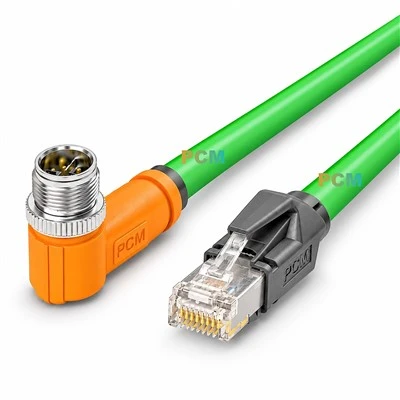
The encoding type of the M12 adapter determines its pin function and transmission protocol, and the actuator selects the corresponding encoding based on the signal type:
A code (3-5 pins): suitable for sensors and low-power actuators
A code is the origin code of M12, supporting 3-5 pin configurations, commonly used for transmitting analog signals or low-power digital signals. For example, in pneumatic actuator control, the 3-pin A-code adapter can transmit switch signals (such as valve opening and closing status), while the 5-pin version can simultaneously transmit power and feedback signals. The STA-M12LS series from Shenzhen Sida Electronics provides 4-pin and 5-pin A code adapters, supporting 24V DC power supply and signal co line transmission, widely used in small actuators in automated production lines.
D-code (4-pin): Standard selection for industrial Ethernet actuators
D encoding is designed specifically for Ethernet, with a 4-pin configuration supporting a transmission rate of 100Mbps/1Gbps, meeting the requirements of protocols such as Profinet and EtherCAT. In the servo motor drive system, the D-code adapter achieves synchronous transmission of high-speed control commands and status feedback through differential signal transmission. For example, a wind power variable pitch system uses an 8-pin D-code adapter, with 4 pins used for Ethernet communication and the other 4 pins providing 24V power to ensure real-time interaction between the pitch motor and the main control system.
X-encoding (8-pin): Future solution for high bandwidth actuators
X encoding supports a transmission rate of 10Gbps and is suitable for high bandwidth actuators such as vision systems and LiDAR. In industrial robotic arms, X-code adapters can simultaneously transmit multiple camera data and control signals, meeting the real-time requirements of 7-axis linkage scenarios. The LM12-X series of Lingke Electric adopts a four pair differential line design, with differential impedance strictly controlled at 100 Ω± 10% to ensure signal integrity.
K/L encoding (5-pin): power solution for high-power actuators
K encoding (4+PE) and L encoding (4+PE, 16A per pole) are designed specifically for high-power actuators, supporting 630V AC/DC voltage and 16A current transmission. In hydraulic systems, the L-code adapter can provide stable power supply for proportional valves, while also implementing grounding protection through PE needles to avoid control deviations caused by electromagnetic interference.
2, Connection method: Balancing installation efficiency and reliability
The installation environment of the actuator varies significantly, and the M12 adapter provides multiple connection methods to adapt to different scenarios:
IDC no stripping connection: the first choice for rapid deployment
IDC (Insulation Displacement Connection) technology uses a blade to directly pierce the insulation layer of a wire, achieving fast connection without the need for wire stripping. In the wiring of AGV onboard actuators, IDC adapters can shorten installation time by 70% and stabilize contact resistance below 5m Ω. Phoenix Contact's SAC series pre assembled cables use IDC technology and pass 100% electrical testing, eliminating on-site wiring quality risks.
Screw connection: a reliable choice for high vibration environments
Screw connections ensure contact stability through mechanical compression and are suitable for scenarios where vibration acceleration exceeds 5g. In the wind power variable pitch system, the screw type D-code adapter can withstand continuous vibration, with a plug-in life of over 500 times and a failure rate only 1/5 of traditional RJ45 interfaces.
Spring connection: a convenient solution for small spaces
The spring type connection achieves tool free insertion and removal through elastic contacts, making it suitable for installing actuators with limited space. For example, at the joints of collaborative robots, the spring-loaded A-code adapter can achieve a 90 ° bend for outgoing lines, avoiding collisions between cables and moving parts, and supporting quick replacement with one hand.
3, Application scenario: Covering actuator requirements across the entire industry
The M12 adapter has a wide range of application scenarios, and the following are typical industry cases:
Industrial automation: standardized connection between PLC and actuator
In the PLC control cabinet, the straight head M12 adapter can be vertically inserted into the panel, saving lateral space and achieving dense arrangement of multiple interfaces. For example, a certain automobile welding workshop uses 200 pre connected D-code adapters to stabilize the transmission delay of control signals within 10ms, meeting millisecond level response requirements.
In the field of new energy: reliable transmission of photovoltaic inverters and charging piles
Photovoltaic inverters need to withstand a temperature difference of -40 ℃ to+85 ℃. Lingke Electric's LM12 series uses UL94V-0 flame retardant materials and salt spray testing certification to ensure long-term stable outdoor operation. In the charging station system, the X-code adapter supports 10Gbps real-time communication between the charging gun and BMS control unit, meeting the requirements of fast charging protocol.
Rail Transit: Millisecond Response of Train Positioning System
The track signal control requires the actuator response time to be less than 1ms. The M12 adapter improves the connection stability by 90% through a dual redundant locking structure (thread+hexagonal locking ring), ensuring the data reliability of the train positioning system during high-speed operation.
4, Customized solution: precise matching of special needs
For non-standard actuators, suppliers provide flexible customized services:
Pin and coding extension: Supports 3-12 pin free configuration, covering special signal transmission requirements. For example, a medical equipment manufacturer customizes a 12 pin M12 adapter to simultaneously transmit power, Ethernet, and analog signals, simplifying device interface design.
Cable material selection: PVC, PUR, shielded wire and other options are available to adapt to different environments. In the chemical workshop, PUR sheathed adapters can withstand oil stains and acid-base corrosion, while shielded wire versions can suppress high-frequency interference generated by frequency converters.
Integrated design: Integrate the adapter and cable through injection molding to eliminate on-site wiring errors. DeSuo Precision Industry's customized service supports delivery from design to sample within 5 working days, and has passed multiple certifications such as ISO9001, RoHS, CE to ensure consistency in mass production.