

一, Functional positioning: The core difference between connectors and adapters
1. M8 connector: the "physical interface" for industrial signal transmission
The M8 connector is a circular electrical connector designed specifically for industrial environments, with its core function being to achieve reliable transmission of signals and power between devices. This product adopts the M8 × 1.0 standard thread specification and ensures connection stability through thread coupling. Typical application scenarios include:
Sensor network: connects low-voltage devices such as photoelectric switches and encoders, supports 3-8-core signal transmission, and has a rated voltage coverage of 24V-30V (AC/DC).
Mechanical wiring system: It realizes power distribution and signal relay in construction machinery and conveyors, and some models have IP68 protection level, which can adapt to outdoor humid environments.
Industrial Ethernet: Models equipped with EtherCAT protocol can be paired with PUR cables to achieve high-speed data transmission in drag chain environments.
Its technological advantages are reflected in:
Environmental adaptability: IP67 basic protection level is achieved through epoxy resin sealing technology, and special models can withstand extreme temperatures from -40 ℃ to+105 ℃.
Anti misplacement design: Adopting a female head notch and male head protrusion structure, combined with A/B/D coding identification, to avoid the risk of mismatch in different application scenarios.
Modular expansion: supports multiple configurations such as straight head/elbow, screw end connection/panel installation, etc., and can flexibly adapt to installation scenarios with limited space.
2. Cable adapter: a "medium converter" for network transmission
Cable adapters (such as power line adapters) belong to the category of communication equipment, and their core function is to achieve data transmission through existing power lines, solving the problems of high wiring costs and poor flexibility in traditional wiring. Typical applications include:
Home network expansion: Using wall sockets to achieve cross floor networking, supporting high bandwidth requirements such as high-definition streaming media and online gaming.
Industrial Internet of Things: Building a sensor network based on PLC (power line communication) in factory environments to avoid the impact of electromagnetic interference on wireless signals.
Intelligent buildings: transmit command signals for lighting control, security monitoring and other systems through power lines to reduce wiring workload.
Its technical features include:
Frequency division multiplexing technology: Using OFDM modulation technology, the data signal is superimposed onto the power line current to achieve a physical transmission rate of 500Mbps.
Plug and play feature: The single meter circuit can automatically network, with a transmission distance of up to 300 meters, and is compatible with the 802.11N wireless standard.
Security encryption mechanism: AES encryption is used to ensure data transmission security and avoid signal attenuation when crossing air switches or three-phase circuits.
二, Comparison of Technical Characteristics: Differences from Physical Layer to Protocol Layer
1. Structure and Materials
M8 connector: The shell is made of nickel plated brass or stainless steel material, and the contacts are made of gold-plated copper alloy, ensuring low contact resistance (<5m Ω) in vibration and impact environments. Some high-end models use PUR molded shells to enhance wear resistance.
Cable adapter: The main body is made of flame-retardant ABS plastic, with an integrated power line communication module and wireless network card inside. Its anti-interference ability needs to be verified through EMC testing.
2. Transmission medium
M8 connector: relies on dedicated cables (such as PUR sheathed cables) to transmit electrical signals, supports custom wire lengths (1-10 meters) to meet equipment layout requirements.
Cable adapter: Using power lines as the transmission medium, no additional wiring is required, but the transmission quality is significantly affected by line noise and electrical equipment interference.
3. Certification standards
M8 connector: requires industry certifications such as UL (US), CE (EU), IEC 61076-2-104, etc. to verify electrical safety, flame retardant performance, and environmental adaptability.
Cable adapter: It must comply with power line communication standards such as HomePlug AV and IEEE 1901, and pass radio spectrum certifications such as FCC (US) and CE (EU).
三, Industry Application: Scenario based Selection Guide
1. Industrial automation scenarios
In the automotive manufacturing production line, the M8 connector is used to connect the force sensor on the robot arm to the PLC control system. Its IP67 protection level can resist cutting fluid splashing, and the threaded coupling design ensures stable connection even under high-frequency vibration. In contrast, cable adapters are more suitable for monitoring camera network deployment, enabling video signal feedback through existing power lines and avoiding interference from independent wiring on the production process.
2. Intelligent building scenarios
In building automation systems, M8 connectors are commonly used for HVAC valve control. Their compact 8mm size can be embedded in small spaces, while the 3-5 core configuration meets the transmission requirements of multiple parameters such as temperature, humidity, and pressure. Cable adapters are used in intelligent lighting systems, transmitting dimming commands through power lines to achieve seamless coverage without damaging walls.
3. Outdoor equipment scene
The sensor network of the solar tracking system needs to operate stably in an environment of -35 ℃ to+85 ℃, and the M8 connector meets the requirements through PVC+GF composite material shell and epoxy resin sealing process. If outdoor monitoring cameras use cable adapters, they need to solve the interference problem of power line noise on high-definition video transmission, and usually need to be used in conjunction with signal repeaters.
What is the difference between M8 connector and cable adapter?
Popular Products

HFM Mini FAKRA Cable
Single channel HFM Mini-FAKRA coaxial cable with female-female, male-male and male-female options for ADAS cameras and

IP67 Waterproof HFM FAKRA Cable
IP67 waterproof HFM to FAKRA cable with 4 connector configurations for automotive cameras, ADAS sensors and RF systems.

Hirose ST Series Connector
Hirose ST Series connector cable assemblies featuring ST40X-10S-CV, ST40X-18S-CV, ST40X-24S-CV and ST40X-36S-CV

GMSL2 FAKRA Z Code Camera Cable
3 m GMSL2 cable with FAKRA Z Code female connectors for camera-to-host, ECU, ADAS and machine vision connections.
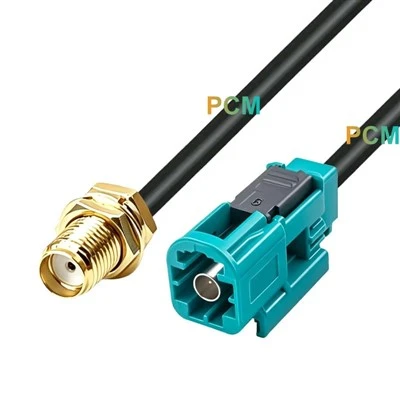
Rosenberger Fakra To SMA Cable
Rosenberger to SMA 50 Ohm coaxial cable with four connector configurations for automotive RF modules, antennas and test
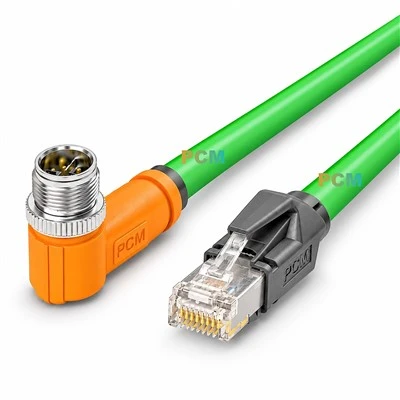
M12 X-Code To RJ45 Cable
M12 X-Code to RJ45 Cat6A cable for 10Gb industrial Ethernet, compatible with X-coded M12 devices, switches and