一, Technical standard: Dual adaptation of international certification and industrial scenarios
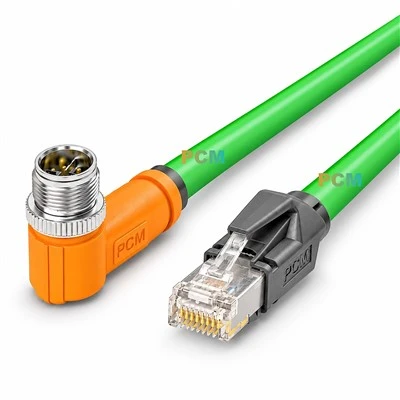
The L-code M12 adapter strictly follows the IEC 61076-2-11 international standard and has passed UL2238 certification (for the North American market) to ensure its compliance in global industrial environments. The core design parameters include:
Rated current: 16A (DC 63V) or 12A (AC 630V), meeting the requirements of high-power equipment;
Protection level: IP67/IP68, can resist dust, water immersion, and high-pressure flushing;
Anti vibration design: M12 * 1 locking thread structure, passed 1 million insertion and extraction tests, suitable for vibration scenarios;
Cable specifications: Supports wires with a maximum cross-sectional area of 2.5mm ² to reduce resistance losses.
Taking TE Connectivity's L-code PROFINET cable assembly as an example, it has been certified by PNO (PROFIBUS&PROFINET International) and has become the designated solution for 24V power supply systems in the PROFINET standard. This component adopts a 360 ° shielding design, achieving 63V DC/16A transmission within a length of 0.5 to 1 meter, with a contact resistance of only 5m Ω, significantly improving power supply efficiency.
二, Application scenario: Covering the entire industrial automation chain
The core value of the L-code M12 adapter lies in its "small size, high current" characteristics, making it the preferred solution for the following scenarios:
1. Power supply for PROFINET system components
PROFINET, as the mainstream protocol of industrial Ethernet, has extremely high requirements for real-time and stable power transmission. The L-code adapter simplifies system wiring by integrating power and data transmission functions. For example, in the welding robot system of an automobile manufacturing plant, the L-code adapter provides 24V DC power to the servo drive, while transmitting 10Gbps control signals through the X-code M12 interface, achieving coaxial transmission of "electrical data" and reducing the number of cables by more than 30%.
2. Power supply for I/O modules and sensor arrays
In distributed control systems, a large number of I/O modules require independent power supply. The L-code adapter can supply power to multiple modules simultaneously through a multi port design (such as a 5-core structure). The monitoring system of a certain photovoltaic power station uses L-code adapters to power 200 temperature sensors, maintaining a voltage fluctuation rate of 0.1% in an environment of -40 ℃ to+85 ℃ to ensure data acquisition accuracy.
3. DC small driver power supply
Devices such as frequency converters and stepper motor drivers require stable DC power supply. The gold-plated contact design of the L-code adapter (contact resistance<1m Ω) can reduce heat generation. For example, in the lubrication pump control system of a wind turbine gearbox, the L-code adapter provides 16A current to the driver. After continuous operation for 2 years, the contact temperature only rises by 5 ℃, far below the industry safety threshold.
4. Power supply for mobile devices and robots
Mobile devices such as AGVs (Automated Guided Vehicles) and collaborative robots require compact power interfaces. The threaded locking structure of the L-code adapter can prevent vibration disengagement. The AGV system of a certain logistics warehouse uses an L-code adapter to power the laser navigation module. Under 5g vibration acceleration, the connection stability reaches 99.99%, and the error rate is less than 10 ⁻¹ ².
三, Performance advantage: Breaking through the bottleneck of traditional power transmission
The L-code M12 adapter solves industry pain points through three major technological innovations:
1. Space efficiency improvement
Compared to traditional 7/8-inch power interfaces, the L-code M12 adapter has reduced its size by 60% and weight by 45%. In the train control system of rail transit, the use of L-code adapters reduces the volume of the distribution box from 0.5m ³ to 0.2m ³, freeing up installation space for other equipment.
2. Optimization of heat dissipation performance
High power transmission can easily cause connector overheating. The L-code adapter reduces temperature rise through the following design:
Thermal conductive material: using aluminum magnesium alloy shell, with a thermal conductivity of 156W/(m · K);
Structural heat dissipation: Fill thermal conductive silicone grease between the contact and the shell, reducing the thermal resistance to 0.5K/W;
Aerodynamic design: Install heat dissipation slots at the locking thread to improve convection efficiency.
The monitoring system test of a blast furnace in a certain steel plant shows that the L-code adapter has a surface temperature 12 ℃ lower than the traditional interface when running at 16A full load, avoiding power interruption caused by overheating.
3. Electromagnetic compatibility (EMC) enhancement
There is strong electromagnetic interference in industrial environments. The L-code adapter improves signal integrity through the following measures:
Double layer shielding: inner aluminum foil shielding+outer galvanized steel woven mesh, with a shielding efficiency of 80dB (1GHz);
Filter design: Integrate common mode inductance at the power input end to suppress noise from 100kHz to 30MHz;
Grounding optimization: Using a 360 ° metal shell grounding to reduce contact resistance to 0.1m Ω.
In the radiation monitoring system of a nuclear power plant, the L-code adapter successfully isolated the 150kHz harmonic interference generated by the frequency converter, ensuring a sensor data accuracy of 99.99%.