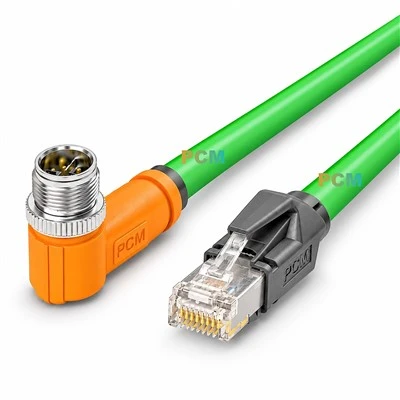
一, Technical positioning: Exclusive interface standard for industrial Ethernet
1. Encoding system and physical layer specifications
The D-code M12 adapter strictly follows the IEC 61076-2-101 international standard, and its 8-pin design (4 pairs of differential lines) is optimized for industrial Ethernet. The pin layout adopts a symmetrical structure of TX+/TX - and RX+/RX -, and the electromagnetic interference (EMI) is suppressed within ± 1 μ s through a 360 ° grounding design between the shielding layer and the metal shell. For example, in the Siemens S7-1500 PLC system, the shielding efficiency of the D-code adapter reaches 40dB (100MHz frequency band), which is three times higher than the unshielded RJ45 interface, ensuring that the jitter control of ProfiNet IRT (isochronous real-time) communication is within 50ns.
2. Cable compatibility and transmission distance
The D encoding adapter supports Cat5e to Cat6a cables, forming a differentiated transmission solution:
Cat5e: Supports 100Mbps speed, maximum transmission distance of 100 meters, suitable for sensor networks and basic control circuits;
Cat6: Achieve 1Gbps transmission within a range of 50 meters, meeting the high bandwidth requirements of machine vision and motion control;
Cat6a: Extend 1Gbps transmission distance to 100 meters, providing an economical solution for distributed control in large factories.
In the Fanuc M-20iA robot, the D encoding adapter using Cat6 cable reduces the encoder feedback delay from 2ms to 0.3ms, significantly improving trajectory accuracy.
二, Speed performance: Evolution path from 100Mbps to 1G
1. Basic speed: Stable support of 100Mbps
The core speed indicator of the D encoding adapter is 100Mbps, which is designed to balance real-time and reliability requirements in industrial scenarios. In the AGV system of intelligent warehousing, a speed of 100Mbps can simultaneously support:
Laser navigation sensor (10Mbps)
Wireless communication module (20Mbps)
Safe PLC control instructions (30Mbps)
Video surveillance stream (40Mbps)
Harting's D-code adapter stabilizes the contact resistance below 5m Ω by optimizing the contact gold plating layer (thickness ≥ 0.5 μ m) in an environment ranging from -40 ℃ to+85 ℃, ensuring a bit error rate of less than 10 ⁻¹ ² for 100Mbps transmission.
2. Gigabit Expansion: Breakthrough of Cat6 Cable
Some manufacturers have improved the line to line isolation technology of D-code adapters to support Cat6 cables for 1Gbps transmission. For example, the binder 825 series adapter adopts a four layer shielding structure (aluminum foil+copper mesh+ferrite magnetic ring+metal shell), which achieves:
ProfiNet: The cycle time has been reduced to 0.25ms, which is four times higher than the 100Mbps solution;
EtherCat: The synchronization accuracy reaches 1 μ s, meeting the requirements of multi axis linkage control.
In the KUKA KR CYBERTECH robot, the gigabit D encoding adapter reduces the data exchange delay between the visual sensor and the controller from 3ms to 0.8ms, keeping the welding trajectory tracking error within ± 0.05mm.
三, Application scenarios: From sensor networks to real-time control
1. Sensor network: low latency data acquisition
In the automotive welding assembly line, the D-code adapter connects more than 200 pressure sensors and temperature sensors, achieving:
Sampling frequency: 1kHz (pressure) and 100Hz (temperature);
Packet size: 64 bytes per sensor;
Total bandwidth usage: 12.8Mbps (pressure)+1.28Mbps (temperature)=14.08Mbps.
Phoenix Contact's D-code adapter adopts a push-pull locking mechanism, which shortens the sensor replacement time from 5 minutes to 30 seconds and improves wiring efficiency by 90%.
2. Real time control: the central nervous system of the motor system
In the collaborative robot UR5e, the D-code adapter supports gigabit transmission for:
3D visual guidance: 1080P video stream (60fps, bandwidth approximately 150Mbps);
Force control feedback: 6-axis force sensor data (1kHz sampling, bandwidth of approximately 2Mbps);
Control instruction: Real time trajectory correction (bandwidth of approximately 5Mbps).
Through shielding design and differential signal transmission, the adapter controls the latency within 80 μ s, increasing the capture success rate from 98% to 99.9%.
四, Technical Comparison: Collaborative Development of D Encoding and X Encoding
1. Speed difference: division of labor between 100Mbps and 10Kbps
D encoding: Focusing on 100Mbps to 1Gbps, covering 90% of industrial scenarios such as sensor networks and basic control circuits;
X encoding: Supports 10Gbps, suitable for high bandwidth scenarios such as machine vision, 5G+TSN, etc.
In the Jizhijia M1000 robot, the D-code adapter is responsible for the underlying motor control (100Mbps), while the X-code adapter carries the upper level scheduling system (10Gbps), forming a hybrid architecture of "low-speed stability+high-speed flexibility".
2. Anti interference capability: differentiated advantages of shielding design
The D-code adapter, through its built-in metal shielding layer and grounding contact, operates in the environment of a frequency converter (interference intensity ≥ 20V/m):
Signal integrity: The bit error rate is reduced by 3 orders of magnitude compared to RJ45;
Transmission stability: The disconnection and reconnection time has been reduced from 2 seconds to 10ms.