1, Core Framework of ATEX Certification: Explosion proof System from Directive to Standard
ATEX certification originates from the EU Directive on Equipment and Protective Systems for Potential Explosive Environments (2014/34/EU), which replaced the 1994 Directive 94/9/EC and established a system of explosion-proof technical regulations covering both mine and non mine equipment. The core logic is to unify the safety requirements of explosion-proof equipment in the European market through a dual mechanism of "technical regulations+coordinated standards":
At the level of technical regulations: The directive specifies that equipment must meet the Basic Health and Safety Requirements (EHSR), including preventing ignition sources, limiting the spread of explosive energy, and mandating that equipment must bear the CE mark before entering the EU market.
At the level of coordinating standards: The European Organization for Standardization (CEN/CENELEC) develops standards such as EN 60079 series (electrical equipment) and EN 13463 series (non electrical equipment), refining technical details such as explosion-proof design and testing methods. For example, EN 60079-0 stipulates that equipment must be verified for explosion-proof performance through spark tests, temperature tests, etc.
ATEX certification categorizes equipment into two main types:
Group I: Mining equipment, further divided into M1 (very high protection level) and M2 (high protection level);
Group II: Non mining equipment, classified into Category 1 (very high protection level), Category 2 (high protection level), and Category 3 (normal protection level) based on the frequency and duration of explosive environments.
2, Explosion proof requirements for M12 cable adapters: a comprehensive upgrade from structure to materials
In explosive environments, the explosion-proof design of M12 adapters needs to address two core issues:
Prevent internal ignition source leakage: The metal contacts inside the adapter may generate electrical sparks when plugged in or powered on, and the ignition source needs to be isolated through explosion-proof enclosures, increased safety designs, or intrinsic safety circuits (such as limiting current/voltage).
Limiting the surface temperature of the casing: The heat generated during equipment operation may ignite surrounding combustibles, and material selection (such as stainless steel casing) and heat dissipation design should be used to ensure that the surface temperature is lower than the ignition temperature of combustibles (such as T4 group requirement ≤ 135 ℃).
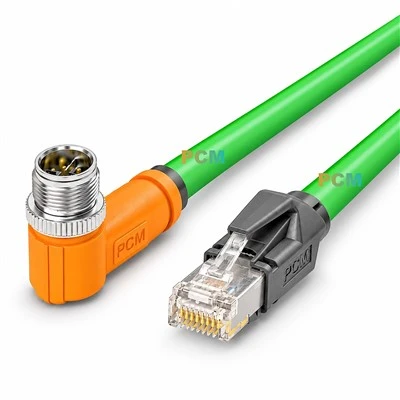
Taking the M12 explosion-proof adapter of a certain brand as an example, its design needs to meet the following ATEX requirements:
Structural protection: Adopting IP67 protection level to prevent dust from entering the interior; Shell thickness ≥ 2mm, capable of withstanding internal explosive pressure without rupture;
Material selection: The contact parts are made of gold-plated copper alloy to reduce contact resistance and heat generation; The shell is made of 316L stainless steel, which is corrosion-resistant and has excellent thermal conductivity;
Temperature control: Optimize the heat dissipation structure through thermal simulation to ensure that the surface temperature is ≤ 120 ℃ under 16A current (compliant with T4 group);
Certification mark: The shell is engraved with the "Ex d IIC T4 Gb" mark, indicating that it is suitable for Class IIC gas environment (such as hydrogen), T4 temperature group, and is a flameproof type (d) equipment.
3, ATEX certification process: strict control from design to production
The M12 adapter needs to go through the following key steps to obtain ATEX certification:
Risk assessment: Determine the protection level based on the equipment usage scenario (such as Zone 0, Zone 1 or Zone 20, Zone 21), and select the applicable explosion-proof type (such as flameproof, increased safety, intrinsic safety).
Design verification: Conduct type tests according to the EN 60079 series standards, including:
Spark test: Simulate the worst-case conditions (such as short circuit, overload) to verify whether the electric spark can ignite the standard mixed gas;
Temperature test: Continuously operate at rated current and measure whether the surface temperature of the shell is lower than the ignition temperature;
Mechanical strength test: Apply impact and vibration to the explosion-proof shell to verify its integrity.
Production control: Establish a quality management system (such as ISO 9001) to ensure that each batch of products is consistent with the submitted samples. For example, a certain factory controls the thickness of the gold plating layer (± 0.5 μ m) through an automated production line to avoid excessive contact resistance.
Announcement body review: EU authorized institutions (such as T Ü V, SGS) review technical documents, test reports, and production processes, and issue ATEX certificates after passing the review.
4, The Value of ATEX Certification in the M12 Adapter Market: Dual Enhancement of Safety and Competitiveness
Market access: The EU market purchases approximately 3 billion euros of explosion-proof equipment annually, and ATEX certification is a mandatory requirement to enter this market. For example, a Chinese manufacturer's M12 adapter did not pass ATEX certification, resulting in its inability to participate in European petrochemical project bidding.
Safety guarantee: In an explosion accident at a chemical plant in Germany, an uncertified M12 adapter caused electrical sparks due to poor contact, igniting leaked ethylene gas and causing significant losses; The production line using ATEX certified adapters has not been affected, highlighting the safety value of certification for personnel and equipment.
Technological upgrade: ATEX certification drives the development of M12 adapters towards high performance. For example, a certain brand has launched an X-code explosion-proof adapter that supports 10Gbps transmission. After passing ATEX certification, it has been successfully applied to high-speed data acquisition systems in European wind farms.