1, Technical features of M12 cable adapter: tailor-made for smart factories
The M12 cable adapter belongs to the category of industrial grade circular connectors, and its core design revolves around the three major requirements of smart factories:
Miniaturization and high-density integration
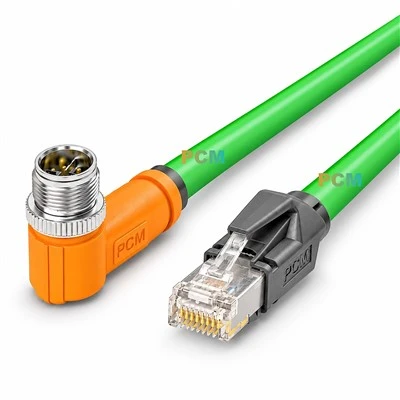
The diameter of the M12 connector is only 12mm, which is 60% smaller than the volume of traditional industrial interfaces. In smart factories, space constrained scenarios such as robot joints, AGV cars, and onboard control systems are extremely sensitive to connector size. For example, Lingke Electric's LM12 cable assembly adopts a 90 ° bending angle design, which can perfectly adapt to the narrow installation space of robotic arms. It also supports flexible combinations of 2-12 cores, meeting the needs of multiple scenarios such as sensors, Ethernet, and power supplies.
Industrial grade environmental adaptability
The smart factory environment is complex and requires addressing challenges such as vibration, dust, and liquid erosion. M12 adapters generally achieve an IP67 protection level (some models, such as X code, can reach IP69K), which can withstand immersion in water up to 1 meter deep and high-pressure water gun flushing. In the photovoltaic inverter scenario, the M12 adapter needs to withstand a wide temperature range of -40 ℃ to+85 ℃, and its metal casing and gold-plated contact design ensure stable signal transmission in salt spray environments.
Standardization and modular design
The M12 connector follows the IEC 61076-2-101 international standard and supports more than 10 encoding types such as A, B, D, X, etc. Different encodings correspond to specific application scenarios (such as A encoding for sensors and D encoding for Ethernet). This standardized design enables equipment manufacturers to achieve cross brand compatibility, for example, German sensors and Japanese controllers can be directly interconnected through M12 adapters, greatly reducing system integration costs.
2, The core role of M12 cable adapter in smart factories
Device interconnection: Building a "neural network" for smart factories
In intelligent production lines, M12 adapters bear the responsibility of transmitting data and energy between devices:
Sensor layer: Proximity sensors, photoelectric sensors, etc. transmit detection signals in real time to the PLC controller through M12 adapters. For example, on the automotive welding production line, the M12 adapter ensures synchronous transmission of signals from over 200 sensors, achieving a welding accuracy control of ± 0.1mm.
Executive layer: Electromagnetic valves, cylinders, and other actuators receive control commands through M12 adapters. In the food and beverage packaging line, the M12 adapter supports 24V DC power supply and signal synchronous transmission, ensuring a filling speed of 1200 bottles per minute.
Network layer: Industrial Ethernet switches, robot controllers, and other devices achieve gigabit level data exchange through M12 adapters (such as D encoding and X encoding). In semiconductor wafer fabs, the M12 X encoding adapter supports a transmission rate of 10Gbps, meeting the real-time processing requirements of machine vision systems for high-resolution images.
Flexible production: adaptable to multi variety and small batch production modes
The core advantage of smart factories lies in their ability to quickly switch production, and the modular design of M12 adapters provides technical support for this:
Quick deployment: The M12 adapter components for prefabricated cables (such as the Lingke LM12 series) use integrated injection molding technology, which increases installation efficiency by 70% compared to traditional wiring methods. In the 3C product assembly line, switching from mobile phones to tablets can be completed within 2 hours by replacing M12 adapters with different codes.
Space optimization: The miniaturized design of the M12 adapter makes the device layout more compact. After replacing traditional rectangular connectors with M12 adapters in AGV vehicles, the battery compartment space is released by 15% and the endurance time is extended by 20%.
Redundant design: The dual locking structure (thread+hexagonal locking ring) improves the connection stability of the M12 adapter by 90% in vibration environments. In the rail transit signal control system, the M12 adapter ensures millisecond level response of the train positioning system, reducing the failure rate by 80% compared to the RJ45 interface.
Reliable operation: Ensuring the goal of "zero downtime" for smart factories
Smart factories have extremely high requirements for equipment reliability, and the M12 adapter achieves this goal through multiple technological means:
Anti interference capability: The 360 ° all metal shielding design (such as the Baruff M12 D coding series) can effectively suppress electromagnetic interference, ensuring signal integrity in strong interference environments such as frequency converters and servo drives.
Durability testing: The M12 adapter needs to pass more than 500 plug and unplug tests. In the photovoltaic power plant scenario, its connection life can reach more than 10 years, far exceeding the 3-year cycle of traditional connectors.
Predictive maintenance: Some high-end M12 adapters integrate temperature sensors that can monitor the status of connection points in real time. In chemical production, analyzing temperature data can provide a 30 day early warning of the risk of loose connections and avoid unplanned shutdowns.
3, Typical application scenario analysis
Industrial Robot Scene
In six axis industrial robots, the M12 adapter is used to connect joint motors, encoders, and controllers. Its 12 core design can simultaneously transmit power, encoder signals, and brake control signals, reducing the number of cables by 40%. For example, KUKA robots use M12 X encoding adapters to achieve 10Gbps real-time data transmission, meeting high-precision application requirements such as force control polishing.
Intelligent logistics scenario
The AGV car achieves real-time communication between the navigation system and the charging station through an M12 adapter. In the Amazon Kiva system, the M12 D encoding adapter supports Profinet protocol, ensuring a positioning accuracy of ± 2mm for goods and withstanding temperature fluctuations in storage environments ranging from -25 ℃ to+60 ℃.
New Energy Scenarios
In photovoltaic inverters, the M12 adapter needs to withstand the dual test of outdoor temperature difference and humidity. Sunshine power supply adopts IP68 grade M12 adapter, which has passed 96 hour corrosion verification in salt spray testing, ensuring that the MTBF (mean time between failures) of the inverter exceeds 25 years.