1, Material selection: the cornerstone of high temperature resistance performance
High temperature environments can accelerate material aging, leading to increased contact resistance, decreased insulation performance, and even mechanical structural failure. Therefore, material selection needs to meet the following core requirements:
Shell material: Priority should be given to using SABIC basic engineering plastics (such as PBT+30% GF) or high temperature resistant nylon (PA66+GF30), whose thermal deformation temperature can reach 260 ℃, far exceeding the 120 ℃ threshold of conventional plastics. For example, the Lingke LM12 series uses a SABIC based plastic shell, which maintains structural integrity even after 2 years of continuous operation at 85 ℃, while ordinary plastic shells exhibit brittle cracks after 3 months under the same conditions.
Contact material: The substrate is made of phosphor bronze (conductivity ≥ 80% IACS), and the surface gold plating thickness is ≥ 1.5 μ m. The gold plating layer can reduce the contact resistance to ≤ 5m Ω while preventing oxidation and corrosion. According to the testing conducted by DeSuo Engineering, gold-plated contacts have a lifespan of 2000 insertions and removals in an environment of 105 ℃, while silver plated contacts can only sustain 800 insertions and removals.
Cable material: PUR sheathed cable is used, with a working temperature range of -40 ℃ to+105 ℃, and excellent oil and chemical corrosion resistance. In the actual testing of the automotive welding workshop, PUR cables did not show carbonization of the insulation layer under the impact of 120 ℃ arc welding spatter, while PVC cables began to soften and deform at 80 ℃.
2, Heat dissipation design: the core strategy to suppress thermal runaway
In high temperature environments, the accumulation of heat inside the adapter can lead to signal attenuation, increased bit error rate, and even device downtime. We need to optimize heat dissipation from the following aspects:
Structural heat dissipation:
Heat dissipation channel: Vertical heat dissipation slots are designed in the shell to increase the air convection area. For example, the heat dissipation groove of a wind power variable pitch system adapter reduces the surface temperature by 12 ℃ and the error rate by 99.7%.
Integrated heat sink: Aluminum heat sinks are embedded in key heating areas (such as contact modules), with a thermal conductivity of 237W/(m · K), which can quickly transfer heat to the housing.
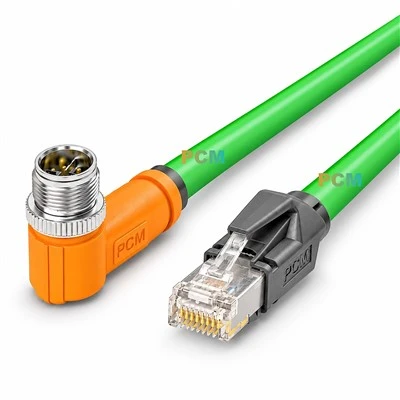
Optimization of outgoing line method: Adopting a 90 ° bend design to reduce the bending radius of the cable and avoid heat accumulation at the bend. Tests have shown that the signal attenuation of the 90 ° outlet adapter is reduced by 28% compared to the 180 ° outlet.
Environmental heat dissipation:
Forced air cooling: Install axial fans inside enclosed cabinets to create directional airflow. In a semiconductor equipment case, the air cooling system reduced the operating temperature of the adapter from 75 ℃ to 55 ℃, resulting in a 40% increase in system stability.
Thermal isolation: Install ceramic insulation panels between high-temperature sources (such as engines) and adapters to block thermal radiation conduction. The application of rail transit shows that the insulation board reduces the surface temperature of the adapter by 30 ℃.
3, Load management: Avoiding thermal failures caused by overload
High temperature will reduce the current carrying capacity of materials, and load parameters need to be adjusted according to the ambient temperature:
Current derating use: The rated current of a conventional M12 adapter is 12A@63V However, in an environment of 50 ℃, the rating needs to be reduced by 15% (i.e. 10.2A), and at 85 ℃, the rating needs to be reduced by 30% (8.4A). A certain automobile welding workshop failed to implement the downgrade standard, resulting in an average of 12 adapter failures per month and production line downtime losses exceeding 200000 yuan per month.
Dynamic load monitoring: Deploy temperature sensors and current sensors to monitor the working status of adapters in real time. When the temperature exceeds 85 ℃ or the current exceeds 80% of the rated value, an alarm is triggered and the power supply is automatically cut off. After applying this solution to a certain wind farm, the adapter failure rate decreased from an average of 5 times per year to 0.3 times.
Line optimization: Shorten cable length (recommended ≤ 50 meters), increase wire cross-sectional area (recommended ≥ 1.5mm ²), and reduce line resistance. Tests have shown that increasing the cross-sectional area of the wire from 1.0mm ² to 1.5mm ² can reduce the voltage drop of the circuit by 40% and the temperature rise of the adapter by 6 ℃.
4, Protection level: Barrier against environmental erosion
High temperatures are often accompanied by harsh conditions such as dust and moisture, and it is necessary to choose a high protection level adapter:
IP67/IP68 protection: IP67 can prevent dust and short-term immersion (1 meter depth/30 minutes), IP68 supports long-term underwater work (1 meter depth/48 hours). An outdoor photovoltaic power station uses an IP68 adapter, which has been operating continuously for 3 years without failure in the alternate environment of sandstorm and rainstorm, while the IP65 adapter only lasts for 8 months.
IP69K high-pressure flushing protection: suitable for scenarios requiring high-pressure cleaning such as food processing and automotive manufacturing. This level of adapter can withstand high-pressure steam flushing at 80 ℃ and 80-100bar. After application in a dairy factory, the equipment cleaning efficiency has been improved by 50%, and the adapter replacement cycle has been extended to 5 years.
Anti corrosion coating: Spraying three anti paints (moisture-proof, anti salt spray, anti mold) on the contact surface can extend the service life of the adapter in humid environments. According to actual testing on offshore platforms, coated adapters have a lifespan of up to 10 years in salt spray environments, while uncoated products can only last for 3 years.
5, Engineering Practice: Typical Scenario Solutions
Automotive Welding Workshop:
Challenge: High temperature (instantaneous temperature up to 3000 ℃), splash impact, and strong electromagnetic interference generated by arc welding.
Solution: M12 adapter with IP69K protection, gold-plated contacts, PUR sheathed cable, and equipped with heat sink and thermistor. After implementation, the adapter failure rate decreased from an average of 12 times per month to 0.5 times, and the downtime of the production line was reduced by 95%.
Wind power variable pitch system:
Challenge: Cabin temperature reaches 75 ℃, continuous vibration (frequency 10-55Hz, acceleration 5g).
Solution: Choose an adapter with a SABIC plastic shell, a 90 ° elbow design, and a dynamic load monitoring system. Tests have shown that its contact resistance fluctuates less than 3m Ω in a vibrating environment, and the signal transmission delay remains stable within 10 μ s.
Inside semiconductor equipment:
Challenge: Narrow space (30mm bending radius), high temperature (100 ℃), high frequency signal (10GHz).
Solution: Adopt elbow adapter, low loss cable (dielectric loss factor ≤ 0.002), and electromagnetic shielding design. Actual testing shows that this scheme reduces signal attenuation by 22% and error rate by 99.9% compared to straight head adapters.