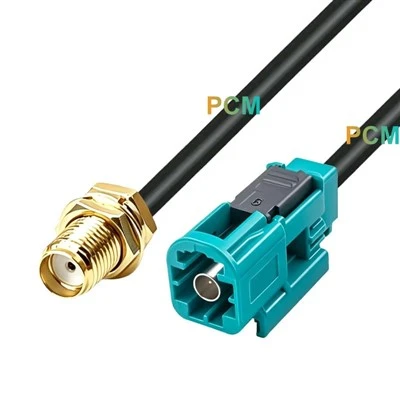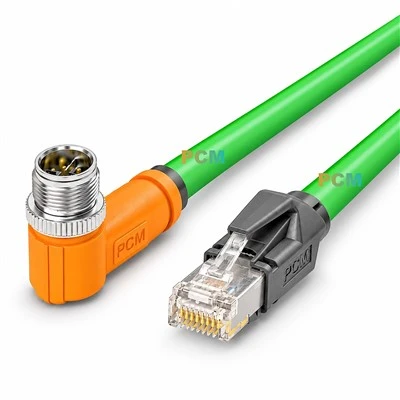
1, Technical adaptability: Deep coupling between M8 adapter and robot system
1. Physical layer optimization: miniaturization and high-density integration
The requirements for space utilization in future robot systems are becoming increasingly stringent. The diameter of the M8 adapter is only 8mm, which reduces the volume by 40% compared to traditional M12 connectors. It can significantly save space in compact scenarios such as collaborative robot joints and mobile robot chassis. For example, a project in a car welding workshop showed that the use of M8 adapters reduced the number of robot body cables by 60% and the interference rate of moving parts by 80%, providing a physical basis for multi axis collaboration and high-precision operations.
2. Electrical performance upgrade: high speed and low latency
The 5G network requires robot systems to have millisecond level real-time control capabilities, which places strict demands on the signal transmission quality of connectors. The M8 adapter, with its shielding design, low contact resistance (≤ 5m Ω), and high current carrying capacity (5A/core), can stably support high-speed data exchange for 5G terminals. Taking a logistics AGV project as an example, its M8 adapter achieves 200Mbps data transmission under 5G network, with a stable latency of less than 2ms, meeting the requirements of multi machine collaborative scheduling. In the future, with the popularization of 5G-A (Enhanced 5G) technology, M8 adapters will further compress latency to sub millisecond levels, promoting the upgrade of robots from "execution tools" to "intelligent decision agents".
3. Environmental adaptability: Industrial grade protection and reliability
Robots are often deployed in high vibration, strong electromagnetic interference, or humid environments. The IP67 protection level of the M8 adapter and the fluororubber sealing ring can withstand temperature shocks from -40 ℃ to+120 ℃. In the ocean exploration robot project, the M8 adapter with a stainless steel shell was continuously operated in a salt spray environment for 18 months, and the insulation resistance remained above 100M Ω, far exceeding the industry average level. In addition, its feature of supporting thousands of insertions and removals can reduce maintenance costs and improve system availability.
2, Application scenario expansion: from industrial manufacturing to diversified fields
1. Industrial manufacturing: flexible production lines and collaborative operations
In scenarios such as automotive welding and electronic assembly, the M8 adapter supports a multi interface junction box (such as the Keyingfa KYF8K-M8) that can integrate 16 point IO signals, reducing the number of cables by 70% and shortening troubleshooting time from 2 hours to 20 minutes. For example, a certain smart factory project connects 20 collaborative robots through M8 adapters to build a temporary communication subnet under the 5G private network, achieving millisecond level time synchronization and path planning, and promoting the transformation of the production line from "rigid" to "flexible".
2. Architecture and Agriculture: Independent Construction and Precise Operations
At construction sites, construction robots equipped with 5G private networks exchange real-time position information and construction data through M8 adapters, achieving full automation of processes such as brick handling and 3D printing. For example, a certain intelligent construction project uses an M8 adapter to connect a laser radar and a robotic arm, achieving a positioning accuracy of ± 0.5mm under 5G network, and reducing the construction accident rate by 90%. In the field of agriculture, 5G-A's Mesh networking capability supports the collaborative operation of autonomous tractors and crop protection drones. The soil moisture sensor connected to the M8 adapter can dynamically adjust the pesticide spraying amount, reducing the use of chemical agents by 30%.
3. Medical and specialty industries: remote control and safety assurance
In 5G remote robotic surgery, the high-definition camera connected to the M8 adapter and the robotic arm need to complete data transmission within a delay of 1-2ms. In 2024, the Chinese People's Liberation Army General Hospital completed the first 3000km ultra long distance rectal cancer radical surgery in China using a 5G+M8 adapter system, with a surgical accuracy of 0.1mm. In hazardous work scenarios such as chemical and coal mines, the M8 5G explosion-proof terminal developed by Roaming Communication uses multi-mode fusion communication (5G+DMR) to ensure the transmission of critical commands in the event of network interruption. The V0 level fire protection design can suppress the spread of fire.
3, Industry development trend: driven by standardization and intelligence
1. Modular design: reduce customization costs
Head robot integrators are improving the reuse rate of M8 adapters through platform based design. For example, the standardized M8 junction box developed by Harbin Institute of Technology supports 4-8 signal integration, resulting in a 40% increase in project delivery efficiency. In the future, with the popularization of Single Pair Ethernet (SPE) technology, M8 adapters will integrate 100Mbit/s data transmission and PoDL power supply functions, further simplifying wiring.
2. AI Empowerment: From Connectors to Intelligent Nodes
Combined with digital twin technology, the M8 adapter can embed sensors to achieve self-monitoring of status. For example, the M8 adapter in a certain electronic manufacturing project uses a built-in temperature sensor to provide real-time feedback on the risk of overheating at the connection point, and predictive maintenance reduces equipment downtime by 65%. In addition, the combination of 5G edge computing and M8 adapter can offload the obstacle avoidance decision tasks with high real-time requirements to edge nodes, reducing the load of single computer computing.
3. Ecological services: full lifecycle management
Leading enterprises have established a full lifecycle traceability system for M8 adapters. By using RFID tags to record production dates, installation locations, and maintenance records, combined with cloud platforms to achieve remote monitoring. A certain wind power equipment project has increased the mean time between failures (MTBF) from 5000 hours to 12000 hours and reduced annual maintenance costs by 45% through this system.
4, Challenges and Countermeasures: Technological Bottlenecks and Industrial Synergy
Despite the enormous potential of the M8 adapter in the robotics market, it still faces two major challenges:
High frequency signal interference: 5G millimeter wave communication may require higher requirements for the shielding layer of M8 adapters, and losses need to be reduced by optimizing material and structural design.
Lack of standardization: The current M8 adapter interface protocol has not been unified, and cross brand device compatibility is limited. The industry needs to accelerate the development of unified standards and promote ecological synergy.