一, Preparation before installation: Dual verification of tools and environment
1. Compliance inspection of tools and materials
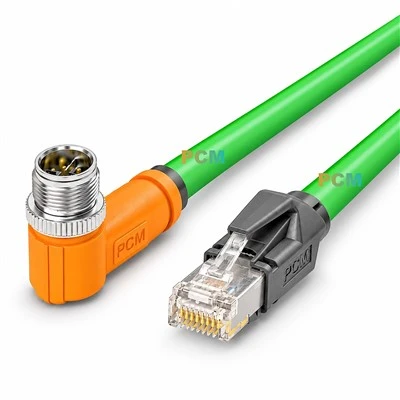
Special tool selection: Use crimping pliers, wire stripping pliers, and torque screwdrivers that match the M8 adapter. For example, an 8-core M8 adapter requires a screwdriver with a torque range of 0.5-1.5N · m to avoid thread slippage caused by excessive tightening.
Wire specification matching: Select wire diameter according to current requirements. For example, when transmitting 24V power with a 3-core M8 adapter, a wire with a cross-sectional area of ≥ 0.5mm ² needs to be selected; If transmitting 485 communication signals, shielded twisted pair cables are required to reduce electromagnetic interference.
Protective material equipment: Insulation sleeves, heat shrink tubing, and waterproof sealing rings need to be prepared. In outdoor or humid environments, adapters with IP67 protection level should be selected and matched with silicone sealing rings.
2. Environmental risk assessment
Temperature and humidity control: The working temperature range of the adapter is usually -40 ℃ to+85 ℃. If wiring in a high-temperature workshop, it is necessary to choose polyvinyl chloride (PVC) wire with a temperature resistance of 105 ℃; In low-temperature environments (below -25 ℃), an adapter housing made of glass fiber reinforced (GF) material should be used to prevent embrittlement.
Dust and waterproof measures: In places where the dust concentration is greater than 10mg/m ³, a dust cover should be installed on the adapter; If used outdoors, it is necessary to ensure that the adapter interface meets the IP69K protection standard and can withstand high-pressure water gun flushing.
Electromagnetic interference (EMI) protection: When wiring near strong interference sources such as frequency converters and servo motors, shielded cables should be used and the shielding layer should be grounded at one end.
二, Wiring Operation Specification: Key Steps from Wiring to Fixation
1. Standardization of wiring process
Stripping length control: When using wire stripping pliers to strip the outer layer of the cable, the exposed length of the copper core should be strictly controlled within 3-5mm. Too long can easily cause short circuits, while too short can affect contact reliability.
Welding and crimping specifications:
Welding: lead-free solder wire is used, and the welding temperature is controlled at 260-300 ℃. The welding time for each solder joint should not exceed 3 seconds to avoid high temperature damage to the insulation layer.
Crimping: Use specialized crimping pliers to ensure that the crimping height meets the equipment requirements. For example, after crimping a 4-core M8 adapter, the contact resistance should be less than 5m Ω.
Polarity marking verification: When wiring the power interface, it is necessary to verify that the "+"/"-" markings on the adapter are consistent with the polarity of the device end to prevent reverse connection and equipment damage.
2. Mechanical fixation and anti loosening design
Thread locking requirements: M8 adapters usually use M8 × 1.0 standard threads, and a torque screwdriver should be used to control the locking torque between 1.0-1.2N · m during installation. If used in vibration environments (such as robot joints), anti loosening screws or spring washers need to be installed.
Wire harness fixing spacing: When wiring along the equipment frame, the distance between wire harness fixing points should be ≤ 300mm; elastic sheaths should be used at turns to avoid excessive bending of the wire and damage to the insulation layer.
Separation state protection: If the adapter is in a separated state for a long time, protective caps should be installed separately for the plug and socket to prevent dust and metal debris from entering and causing poor contact.
三, Security testing and acceptance: a comprehensive inspection from functionality to compliance
1. Electrical performance testing
Insulation resistance testing: Use a 500V megohmmeter to measure the insulation resistance between adapter wires and to ground, and the value should be greater than 100M Ω.
Voltage withstand test: Apply twice the rated voltage (such as 48V for a 24V adapter) for 1 minute without breakdown or flashover.
Contact resistance verification: Use a micro ohmmeter to measure the contact resistance of the adapter pin, and the value should be less than 10m Ω.
2. Mechanical strength verification
Insertion and extraction force test: Simulate actual usage scenarios and conduct 50 insertion and extraction cycles for testing. The change rate of insertion and extraction force should be less than 15%.
Vibration impact test: Under the conditions of frequency 10-55Hz and amplitude 1.5mm, the adapter should vibrate for 2 hours without looseness or poor contact.
3. Compliance certification verification
Standard compliance: Certification is required through GB/T 5095 "Basic Test Procedures for Electromechanical Components for Electronic Equipment" and IEC 60601 "Safety Standards for Medical Electrical Equipment".
Integrity of identification: The adapter housing should be clearly labeled with rated voltage, current, protection level, and production date for easy traceability and maintenance.
四, Maintenance and Emergency Response: From Daily Inspection to Troubleshooting
1. Regular inspection plan
Appearance inspection: Check the adapter housing monthly for cracks, deformation, and worn threads.
Wiring harness status monitoring: Check the insulation layer of the wiring harness for aging and the fixing points for looseness every quarter.
Environmental adaptability assessment: IP protection level retesting of outdoor adapters is conducted annually to ensure that the sealing performance meets the standards.
2. Emergency handling of faults
Short circuit troubleshooting: If the device alarms "overcurrent", immediately disconnect the power supply, use a multimeter to check the resistance between the adapter wires, and troubleshoot the short circuit point.
Poor contact repair: If a signal interruption is found, check whether the adapter pins are oxidized, and use an alcohol swab to clean the contact surface.
Waterproof failure treatment: If the adapter gets wet, immediately turn off the power and disassemble it to dry it. Replace the sealing ring and perform a pressure test again.
五, Industry Case Warning: The Cost of Safety Negligence
Case 1: Short circuit accident on automobile production line
During the battery pack testing process at a new energy vehicle factory, the M8 adapter wire diameter was chosen to be too thin (0.3mm ² instead of 0.5mm ²), resulting in overheating when transmitting 24V/4A current, causing the insulation layer of the wiring harness to melt and resulting in equipment shutdown losses exceeding 500000 yuan.
Case 2: Water ingress failure of food processing equipment
A certain dairy production line was shut down for 12 hours due to the failure to install an IP69K protective cover for the M8 adapter during CIP cleaning, resulting in water ingress during high-pressure water gun flushing and sensor signal interruption. The direct economic loss amounted to 200000 yuan.