CAN Bus Cable FAQ: What Engineers Actually Care About
High-Flex / Drag Chain / AMP 1745078-1 Solutions Explained
📋 Contents
Part 1: The Basics & Troubleshooting Glitches
Q1: Why do CAN Bus systems usually fail at the cable rather than the controller?
It's a classic oversight. In construction machinery, AGVs, and AG tech, communication blackouts rarely stem from protocol errors. The real culprits are:
- Constant Flexing: Leading to microscopic fractures in the conductor.
- Loose Connectors: Resulting in intermittent contact.
- EMI (Electromagnetic Interference): Causing packet loss.
The Bottom Line: Your controller is rock solid; your "interconnect" is the weak link. This is why engineers spend so much time troubleshooting "intermittent signal loss."
Q2: Can I just use standard cable for CAN Bus?
Short answer: You can, but it'll cost you later.
CAN Bus isn't just about "making a connection"; it's about stability and noise immunity. Key requirements include:
- Twisted Pairs (CAN_H / CAN_L): Essential for noise cancellation.
- 120Ω Impedance: Critical to prevent signal reflection.
Standard cable risks: Without proper twisting or impedance matching, you'll get signal reflections and poor EMC performance, leading to "ghost" errors that are nearly impossible to track.
Q3: Why does my CAN Bus system "glitch" and then fix itself after a reboot?
This is the ultimate engineering headache. Usually, it means the cable is at its "critical fatigue state." The internal conductors are fraying-they still touch, but the signal quality is marginal. It won't fail completely yet, but the dropouts will become more frequent until the machine finally stays down.
Part 2: The Shift Toward Hybrid Cables

Q4: Why is the shift toward "Hybrid" (Signal + Power) cables happening?
The trend is clear, especially in mobile hydraulics and robotics.
- The Old Way: Separate cables for CAN and power.
- The Problem: Messy routing, more failure points, and higher labor costs.
- The Hybrid Advantage: One cable, one connector, half the footprint.
A typical high-performance design looks like this:
2 × 0.5 mm²: Dedicated CAN Signal
4 × 2.5 mm²: Power Supply
Part 3: Drag Chains, High-Flex & PUR Jackets

Q5: Why do standard cables die so fast in drag chains?
Two words: Fatigue. Drag chains involve continuous bending, fixed paths, and high-frequency movement. Standard cables use thicker copper strands and rigid jackets that eventually crack under the strain. Once the jacket goes, the copper strands follow, leading to that dreaded intermittent contact.
Q6: Does the "5-Million Flex Cycle" rating actually matter?
Yes. In the industry, we generally categorize durability into three tiers:
| < 1 Million Cycles | Standard industrial use |
| 1M to 3M Cycles | Moderate motion |
| 5M+ Cycles | High-dynamic (Robotics/AGVs) |
This isn't just a marketing flex (pun intended). A 5-million cycle rating directly correlates to lower machine downtime and extended maintenance intervals.
Q7: PUR vs. PVC: Why pay more for the jacket?
The jacket is effectively the cable's armor. In a drag chain, the jacket determines 50% of the cable's lifespan.
- PVC: Cheap, but gets brittle and cracks when exposed to oil or low temperatures.
- PUR (Polyurethane): Highly abrasion-resistant, oil-resistant, and significantly more flexible.
Part 4: Connectors & Upgrading OEM Cables

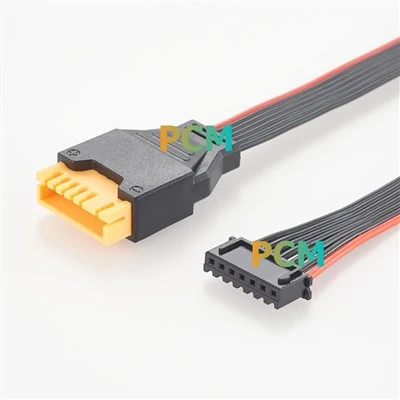
Q8: Why is the AMP 1745078-1 connector the industry go-to?
The TE Connectivity AMP 1745078-1 is a "battle-tested" solution. It's widely adopted because it meets automotive-grade standards, handles high-vibration environments with ease, and offers a secure locking mechanism. It's not the cheapest part on the bill of materials, but it's the one you don't have to worry about failing.
Q9: Can I replace an IFM E12834 with a custom solution?
As long as the pinout, connector (AMP 1745078-1), and electrical specs match, yes. Engineers often switch from OEM cables like the E12834 to high-flex custom alternatives because:
- Cost: OEM markups are exceptionally high.
- Availability: Avoid long lead times for "brand name" replacements.
- Customization: The ability to specify exact lengths or higher flex (PUR) ratings for better durability.

Q10: Where is this high-flex cable most needed?
If your setup involves any of the following, "standard" cable simply won't cut it:
- Motion: Drag chains or robotic arms.
- Vibration: Construction or agricultural machinery.
- High Uptime: 24/7 automated warehouses (AGVs/AMRs).
Q11: When is it time to upgrade your cable?
A good rule of thumb: If you've replaced the same cable twice in a year, you're using the wrong spec.
Upgrade if your downtime costs are high, your environment is oily or vibrating, or your system is growing in complexity.
👉 High-spec cable is an insurance policy against the most annoying type of equipment failure.
Source Custom High-Flex CAN Cables
Premier Cable manufactures OEM-equivalent and upgraded CAN Bus cables, including high-flex PUR, hybrid (signal+power), and assemblies utilizing genuine AMP 1745078-1 connectors (ideal alternatives to IFM E12834). Stop replacing standard cables-contact us for a ruggedized solution.