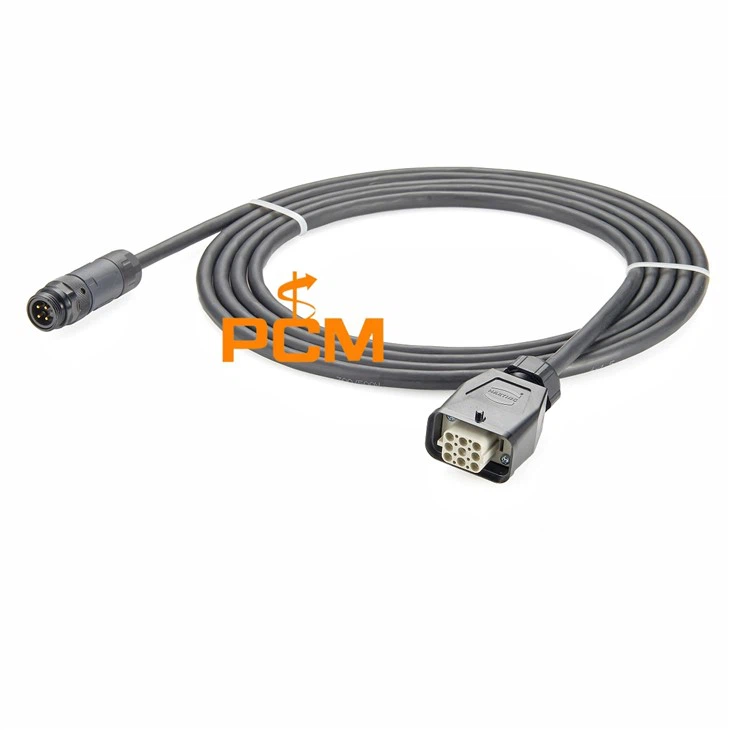

Hey there! I'm a supplier of m23 encoder cables, and I often get asked if these cables can be used in textile machines. Well, let's dive right into it and figure out if the m23 encoder cable is a good fit for textile machines.
First off, let's understand what an m23 encoder cable is. An m23 encoder cable is a type of cable commonly used to connect encoders to various devices. Encoders are sensors that convert motion into an electrical signal, which can then be used to measure speed, position, or direction. The m23 connector is a circular connector with 23 pins, which provides a reliable and secure connection for the encoder.
Now, let's talk about textile machines. Textile machines are complex pieces of equipment that are used to manufacture textiles, such as fabrics, yarns, and threads. These machines often have multiple moving parts, including motors, spindles, and rollers, which need to be precisely controlled to ensure the quality of the textile products. Encoders play a crucial role in textile machines by providing feedback on the position and speed of these moving parts, allowing the machine to operate smoothly and efficiently.
So, can the m23 encoder cable be used in a textile machine? The answer is yes, in most cases. The m23 encoder cable is designed to provide a stable and reliable connection for encoders, which is essential for the proper functioning of textile machines. The cable's robust construction and high-quality materials make it suitable for use in industrial environments, including textile manufacturing facilities.
One of the key advantages of using an m23 encoder cable in a textile machine is its flexibility. Textile machines often have tight spaces and complex wiring layouts, which require a cable that can bend and flex without breaking. The m23 encoder cable is designed to be flexible, allowing it to be easily routed through the machine's wiring harness without causing any damage.
Another advantage of using an m23 encoder cable in a textile machine is its resistance to interference. Textile machines generate a lot of electrical noise, which can interfere with the encoder's signal and cause inaccurate readings. The m23 encoder cable is shielded to protect against electromagnetic interference (EMI) and radio frequency interference (RFI), ensuring that the encoder's signal remains clear and accurate.
In addition to its flexibility and resistance to interference, the m23 encoder cable is also easy to install and maintain. The cable's m23 connector is designed to be quickly and easily connected and disconnected, making it easy to replace or repair the cable if necessary. This can save time and money in the long run, as it reduces the downtime of the textile machine.
Now, let's take a look at some of the specific applications of m23 encoder cables in textile machines. One common application is in the control of motors. Textile machines often use servo motors to drive the various moving parts, and encoders are used to provide feedback on the motor's position and speed. The m23 encoder cable can be used to connect the encoder to the motor controller, allowing the controller to accurately control the motor's operation.
Another application of m23 encoder cables in textile machines is in the control of spindles. Spindles are used to twist and wind the yarn or thread, and encoders are used to provide feedback on the spindle's speed and position. The m23 encoder cable can be used to connect the encoder to the spindle controller, allowing the controller to accurately control the spindle's operation.
Finally, m23 encoder cables can also be used in the control of rollers. Rollers are used to transport the fabric or yarn through the textile machine, and encoders are used to provide feedback on the roller's speed and position. The m23 encoder cable can be used to connect the encoder to the roller controller, allowing the controller to accurately control the roller's operation.


In conclusion, the m23 encoder cable can be used in a textile machine in most cases. Its flexibility, resistance to interference, and ease of installation and maintenance make it a suitable choice for use in industrial environments, including textile manufacturing facilities. If you're looking for a reliable and high-quality m23 encoder cable for your textile machine, I recommend checking out our products: Servo Motor Encoder Cable M23 To DB25, Sensor Transducer Encoder Cable M23 To D-Sub, and M23 To DB9 Servo Motor Encoder Cable.
If you have any questions or would like to discuss your specific requirements, please don't hesitate to get in touch. We're here to help you find the right m23 encoder cable for your textile machine.
References:
- General knowledge about encoder cables and textile machines.