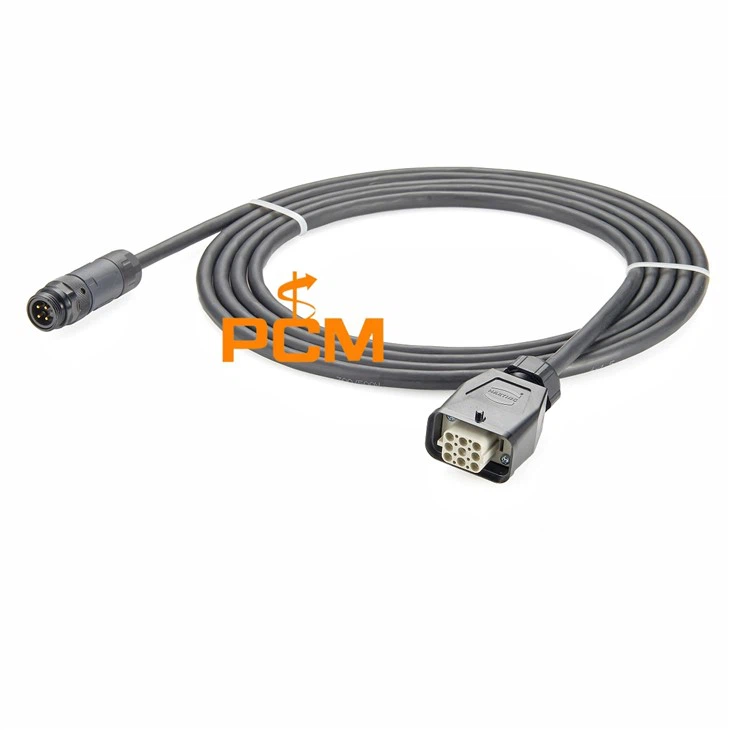

Certification standards play a crucial role in the quality and reliability of M23 encoder cables. As a supplier of M23 encoder cables, I understand the significance of meeting these standards to ensure that our products can perform optimally in various industrial applications. In this blog post, I will delve into the key certification standards for M23 encoder cables and explain why they matter.


Electrical Performance Standards
One of the primary aspects of M23 encoder cables is their electrical performance. The cables need to transmit signals accurately and efficiently to ensure the proper functioning of the encoder systems.
Impedance Matching
Impedance matching is a critical factor in electrical performance. M23 encoder cables are typically designed to have a specific characteristic impedance, usually 100 ohms or 120 ohms, depending on the application. This impedance matching helps to minimize signal reflections, which can cause interference and degrade the quality of the transmitted signals. For example, in high - speed data transmission applications, improper impedance matching can lead to data errors and system malfunctions.
Signal Integrity
Maintaining signal integrity is essential for the reliable operation of encoder systems. M23 encoder cables are required to have low attenuation, which means that the signal strength does not decrease significantly over the length of the cable. Additionally, they should have good noise immunity to resist electromagnetic interference (EMI) and radio - frequency interference (RFI). Shielding is often used in M23 encoder cables to protect the signals from external interference. A well - shielded cable can significantly reduce the impact of EMI and RFI, ensuring that the encoder signals remain accurate and stable.
Mechanical Performance Standards
M23 encoder cables are often used in industrial environments where they are subject to various mechanical stresses. Therefore, they need to meet certain mechanical performance standards.
Flexibility
Flexibility is an important characteristic, especially in applications where the cables need to be bent or moved frequently. M23 encoder cables are designed to have a certain degree of flexibility to withstand repeated bending without breaking. The flexibility is usually measured by the minimum bend radius, which indicates the smallest radius that the cable can be bent without causing damage. A smaller minimum bend radius means that the cable is more flexible and can be used in more confined spaces.
Tensile Strength
Tensile strength refers to the maximum amount of pulling force that a cable can withstand without breaking. In industrial settings, M23 encoder cables may be pulled or tugged during installation or operation. Therefore, they need to have sufficient tensile strength to ensure their durability. High - quality M23 encoder cables are made with strong conductors and insulation materials to provide good tensile strength.
Abrasion Resistance
In many industrial applications, M23 encoder cables may rub against other objects, such as machinery or pipes. To prevent damage from abrasion, the cables need to have good abrasion resistance. Special outer jackets are often used to protect the cables from abrasion. These jackets are made of materials such as polyurethane or PVC, which have high abrasion - resistant properties.
Environmental Performance Standards
M23 encoder cables are used in a wide range of environmental conditions, from clean indoor environments to harsh outdoor or industrial settings. Therefore, they need to meet certain environmental performance standards.
Temperature Resistance
The cables need to be able to operate within a specific temperature range. In high - temperature environments, the insulation and jacket materials of the cables may degrade, leading to electrical failures. On the other hand, in low - temperature environments, the cables may become brittle and lose their flexibility. M23 encoder cables are designed to have good temperature resistance, with a specified operating temperature range, such as - 40°C to + 80°C or - 20°C to + 60°C, depending on the application.
Chemical Resistance
In some industrial environments, M23 encoder cables may come into contact with various chemicals, such as oils, solvents, and acids. The cables need to have good chemical resistance to prevent damage from these chemicals. The outer jackets and insulation materials of the cables are selected based on their chemical resistance properties. For example, some cables are coated with a chemical - resistant layer to protect them from corrosive substances.
IP Rating
The Ingress Protection (IP) rating is a standard that indicates the degree of protection provided by the cable against the ingress of solid objects and liquids. M23 encoder cables often have an IP rating, such as IP67 or IP68. An IP67 - rated cable is dust - tight and can withstand immersion in water up to 1 meter for 30 minutes. An IP68 - rated cable provides even higher protection and can be submerged in water at greater depths for longer periods.
Industry - Specific Certifications
In addition to the general electrical, mechanical, and environmental performance standards, M23 encoder cables may also need to meet industry - specific certifications.
UL Certification
The Underwriters Laboratories (UL) certification is a widely recognized safety certification in North America. UL - certified M23 encoder cables have been tested and meet the safety requirements for use in various applications. This certification provides assurance to customers that the cables are safe to use and comply with the relevant safety standards.
CE Certification
The CE (Conformité Européene) certification is required for products sold in the European Union. It indicates that the M23 encoder cables meet the essential health and safety requirements of the EU directives. CE - certified cables are allowed to be freely traded within the EU market.
Our Product Range
As a supplier of M23 encoder cables, we offer a wide range of products to meet different customer needs. Our product range includes M23 To DB9 Servo Motor Encoder Cable, which is suitable for applications that require a connection between an M23 connector and a DB9 connector. We also have Servo Motor Encoder Cable for VW3M8102R50 VW3M8102R100, designed specifically for use with certain servo motor models. Another popular product is our Servo Motor Encoder Cable M23 To DB25, which provides a reliable connection between an M23 connector and a DB25 connector.
Why Choose Our M23 Encoder Cables
All our M23 encoder cables are manufactured to meet or exceed the relevant certification standards. We use high - quality materials and advanced manufacturing processes to ensure the electrical, mechanical, and environmental performance of our cables. Our cables are rigorously tested to guarantee their reliability and durability. Whether you need cables for a simple industrial automation application or a complex high - speed data transmission system, we have the right solution for you.
Contact Us for Procurement
If you are interested in our M23 encoder cables and would like to discuss your specific requirements, please feel free to contact us. We are committed to providing high - quality products and excellent customer service. Our team of experts can help you select the most suitable cables for your application and answer any questions you may have. Start your procurement journey with us today and experience the difference of our certified M23 encoder cables.
References
- IEEE Standards Association. "IEEE Standards for Electrical and Electronics Engineering."
- International Electrotechnical Commission (IEC). "IEC Standards for Cables and Connectivity."
- Underwriters Laboratories. "UL Standards for Electrical Safety."
- European Committee for Standardization (CEN). "European Standards for Industrial Products."