SMA and RS-SMA are two common RF coaxial connectors, widely used in wireless communications, mobile base stations, satellite antennas, GPS navigation systems and other high-frequency applications. To better understand of the differences between SMA and RP-SMA, it is very helpful to first understand the meaning of each term.
SMA
SMA is short for SubMiniature version A, developed in the 1960s. The SMA connector typically feature 50 Ω impedance and supports frequencies up to 18 GHz or even higher. And it is rated for up to 500 mating cycles, provided that the proper torque wrench i used to apply the specified force when making connections.
The SMA connector has two types: Male and Female. Its main difference lies in the structure of the connection parts. The SMA male connector has internal threads and a centre pin, while the SMA female connector has external threads and a centre hole.


RP-SMA
RP-SMA, which stands for Reverse Polarity SMA, is a variant of the SMA connector. While they look similar, their central contact points have opposite polarities, effectively reducing the risk of misconnections, improving operational security, and enhancing system stability.
In RP-SMA, the male connector features inner threads and a hole in the centre, while the female connector features outer threads and a pin in the centre.


RF Coaxial Cable
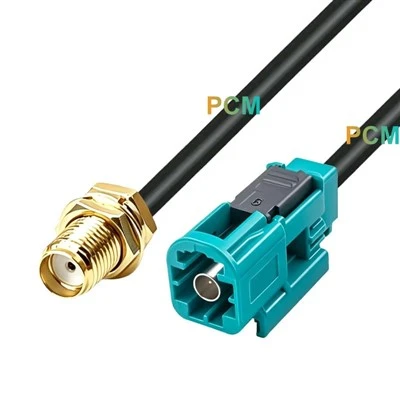
SMA, RP-SMA, FAKRA, and Mini FAKRA are all radio frequency (RF) connectors designed to transmit high-frequency signals. They can be used with common coaxial cables, such as RG316, RG174, and RG58, to form RF coaxial cable assemblies, including FAKRA to SMA, FAKRA to RP-SMA, Tyco Mini Fakra to SMA, Quad HFM Mini Fakra to SMA, and so on. Here are some pictures for reference.