

1, Breakthrough in Materials Science: Building an Anti Fatigue Foundation Layer
The bending life of robot joint cables is essentially the fatigue resistance of materials under dynamic loads. Traditional PVC or rubber materials are prone to problems such as insulation cracking and conductor fracture after millions of bends, while the new generation M8 cable achieves performance leaps through the following material innovations:
Optimization of conductor materials
Using tin plated copper alloy conductors, by controlling the single wire diameter (0.08mm-0.12mm) and pitch (12-15 times the conductor diameter), the fatigue resistance is improved while ensuring flexibility. For example, some Japanese robot manufacturers use ultra-fine tinned copper wire twisting technology to reduce the resistance change rate of conductors to less than 2% after 5 million bends, which is three times longer than traditional conductors.
Upgrading of insulation layer materials
Using thermoplastic elastomers (TPE) or cross-linked polyethylene (XLPE) instead of PVC, its temperature resistance range is from -40 ℃ to+105 ℃, and it can release stress through molecular chain sliding when bent. A certain domestic cable brand modified TPE with nanoscale siloxane to maintain the integrity of the insulation layer after 10 million bends, reducing the crack propagation rate by 80%.
Innovation in shielding layer structure
To address the issue of electromagnetic interference (EMI), a composite shielding structure of tin plated copper wire weaving and aluminum foil is adopted, with a weaving density of over 90%. A certain German robot cable can maintain a shielding efficiency of -80dB even under high-frequency bending by optimizing the shielding layer pitch (offset by 30% from the conductor pitch), avoiding control errors caused by signal distortion.
2, Structural Design Revolution: From Static Protection to Dynamic Adaptation
The complex motion patterns of robot joints, such as rotation, swing, and compound torsion, require cables to have dynamic adaptive capabilities. The M8 cable achieves the concept of "overcoming rigidity with softness" through the following structural design:
Segmented buffer structure
At the joint with the smallest bending radius of the cable, a segmented design of "hard sheath+flexible buffer layer" is adopted. For example, a collaborative robot cable is embedded with a silicone buffer ring at the joint, which has a Shore hardness of 30A and can absorb 30% of bending stress, increasing the lifespan of the area from 2 million cycles to 6 million cycles.
Anti torsion reinforcement layer
In response to the twisting requirements of rotating joints, an aramid fiber braided reinforcement layer is added to the outer layer of the cable, which increases the torsional stiffness by 50% compared to traditional materials. The cable of a certain surgical robot is wound with aramid fiber through bidirectional spiral winding. In the ± 180 ° torsion test, the residual deformation after 10 million cycles is less than 5%.
Dynamic wiring system
Drawing on the cable management technology of surgical robots, a three-stage wiring design of "inner peripheral part+bending part+outer peripheral part" is adopted. When the joint rotates, the length of the inner peripheral cable is shortened, the length of the outer peripheral cable is extended, and the bending part avoids stress concentration through smooth transition. After applying this technology to a certain six axis industrial robot, the cable life was extended from 5 million times to 12 million times.
3, Strict testing standards: the "touchstone" for quantifying lifespan
The global mainstream testing standards provide a quantitative basis for the bending life of M8 cables:
T Ü V 2PFG2577 standard
This standard stipulates that cables must pass 8 types of dynamic tests, with key indicators including:
Bending test: reciprocating at a speed of 0.5m/s in a drag chain with a radius of 6 times the diameter of the cable, with a testing cycle of 10 million times;
3D Rotation Test: Simulate joint compound motion, apply ± 90 ° torsion in the XYZ three-axis directions, and test for 5 million cycles;
High temperature bending test: Perform 5 million bending cycles at 85 ℃, with insulation resistance maintained at ≥ 100M Ω.
CRIA 0003-2016 Chinese Standard
The standard adds "low temperature bending" and "oil pollution tolerance" test items, requiring cables to have no brittle fracture after bending 3 million times in -40 ℃ environment, and insulation performance degradation rate of less than 10% after soaking in IRM902 oil for 168 hours.
Actual working condition acceleration test
A certain automotive welding robot manufacturer conducted an "equivalent life test" and set the test conditions as follows: bending radius of 15mm, frequency of 5Hz, temperature of 105 ℃, load current of 10A, simulating 24-hour continuous operation of the production line. Tests have shown that high-quality M8 cables can operate stably for 18 months (approximately 5 years of actual use) under these conditions.
4, Industry Application Case: Validation from Laboratory to Production Line
Application of industrial robot joints
A certain German heavy-duty robot joint uses M8 cable and achieves a bending life of 8 million times through the following optimization:
Conductor: 0.1mm tinned copper wire, twisted 16 strands;
Insulation: cross-linked polyethylene (XLPE), thickness 0.8mm;
Shielding: Tin plated copper wire weaving (density 95%)+aluminum foil composite;
Sheath: Polyurethane (PU), Shore hardness 92A.
In the actual testing of the production line, the cable has not experienced any signal interruption or insulation failure after continuous operation for 3 years, which is 200% longer than the service life of traditional cables.
Application of dexterous hands in humanoid robots
A domestically produced humanoid robot's dexterous hand joint adopts ultra flexible M8 cable, and its innovative points include:
Conductor: 0.05mm ultra-fine copper alloy, twisted 32 strands;
Insulation: Thermoplastic polyurethane elastomer (TPU), thickness 0.5mm;
Structure: Segmented buffer ring+dynamic routing system.
The test shows that the cable has a lifespan of 10 million times under high-frequency bending of fingers (120 times per minute), meeting the 10-year service life requirement of the robot.
What is the bending life of M8 cable in robot joints?
Popular Products

HFM Mini FAKRA Cable
Single channel HFM Mini-FAKRA coaxial cable with female-female, male-male and male-female options for ADAS cameras and

IP67 Waterproof HFM FAKRA Cable
IP67 waterproof HFM to FAKRA cable with 4 connector configurations for automotive cameras, ADAS sensors and RF systems.

Hirose ST Series Connector
Hirose ST Series connector cable assemblies featuring ST40X-10S-CV, ST40X-18S-CV, ST40X-24S-CV and ST40X-36S-CV

GMSL2 FAKRA Z Code Camera Cable
3 m GMSL2 cable with FAKRA Z Code female connectors for camera-to-host, ECU, ADAS and machine vision connections.
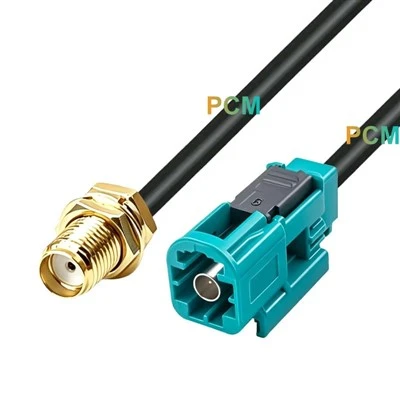
Rosenberger Fakra To SMA Cable
Rosenberger to SMA 50 Ohm coaxial cable with four connector configurations for automotive RF modules, antennas and test
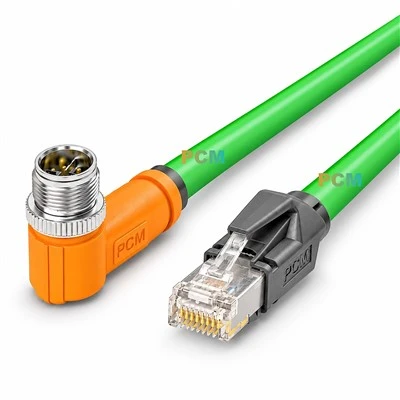
M12 X-Code To RJ45 Cable
M12 X-Code to RJ45 Cat6A cable for 10Gb industrial Ethernet, compatible with X-coded M12 devices, switches and