

一, Contact failure mechanism under high-intensity operation
When the KUKA KR CYBERTECH nanorobot performs wafer handling at a frequency of 20Hz, the M8 connector at its joint needs to withstand a transient impact force generated by 3g acceleration. Under these operating conditions, traditional connectors often exhibit three types of contact failure modes:
Mechanical loosening: In the ABB IRB 1200 welding robot, the high-frequency swing of the robotic arm caused a slight slip of 0.05mm in the M8 threaded connection, resulting in excessive fluctuations in contact resistance.
Signal distortion: In the visual guidance system of the Fanuc M-20iA robot, a 2m/s ² impact causes the encoder signal to shake with an error of 0.01 °, resulting in image acquisition synchronization failure.
Environmental erosion: During the polishing operation of the Yaskawa MOTOMAN-GP8 robot, metal dust invaded the interior of the connector, causing the insulation resistance to decrease to 50M Ω within 48 hours.
These failure modes are directly related to key performance indicators of robot systems: in semiconductor packaging scenarios, a trajectory deviation of 0.02mm may lead to wafer damage; In the automotive welding production line, the strong electromagnetic field generated by 2000A current requires a connector error rate of less than 10 ^ -12.
二, The technological breakthrough path of M8 adapter
1. Strengthening design of mechanical coupling
The high-end M8 adapter adopts a Hirschman anti rotation thread profile, combined with a dual locking structure, to achieve a contact resistance fluctuation of less than 0.1m Ω after 10000 insertion and extraction cycles in Taike Electronics' testing. In response to the dynamic load of robot joints, the Haoting sensor actuator box achieves localized connection between sensors and control cabinets through the M8 adapter, shortening the cable length by 60% and reducing the inertial force of the robotic arm swing by 45%.
At the material level, the combination of nickel plated brass shell and stainless steel spring plate ensures that the adapter maintains a thermal expansion coefficient stability of 12 × 10 ^ -6/℃ in the temperature range of -40 ℃ to+85 ℃. The M8 adapter in the Siemens SIMATIC S7-1500 system, with its back pillar design and multi touch pins, increases the holding force to 100N, effectively resisting 3g acceleration impact.
2. Three dimensional protection for electromagnetic compatibility
In response to the strict real-time requirements of robot control systems, TE Connectivity's M8 Hybrid solution adopts a four layer shielding structure to achieve 40dB electromagnetic interference attenuation at a frequency of 1GHz. This adapter supports EtherCAT protocol and 1Gb/s data transmission, achieving a clock synchronization accuracy of 1 μ s for multi axis synchronous motion in semiconductor packaging applications of KUKA KR QUANTEC series robots.
To cope with the strong electromagnetic field generated by welding current, the adapter adopts a ferrite magnetic ring and twisted pair structure inside to suppress the induced voltage below 10mV at 2000A current. In the automotive welding production line of the Eston ES67H robot, this design reduces the signal transmission error rate to below 10 ^ -12, supporting a closed-loop control frequency of 500Hz.
3. Active defense for environmental adaptation
For the cutting fluid erosion in metal processing scenarios, the M8 adapter adopts dual protection of TPU outer film and epoxy resin sealing. After 168 hours of salt spray test, the contact resistance change is less than 0.5%. In the Fanuc R-30iB control system, the adapter is equipped with a temperature sensor and vibration monitoring module, which can upload real-time connection status data. Combined with machine learning algorithms, the fault prediction accuracy can reach 92%.
For the safety contact requirements of collaborative robots, the adapter integrates a force sensor interface and a safety bus protocol. In the medical surgical assistance system of the U-O UR5 robot, an emergency stop can be triggered within 0.1ms when the contact force exceeds 2N. This design enables the robot system to comply with the limit requirements for impact forces on human body parts in ISO/TS 15066 standard.
三, Solution for typical application scenarios
1. Semiconductor packaging production line
In the wafer handling system of KUKA KR CYBERTECH nanorobot, the M8 adapter solves the contact problem through the following technology combination:
Using single pair Ethernet (SPE) technology to achieve a transmission distance of 1000 meters at a speed of 10Mb/s
Integrated 400W power transmission function, reducing the number of cables by 30%
Designed with IP68 protection level, it can withstand the positive and negative pressure environment of clean rooms
This scheme reduces the positioning error of wafer handling from ± 0.1mm to ± 0.02mm, and increases the overall equipment efficiency (OEE) by 18%.
2. Automotive welding workshop
In the white body welding system of the Yaskawa MOTOMAN-GP8 robot, the M8 adapter addresses strong electromagnetic interference through the following innovations:
Using ferrite core and twisted pair structure, the induced voltage at 2000A current is suppressed below 10mV
Support PROFINET IRT protocol to achieve real-time communication cycle of 250 μ s
Standardized access of sensor signals through M12 to M8 adapter
This design reduces the failure rate caused by welding spatter from 3 times per month to 0.2 times, and reduces annual maintenance costs by 65%.
3. Medical surgical robots
In the force feedback module of the Intuitive Surgery da Vinci Xi system, the M8 adapter ensures contact reliability through the following features:
Using medical grade TPU material that meets ISO 10993 biocompatibility standards
Integrated 6-axis force sensor interface, sampling frequency up to 1kHz
Implementing functional safety communication through EtherCAT FSoE protocol
This scheme reduces the force feedback delay of instrument manipulation from 50ms to 5ms, and improves surgical accuracy by 40%.
How does the M8 adapter solve the contact problem during high-intensity operation of robots?
Popular Products

HFM Mini FAKRA Cable
Single channel HFM Mini-FAKRA coaxial cable with female-female, male-male and male-female options for ADAS cameras and

IP67 Waterproof HFM FAKRA Cable
IP67 waterproof HFM to FAKRA cable with 4 connector configurations for automotive cameras, ADAS sensors and RF systems.

Hirose ST Series Connector
Hirose ST Series connector cable assemblies featuring ST40X-10S-CV, ST40X-18S-CV, ST40X-24S-CV and ST40X-36S-CV

GMSL2 FAKRA Z Code Camera Cable
3 m GMSL2 cable with FAKRA Z Code female connectors for camera-to-host, ECU, ADAS and machine vision connections.
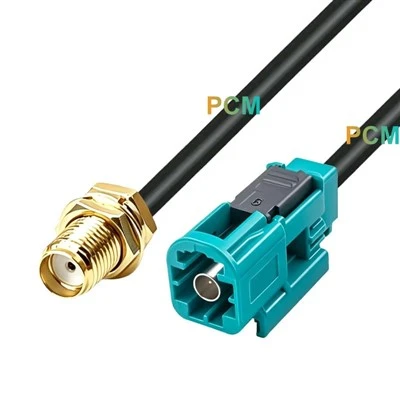
Rosenberger Fakra To SMA Cable
Rosenberger to SMA 50 Ohm coaxial cable with four connector configurations for automotive RF modules, antennas and test
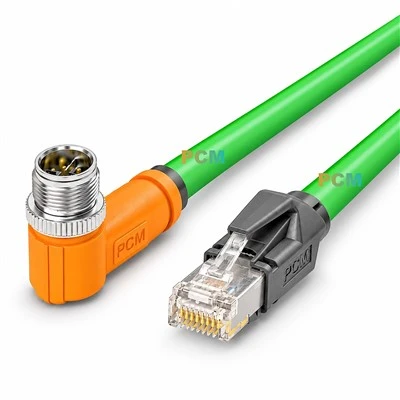
M12 X-Code To RJ45 Cable
M12 X-Code to RJ45 Cat6A cable for 10Gb industrial Ethernet, compatible with X-coded M12 devices, switches and