1, Environmental adaptability: the leap from office to industrial site
RJ45 connectors were born in commercial network environments, and their IP20 protection level can only resist finger contact and vertical dripping. They are prone to poor contact due to contact oxidation in humid, dusty, or oily environments. A certain 3C factory once had its entire SMT production line shut down for 2 hours due to water ingress into the RJ45 interface, exposing its fatal defect in industrial settings.
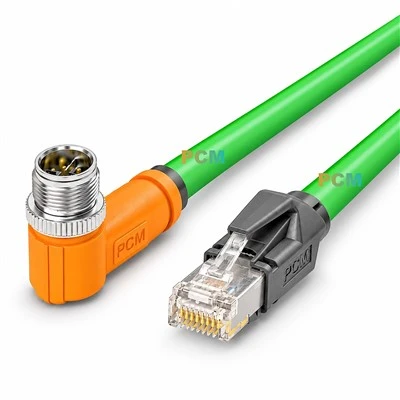
The M12 connector is designed with IP67/IP69K protection to achieve a fully enclosed structure, which can withstand immersion in 1 meter of water for 30 minutes or high-pressure water gun flushing. In extreme environments such as underground coal mines, the M12 connector, with its explosion-proof design, stably transmits gas monitoring data; In food and beverage production lines, M12 connectors with IP69K rating can withstand high temperature and high pressure cleaning, ensuring continuous operation of equipment in environments with strict hygiene requirements.
2, Mechanical Strength: Comparison between Vibration Resistance and Insertion/Insertion Life
RJ45 adopts a plastic buckle locking structure, which is prone to loosening and falling off in high-frequency vibration (10-500Hz) scenarios of robotic arms. A test conducted in a certain automobile welding workshop showed that the RJ45 interface experiences a signal interruption frequency of 3 times per hour under continuous vibration, while the M12 threaded locking structure achieves a 90% improvement in seismic performance through metal interlocking, and can resist the impact force generated by emergency braking during the operation of rail transit vehicles.
In terms of plug and unplug lifespan, the RJ45 standard lifespan is 500-1000 times, while the M12 reaches 1000-5000 times. Taking AGV cars as an example, equipment using M12 connectors maintains zero faults after 3000 hours of continuous operation, while RJ45 interfaces need to be replaced once a month under the same conditions, significantly increasing maintenance costs.
3, Transmission performance: intergenerational leap from 100Mbps to 10G
RJ45 can achieve 10Gbps transmission under the Cat6A standard, but long-distance high-frequency signals are susceptible to electromagnetic interference. A certain photovoltaic inverter test showed that in a dense environment of frequency converters, the bit error rate of the RJ45 interface reached 10 ⁻⁶, which cannot meet the zero delay requirements of industrial equipment.
M12 connector achieves scene adaptation through differentiated coding:
D encoding: Designed specifically for industrial Ethernet, supporting a transmission rate of 100Mbps, adopting a 4-wire (2 pairs of Cat5e) structure, and achieving sub millisecond response in the Profinet IRT protocol.
X encoding: Supports 10Gbps transmission and controls the bit error rate below 10 ⁻¹ ² through a 360 ° all metal shielding layer, meeting the data relay requirements of 5G base stations.
Encoding A: Implement 1Gbps transmission in sensor networks and enhance anti-interference capability through differential signal technology.
4, Standardization system: from universal interfaces to industry customization
RJ45 follows the IEEE 802.3 Ethernet standard, and its T568A/B wiring specification unifies commercial network cabling, but lacks the ability to customize industrial scenarios. For example, in emergency power scenarios that require quick disconnection, RJ45 cannot meet the requirements.
The M12 connector is designed to prevent accidental insertion through mechanical coding
B code: Reverse single key slot design to avoid misconnection of PROFIBUS bus.
S code: replaces C code for AC power transmission and enhances safety by extending the grounding pin.
P-code: Supports fast plugging and unplugging, enabling minute level deployment in temporary power supply systems for large-scale events.
In terms of industry certification, M12 connectors have been certified according to standards such as UL2238 and IEC 61076-2-101, while RJ45 mainly relies on commercial network certification systems and has gaps in industrial environment adaptability testing.
5, Cost effectiveness: The game between short-term savings and long-term risks
The cost of a single RJ45 connector is only one-third of that of an M12, but its hidden cost cannot be ignored:
Maintenance cost: According to statistics from a semiconductor factory, the annual maintenance frequency of equipment using RJ45 interface is four times that of M12, with a single shutdown loss exceeding 100000 yuan.
Certification cost: The project rework rate due to EMC performance non-compliance is 60% higher for RJ45 interfaces compared to M12.
Upgrade cost: In the Industry 4.0 transformation, RJ45 interfaces require additional modules to achieve PoE++power supply, while M12 T encoding can directly support 90W DC power supply, reducing system complexity.