

一, The coupling path between EMI interference source and robot system
The EMI problem of robot systems has the characteristics of high frequency, high energy, and complex coupling paths, and its interference sources mainly include:
High frequency switching devices: IGBT, MOSFET and other power devices switch at high speed at PWM frequency, generating common mode and differential mode interference. For example, the servo board of a six axis industrial robot often experiences excessive conduction emission in the 150kHz-1MHz frequency band, leading to communication interruption or sensor data distortion.
High current circuit: The driving current operates at the ampere level, with a large rate of current change (di/dt), which can easily form an "antenna effect" through cable radiation.
Long distance cable: If the shielded cable between the servo motor and the control board is poorly grounded, it will become the main path of radiation interference.
Mixed signal design: The coexistence of analog and digital circuits exacerbates issues such as ground potential difference and crosstalk, especially in compact spaces at robot joints.
二, Breakthrough in the Core Technology of M8 Connector's EMI Resistance Performance
1. Shielding layer design: from passive protection to active suppression
Modern M8 connectors achieve EMI attenuation through a multi-layer shielding structure:
Metallized plastic shell: The Lelutong M8 series uses copper alloy nickel plated contacts combined with a metalized plastic shell to increase EMI attenuation at a frequency of 1MHz to 62dB, which is 24% higher than the UL 2238 standard baseline value (50dB).
360 ° full screen shielded crimping system: The PROVERTHA M8 connector achieves 360 ° EMI/RFI shielding through a crimping flange and sleeve system, coupled with a fully metal galvanized alloy nickel plated shell, which can resist strong electromagnetic interference in the temperature range of -20 ℃ to+85 ℃, suitable for high vibration fields such as railway transportation and stamping machines.
Twisted pair shielding layer: The TXGA D-encoded M8 connector adopts a twisted pair structure, combined with a metal shielding layer, with a data transmission rate of 100MB/s, meeting the requirements of real-time industrial Ethernet protocols such as EtherCAT and Profinet.
2. Material Innovation: From Single Metal to Composite Protection
Coating optimization: Copper alloy nickel plated contacts not only improve conductivity, but also enhance corrosion resistance through nickel layers, adapting to harsh environments such as humidity and oil pollution. For example, the Lelutong M8 connector can still maintain IP68 protection performance at a high temperature of 125 ℃, with a contact resistance fluctuation of ≤ 3m Ω.
Non metallic shielding materials: Some manufacturers use conductive plastics or carbon fiber composite materials to achieve electromagnetic shielding while reducing weight, suitable for lightweight scenarios such as drones and exoskeleton robots.
3. Structural optimization: From static connections to dynamic reliability
Slope self compensating buckle: The unique slope self compensating buckle design of Lelutong ensures that the insertion and extraction force is ≤ 45N, the insertion accuracy is ± 0.15mm, and it is suitable for millimeter level alignment errors of flexible joints in collaborative robots. At the same time, through a third-order point damping structure, the contact resistance fluctuation under 10-2000Hz random vibration is controlled within 3m Ω.
Dual mode of embedded quick plug and threaded connection: TXGA M8 connector provides two interconnection modes: threaded connection and embedded quick plug. The former has a vibration resistance level of ISO 20653:2013 standard, and the latter has a plug-in life of over 2000 times, meeting the frequent maintenance needs of production lines.
三, Industry Practice: Application of M8 Connector in Typical High Interference Scenarios
1. Industrial robot servo system
In the automotive welding production line, robots need to achieve millimeter level welding accuracy in a strong electromagnetic interference environment. The M8 connector ensures communication stability through the following design:
Integration of common mode choke coil: Some high-end models integrate common mode choke coil inside the connector, which is matched with shielded twisted pair to suppress common mode interference to below -60dB.
Differential mode filtering design: Adopting CLC filtering structure, absorbing high-frequency noise in the frequency range of 150kHz-1MHz, ensuring zero distortion of servo motor encoder signal.
2. Collaborative robot flexible joints
Collaborative robots need to resist radiation interference from frequency converters and servo drives in human-machine collaboration scenarios. The solution for M8 connectors includes:
Metal back shell design: A Faraday cage is formed by grounding the back shell, which guides the EMI induced current to the equipment ground and protects the signal line from damage.
Compact layout: The TXGA M8 connector with a panel opening diameter of only 8.1mm can save internal space of robot joints, while isolating analog and digital signals through a shielding layer to reduce crosstalk risks.
3. Application of special robots in extreme environments
In mining, firefighting and other scenarios, robots need to face complex interferences such as high temperature, high humidity, and strong vibration. The adaptive design of M8 connector includes:
IP69K protection level: Some models achieve triple protection of dust, water, and corrosion resistance through silicone sealing rings and epoxy resin encapsulation technology, and are suitable for temperatures ranging from -40 ℃ to+125 ℃.
Corrosion resistant coating: Made of zinc nickel alloy coating, it performs well in salt spray testing and meets the pollution prevention needs of industries such as marine exploration and food processing.
What is the EMI resistance performance of M8 connector in high interference environment of robots?
Popular Products

HFM Mini FAKRA Cable
Single channel HFM Mini-FAKRA coaxial cable with female-female, male-male and male-female options for ADAS cameras and

IP67 Waterproof HFM FAKRA Cable
IP67 waterproof HFM to FAKRA cable with 4 connector configurations for automotive cameras, ADAS sensors and RF systems.

Hirose ST Series Connector
Hirose ST Series connector cable assemblies featuring ST40X-10S-CV, ST40X-18S-CV, ST40X-24S-CV and ST40X-36S-CV

GMSL2 FAKRA Z Code Camera Cable
3 m GMSL2 cable with FAKRA Z Code female connectors for camera-to-host, ECU, ADAS and machine vision connections.
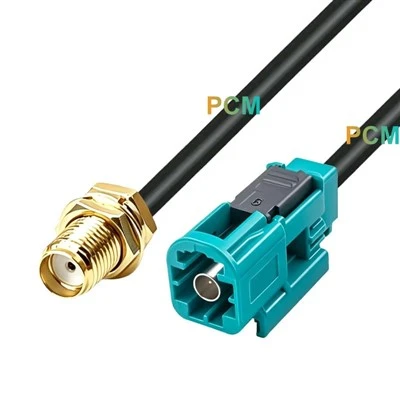
Rosenberger Fakra To SMA Cable
Rosenberger to SMA 50 Ohm coaxial cable with four connector configurations for automotive RF modules, antennas and test
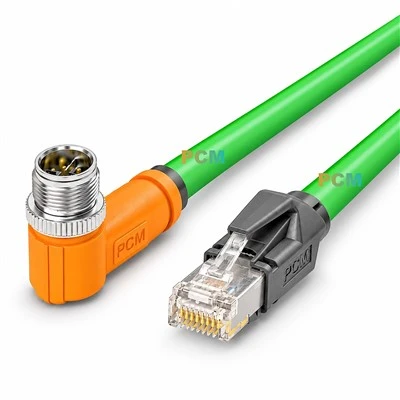
M12 X-Code To RJ45 Cable
M12 X-Code to RJ45 Cat6A cable for 10Gb industrial Ethernet, compatible with X-coded M12 devices, switches and