

一, Basic electrical parameters of M8 adapter
1. Rated current range
The rated current of the M8 adapter is usually between 0.5A and 6A, depending on the pin configuration, contact material, and heat dissipation design
Low power scenario: The rated current of the 3-pin basic model is mostly 0.5A to 2A, suitable for low-power devices such as temperature sensors and photoelectric switches. For example, a certain brand of M8 connector can stably transmit 1.5A current at 24V DC, with a contact resistance of ≤ 5m Ω, meeting the requirements of low-power signal transmission.
Medium power scenario: The 4/5 pin model has a rated current of 4A to 6A and supports devices such as ultrasonic sensors and strain gauge force sensors. Taking a certain model as an example, its rated current is 4A, contact resistance is ≤ 8m Ω, insulation resistance is ≥ 500M Ω, and it can work for a long time in an environment from -25 ℃ to+85 ℃.
Special design models: Some manufacturers increase the rated current to 8A by optimizing the contact point coating (such as gold plating) or increasing the conductor cross-sectional area, but these products are mostly used in customized scenarios and are not universal standards.
2. Rated voltage range
The rated voltage of M8 adapter covers 24V to 250V, and should be selected according to the application scenario:
Low voltage signal transmission: 24V to 30V DC is the mainstream application scenario, such as signal interaction between PLC and sensors. A certain model of M8 connector can withstand a pulse voltage of 1500V at 30V DC, with a pollution level of 3 and an overvoltage protection level of 2, ensuring signal transmission stability.
Medium voltage equipment power supply: Some models support 60V to 125V AC/DC, suitable for small motor drives or industrial lighting equipment. For example, a certain brand's M8 socket can carry 4A current at 60V DC, with an output power of 240W, meeting the power supply needs of low-power devices.
High voltage compatibility: A few industrial grade models have a rated voltage of 250V AC, but it should be noted that their rated current is usually reduced to below 2A to avoid the risk of overheating.
二, Core factors affecting carrying capacity
1. Material and Process Design
Contact material: Copper nickel plating is the mainstream choice, balancing conductivity and corrosion resistance; The high-end models use copper gold-plated contacts, which can reduce contact resistance to below 3m Ω and improve current transmission efficiency.
Insulation materials: PA66, PVC+GF and other materials have high insulation resistance (≥ 100M Ω) and temperature resistance (-40 ℃ to+105 ℃), preventing leakage and short circuit.
Sealing process: Epoxy resin sealing achieves IP67 basic protection, and special models are designed with PUR molds or stainless steel covers to achieve IP69K, suitable for high-pressure water flushing or food processing cleaning scenarios.
2. Heat dissipation and mechanical structure
Conductor cross-sectional area: Pin diameter directly affects current carrying capacity. For example, a certain model of M8 connector uses a 0.5mm ² conductor and can withstand 4A current for a long time at an ambient temperature of 40 ℃; If the cross-sectional area of the conductor increases to 1mm ², the current carrying capacity can be increased to 8A.
Heat dissipation design: The threaded coupling structure improves heat dissipation efficiency by increasing the contact area, while the metal shell model (such as stainless steel cover design) can further reduce thermal resistance and extend the service life in high-temperature environments.
3. Environmental adaptability
Temperature effect: Within the range of -40 ℃ to+105 ℃, the resistance of the conductor increases with temperature, leading to a decrease in current carrying capacity. For example, a certain model has a rated current of 4A at 25 ℃, but needs to be downgraded to 3A for use in an environment of 85 ℃.
Vibration and impact: The thread locking design can withstand high-frequency vibrations (such as 10Hz to 500Hz), but long-term vibration may cause oxidation of the contact point, and regular detection of changes in contact resistance is required.
三, Verification of carrying capacity in industry applications
1. In the field of industrial robots
In welding robots, the M8 adapter needs to simultaneously transmit visual sensor image data and force sensor feedback signals:
Signal transmission: A certain model of M8 connector supports EtherCAT protocol and transmits 1280 × 720 resolution images at 24V DC, with a current load of only 0.8A, far below the rated value.
Power supply: When supplying power to strain gauge force sensors, a rated current of 4A can meet their peak power requirements (such as 24V × 4A=96W), while suppressing electromagnetic interference through shielding layer design.
2. Outdoor electrical equipment field
In the intelligent street light control system, the M8 adapter needs to work stably in an environment of -30 ℃ to+60 ℃:
Temperature resistance test: The M8 connector of a certain brand adopts a cold resistant PVC+GF shell, which can still maintain structural stability at a low temperature of -35 ℃, and the rated current has no attenuation.
Waterproof verification: After soaking in a water depth of 1 meter for 72 hours, the insulation resistance of the IP68 model is still ≥ 500M Ω, ensuring the safety of outdoor use.
3. Food processing industry
In the automated packaging line, the M8 adapter needs to withstand high-frequency cleaning and corrosive gases:
Anti pollution design: The stainless steel cover model has passed IP69K certification and can withstand high temperature and high pressure water flushing at 80 ℃, while preventing cleaning agents from infiltrating the interior.
Chemical resistance: The TPU shell material can resist the corrosion of chemical substances such as grease and alcohol, ensuring long-term use without aging.
四, Selection principles and safety regulations
1. Parameter matching principle
Current redundancy design: The actual operating current should be less than 80% of the rated value. For example, when the device needs to transmit 3A current, a model with a rated current ≥ 4A should be selected.
Voltage derating use: In high voltage scenarios of 250V, it is recommended to prioritize models certified by UL, CE, etc., and ensure that the insulation resistance is ≥ 1G Ω.
2. Environmental adaptability assessment
High temperature scenario: If the ambient temperature continues to be ≥ 60 ℃, a model with a temperature resistance of 105 ℃ should be selected and used with a reduced rating (such as the 4A model with a 3A load).
Vibration scenario: In situations where the vibration frequency is ≥ 100Hz, it is necessary to choose a model with anti loosening threads and regularly check the contact resistance.
3. Safety certification and standards
International certification: Priority should be given to products certified by standards such as IEC 61076-2-104 and UL 2238 to ensure electrical safety and compatibility.
Industry standards: In fields such as food processing and medical equipment, special requirements such as FDA and ISO 13485 must be met, such as halogen-free materials and biocompatibility.
How much current and voltage can the M8 adapter withstand?
Popular Products
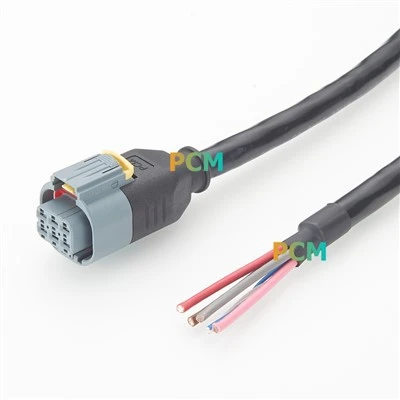
Tyco 1745078-1 Automotive Cable
The Tyco 1745078-1 Automotive Cable is an assembly featuring the AMP 6-position 1745078-1 connector, designed for
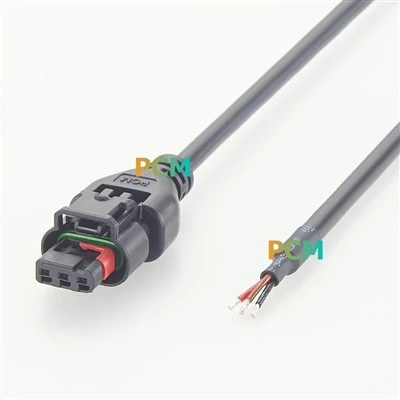
TE Connectivity 1488991 Cable
The TE Connectivity 1488991 is a 3-position, sealed automotive connector housing with IP67 protection, designed to

5 Pole Pluggable Luminaire Connector 450V 16A
PCM-2067-5P 5 Pole Pluggable Luminaire ConnectorA detachable 5-pole connector designed for internal wiring in LED

5 Pole Push-In Luminaire Terminal Block 450V 20A
935-5P 5 Pole Push-In Lighting Terminal Block5-pole quick wiring connector for LED drivers, luminaires and internal

M12 5-Pin Male To DIN 43650 Form C Valve Connector Cable With Yellow LED And ...
PCM-HS-009 is an M12 A-coded 5-pin male to DIN 43650 / EN 175301-803 Form C solenoid valve connector cable designed for

M12 4 Pin Male To DIN 43650 Form A Solenoid Valve Connector Cable Compatible ...
M12 A-coded 4-pin male to DIN 43650 / EN 175301-803 Form A solenoid valve connector cable.Only two pins are wired:M12