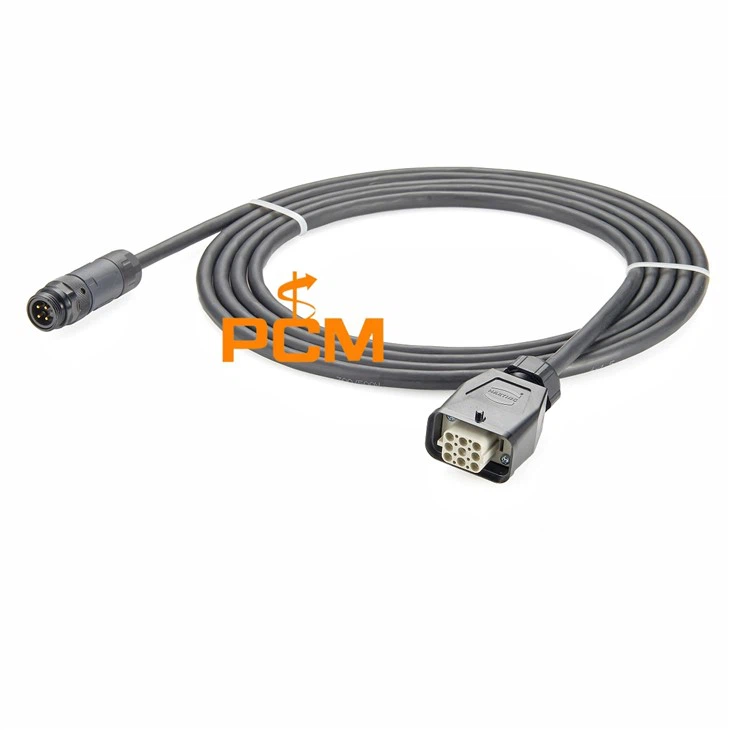

In the dynamic realm of electrical engineering, understanding the behavior of power cables under different conditions is crucial for ensuring optimal performance. As a reputable supplier of 7/8 - 16un power cables, I am often asked about how the signal attenuation of these cables changes with frequency. This blog post aims to delve into this topic, providing insights that can help engineers, technicians, and procurement professionals make informed decisions.
Understanding Signal Attenuation
Signal attenuation refers to the reduction in the strength of a signal as it travels through a medium, in this case, a power cable. It is typically measured in decibels per unit length (dB/m) and is influenced by several factors, including the cable's construction, material properties, and the frequency of the signal.
For 7/8 - 16un power cables, signal attenuation is a critical consideration, especially in applications where high - frequency signals are involved. As the frequency of the signal increases, the attenuation characteristics of the cable can change significantly, potentially affecting the quality and reliability of the transmitted power.
Factors Affecting Signal Attenuation in 7/8 - 16un Power Cables
1. Skin Effect
One of the primary factors contributing to signal attenuation at high frequencies is the skin effect. As the frequency of the current flowing through the cable increases, the current tends to concentrate near the outer surface (skin) of the conductor. This reduces the effective cross - sectional area of the conductor available for current flow, increasing the resistance of the cable. According to the formula (R = \rho\frac{l}{A}) (where (R) is resistance, (\rho) is resistivity, (l) is length, and (A) is cross - sectional area), an increase in resistance leads to higher power losses and, consequently, greater signal attenuation.
In 7/8 - 16un power cables, the skin effect becomes more pronounced at higher frequencies. The cable's design and the choice of conductor material play a crucial role in mitigating the impact of the skin effect. For example, using conductors with a larger cross - sectional area or materials with lower resistivity can help reduce the increase in resistance due to the skin effect.
2. Dielectric Losses
Another significant factor affecting signal attenuation is dielectric losses. The dielectric material in the cable acts as an insulator between the conductors. When an alternating current passes through the cable, the dielectric material is subjected to an alternating electric field, causing the molecules in the dielectric to vibrate. This vibration results in energy losses in the form of heat, which contribute to signal attenuation.
The dielectric losses are frequency - dependent, with higher frequencies generally leading to greater losses. The dielectric constant ((\epsilon_r)) and the loss tangent ((\tan\delta)) of the dielectric material are key parameters that determine the magnitude of the dielectric losses. 7/8 - 16un power cables are often designed with dielectric materials that have low loss tangents to minimize dielectric losses at high frequencies.
3. Radiation Losses
At high frequencies, 7/8 - 16un power cables can also experience radiation losses. As the electromagnetic field around the cable changes with the alternating current, some of the energy is radiated into the surrounding environment. This radiation represents a loss of power from the cable, contributing to signal attenuation.
The amount of radiation loss depends on the cable's geometry, the frequency of the signal, and the presence of nearby conductive objects. To reduce radiation losses, 7/8 - 16un power cables are often shielded. The shielding helps to contain the electromagnetic field within the cable, minimizing the amount of energy radiated into the environment.
Measuring Signal Attenuation with Frequency
To accurately determine how the signal attenuation of a 7/8 - 16un power cable changes with frequency, specialized testing equipment is required. One common method is to use a network analyzer, which can measure the scattering parameters (S - parameters) of the cable. The S21 parameter, in particular, provides information about the forward transmission of the signal through the cable and can be used to calculate the signal attenuation.
Typically, a series of measurements are taken at different frequencies across the cable's operating range. The results are then plotted on a graph, with frequency on the x - axis and attenuation on the y - axis. This graph, known as an attenuation - frequency curve, provides a visual representation of how the signal attenuation changes with frequency.
In general, the attenuation - frequency curve for a 7/8 - 16un power cable shows an upward trend, indicating that the signal attenuation increases as the frequency increases. However, the rate of increase can vary depending on the cable's construction and the factors mentioned above.
Impact on Applications
The change in signal attenuation with frequency has significant implications for various applications of 7/8 - 16un power cables.
Industrial Automation
In industrial automation systems, 7/8 - 16un power cables are often used to transmit power and control signals to various devices, such as sensors, actuators, and controllers. High - frequency signals are commonly used in modern automation systems for fast data transfer and precise control. However, the increasing signal attenuation at high frequencies can lead to signal degradation, resulting in errors in data transmission and reduced system performance.
For example, in a DeviceNET or Profibus network, where high - speed communication is essential, the signal attenuation of the 7/8 - 16un power cable can affect the reliability of the communication. If the attenuation is too high, the received signal may be too weak to be accurately decoded, leading to communication failures. To address this issue, it is important to select cables with low attenuation characteristics at the operating frequencies of the system.
Power Distribution
In power distribution applications, 7/8 - 16un power cables are used to transmit electrical power from a source to a load. While the frequencies involved in power distribution are typically lower compared to data communication applications, high - frequency components can still be present due to factors such as harmonics in the power supply.
The signal attenuation at these frequencies can result in power losses, reducing the efficiency of the power distribution system. Additionally, excessive attenuation can cause voltage drops along the cable, which can affect the performance of the connected equipment. Therefore, understanding the attenuation characteristics of the cable at different frequencies is crucial for designing efficient and reliable power distribution systems.
Our Product Offerings
As a leading supplier of 7/8 - 16un power cables, we offer a wide range of products designed to meet the diverse needs of our customers. Our cables are carefully engineered to minimize signal attenuation at high frequencies, ensuring optimal performance in various applications.
We have the 7/8" Circular Connector To IEC C13 Power Cable, which is ideal for applications that require a reliable connection between a circular connector and an IEC C13 outlet. This cable is designed with high - quality conductors and dielectric materials to reduce signal attenuation and ensure stable power transmission.
Our 7/8" Connector To Europe Plug Power Connection Cable is specifically designed for use in European power systems. It features a robust construction and excellent shielding to minimize electromagnetic interference and signal attenuation.
For industrial automation applications, we offer the DeviceNET Profibus 7/8"-16UNF Mini Change Power Extension Cable. This cable is optimized for high - speed data transmission and power supply in DeviceNET and Profibus networks, with low attenuation characteristics at the operating frequencies of these systems.
Conclusion
The signal attenuation of a 7/8 - 16un power cable is a complex phenomenon that is influenced by several factors, including the skin effect, dielectric losses, and radiation losses. As the frequency of the signal increases, the attenuation generally increases, which can have a significant impact on the performance of the cable in various applications.
At our company, we are committed to providing high - quality 7/8 - 16un power cables that offer low signal attenuation at high frequencies. Our products are designed to meet the strict requirements of modern electrical systems, ensuring reliable and efficient power transmission.


If you are in the market for 7/8 - 16un power cables or have any questions about signal attenuation and cable performance, we invite you to contact us for a detailed discussion. Our team of experts is ready to assist you in selecting the right cable for your specific application and to provide you with the best possible solutions.
References
- John D. Kraus, Ronald J. Marhefka, "Electromagnetics," McGraw - Hill, 6th edition, 2002.
- Clayton R. Paul, "Introduction to Electromagnetic Compatibility," Wiley, 2nd edition, 2006.
- Stephen W. Ellingson, "Radio Systems Engineering," Cambridge University Press, 2016.