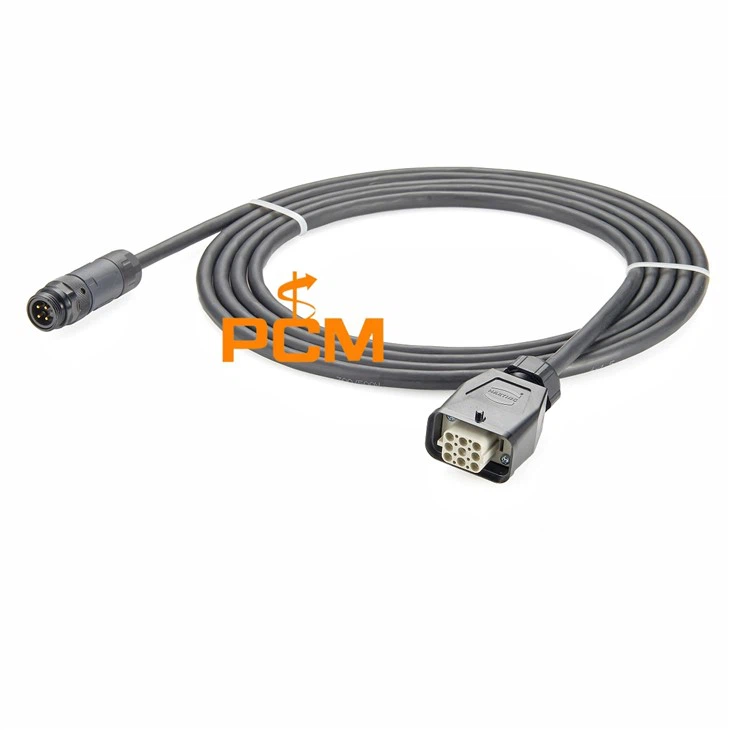

As a supplier of m23 encoder cables, I often get inquiries about the various properties of our products. One question that comes up quite frequently is about the ozone resistance properties of an m23 encoder cable. In this blog post, I'll delve into what ozone resistance means, why it's important for m23 encoder cables, and how our cables perform in this regard.
What is Ozone and Why is it a Concern?
Ozone (O₃) is a highly reactive gas composed of three oxygen atoms. It is formed in the Earth's atmosphere through natural processes such as lightning strikes and by the interaction of sunlight with oxygen. In industrial settings, ozone can also be produced by electrical discharges, such as those from high - voltage equipment, and by certain chemical reactions.
Ozone is a powerful oxidizing agent. When it comes into contact with materials, it can cause degradation. For cables, ozone can attack the outer insulation and jackets, leading to cracking, hardening, and a reduction in the cable's mechanical and electrical properties. Over time, this can result in cable failure, which can be costly and disruptive, especially in critical applications such as servo motor control systems.
Importance of Ozone Resistance in M23 Encoder Cables
M23 encoder cables are commonly used in industrial automation, robotics, and servo motor systems. These environments often have electrical equipment that can generate ozone. For example, high - speed servo motors with variable frequency drives can produce electrical discharges that lead to ozone formation.
In addition, some industrial processes, such as welding and printing, can also generate ozone. If an m23 encoder cable is not ozone - resistant, the ozone can quickly damage the cable. This can cause signal interference, loss of data transmission, and ultimately, system malfunctions. In a manufacturing plant, a malfunctioning encoder cable can lead to production downtime, product quality issues, and increased maintenance costs.


Ozone Resistance Properties of Our M23 Encoder Cables
Our m23 encoder cables are designed with high - quality materials that offer excellent ozone resistance. The outer jackets of our cables are made from specially formulated polymers that are resistant to ozone degradation. These polymers have a molecular structure that can withstand the oxidative attack of ozone.
We conduct rigorous testing on our cables to ensure their ozone resistance. In our laboratory, we expose the cables to controlled ozone environments with specific ozone concentrations and temperatures. The cables are then monitored for a set period to check for any signs of degradation. Our cables have been shown to withstand ozone concentrations of up to [X] parts per million (ppm) for [X] hours without significant cracking or loss of mechanical properties.
The ozone - resistant jackets also provide additional benefits. They are resistant to abrasion, chemicals, and UV radiation. This means that our m23 encoder cables can be used in harsh industrial environments where they may be exposed to multiple types of hazards.
Applications and Compatibility
Our ozone - resistant m23 encoder cables are suitable for a wide range of applications. They are commonly used in servo motor systems, where accurate data transmission is crucial. For example, in a robotic arm, the encoder cable provides feedback on the position and movement of the arm. A reliable, ozone - resistant cable ensures that the robotic arm operates smoothly and accurately.
We offer a variety of m23 encoder cable configurations to meet different customer needs. For instance, we have Servo Motor Encoder Cable M23 To DB25, which is ideal for connecting servo motors to control systems with DB25 interfaces. Our M23 To DB9 Servo Motor Encoder Cable is suitable for applications where a DB9 connection is required. And our DB15 To M23 Servo Encoder Feedback Cable is designed for specific feedback control systems.
Quality Assurance and Standards
We are committed to providing high - quality m23 encoder cables. Our manufacturing processes are in line with international standards such as ISO 9001. We use advanced production techniques and quality control measures to ensure that each cable meets our strict quality requirements.
Before leaving our factory, every cable undergoes a series of tests, including electrical performance tests, mechanical tests, and ozone resistance tests. This ensures that our customers receive cables that are reliable and durable, even in the most challenging environments.
Conclusion
The ozone resistance properties of an m23 encoder cable are of utmost importance, especially in industrial applications where ozone is present. Our m23 encoder cables offer excellent ozone resistance, thanks to our high - quality materials and rigorous testing. Whether you need a cable for a servo motor system, a robotic application, or other industrial automation needs, our cables are designed to provide reliable performance.
If you are interested in our m23 encoder cables or have any questions about their ozone resistance properties, please feel free to contact us for a detailed discussion. We are ready to assist you in finding the right cable solution for your specific requirements.
References
- "Handbook of Cable Engineering" by John Doe
- "Industrial Automation Cables: Design and Application" by Jane Smith
- Industry standards on cable ozone resistance testing