一, Technical adaptability: customized requirements for photovoltaic scenarios
The special environment of photovoltaic power plants imposes strict requirements on connectors: long-term outdoor exposure requires resistance to extreme temperature differences of -25 ℃ to+85 ℃, sand and dust environments require IP67 level sealing, and vibration conditions (such as tracking brackets) require anti loosening design. The M12 adapter achieves precise adaptation through the following technical features:
Coding system matching
A code: Suitable for DC power transmission, such as 48V power supply lines from photovoltaic modules to combiner boxes, supporting 16A rated current, meeting the long-distance wiring requirements of centralized power stations.
D code: Designed specifically for PROFINET industrial Ethernet, it enables real-time interaction between sensor data and SCADA systems in photovoltaic monitoring systems, with a transmission rate of up to 100Mbps.
X-code: Supports 10Gbps high-speed communication and is suitable for AI operation and maintenance systems in future photovoltaic power plants, achieving millisecond level transmission of fault prediction data.
Material and process upgrade
Copper alloy gold-plated contacts (plug-in life ≥ 2000 times) ensure low contact resistance (<5m Ω) in salt spray environments, reducing power loss.
The PUR cable formed by integrated injection molding has UV resistance, which can delay the aging rate of the outer skin in strong radiation areas such as the Qinghai Plateau.
Form innovation
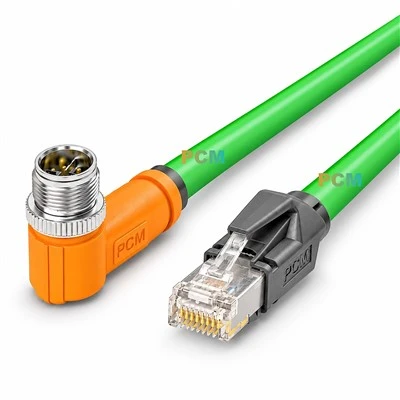
90 ° elbow design: solves the problem of limited space on the back of the inverter. The actual test of a 100MW power station in Gansu shows that the use of elbow adapters reduces wiring space occupation by 40%.
Pre installed terminals without wiring: For example, the Lingke LM12 series adopts factory pre installation technology, compressing on-site installation time from traditional 30 minutes/node to 3 minutes, significantly improving the construction efficiency of distributed power stations.
二, Typical application scenario analysis
1. Photovoltaic module level monitoring system
In smart photovoltaic power plants, each component needs to be equipped with current and voltage sensors. The M12 adapter is implemented through 4-core D encoding:
Signal transmission: RS485 protocol communication, supporting 32 components in series networking.
Power supply: Using the remaining 2 cores to provide 12V DC power to the sensor, replacing traditional independent power supply lines, reducing wiring costs by 35%.
2. Tracking bracket control system
The motor drive of the dual axis tracking bracket requires high reliability connection:
Anti vibration design: The threaded locking structure, combined with a hexagonal anti slip outer ring, reduces the connection looseness rate from 15% of the buckle type to 0.2% when tested under 8 levels of wind in Inner Mongolia wind farm.
Environmental adaptability: The IP68 protection level is suitable for sandstorm conditions in desert areas. Data from a Middle Eastern power station shows that the MTBF (Mean Time Between Failures) of the M12 adapter is 12 years, which is three times that of traditional connectors.
3. Energy storage system integration
In the integrated photovoltaic power station, the M12 adapter achieves:
Battery Management System (BMS) communication: 8-core X code supports CAN bus protocol, synchronously transmitting voltage and temperature data of 200+battery cells.
High Voltage Interlock (HVIL): Designed with dedicated contacts, it automatically cuts off the high voltage circuit during maintenance, meeting the IEC 61851 safety standard.
三, Standardized installation process and quality control
1. Preparation before installation
Cable pretreatment: Use specialized wire stripping pliers to remove the outer layer, ensuring that the exposed length of the conductor is accurate to 5.0 ± 0.2mm, and avoiding virtual connections.
Installation of sealing components: Insert the sealing ring, wire clamp, and housing onto the cable in sequence, paying attention to directional markings (usually distinguished by arrows or colored rings).
2. Selection of End Connection Process
IDC self-locking: suitable for batch deployment scenarios, achieving mechanical interlocking between conductors and contacts through crimping, with a single node installation time of less than 10 seconds.
Screw fastening type: Used in areas with severe vibration (such as offshore photovoltaic platforms), a torque wrench should be used to tighten with a torque of 0.5N · m, and regular re inspection is required.
3. Acceptance testing standards
Insulation resistance: measured with a 500V megohmmeter, the value should be ≥ 200M Ω.
Contact resistance: detected by a micro ohmmeter, the value should be ≤ 5m Ω.
High voltage test: Apply 2000V AC voltage for 1 minute without any breakdown phenomenon.
四, Fault prevention and operation and maintenance strategies
1. Common failure modes
Contact oxidation: In humid environments, non gold-plated contacts are prone to forming an oxide layer, leading to an increase in contact resistance. Solution: Regularly use contact cleaner for treatment, or directly replace with a gold-plated adapter.
Cable fatigue fracture: Frequent bending leads to cracking of the PUR outer skin. Preventive measures: Use highly flexible cables (bending radius ≤ 5D) and install spring sleeves at the turning points.
2. Intelligent operation and maintenance practice
Temperature monitoring: An NTC thermistor is embedded in the contact area of the adapter to monitor temperature anomalies in real-time through an IoT platform (with a threshold set at 85 ℃).
Vibration analysis: using acceleration sensors to collect vibration data, triggering warnings when the vibration amplitude exceeds 0.5g, and replacing potential fault nodes in advance.