1, The technical bottleneck of high-frequency transmission and the breakthrough path of M12 adapter
High frequency signals (usually referring to electromagnetic waves ≥ 100MHz) face two core challenges during transmission: signal attenuation and electromagnetic interference (EMI). Traditional connectors, due to structural design flaws, are prone to reflection, crosstalk, and even signal distortion of high-frequency signals during transmission. The M12 adapter achieves breakthroughs through three major technological innovations:
Differential signal transmission architecture
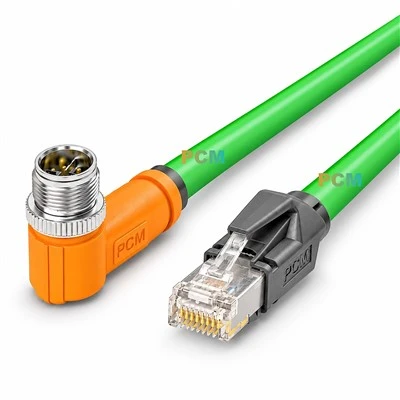
The M12 adapter adopts a differential pair design, transmitting data through the voltage difference between positive and negative signal lines. This architecture naturally has anti-interference ability: when an external electromagnetic field acts on both positive and negative signal lines, the interference signal will be cancelled out by the differential circuit. For example, in the tracking bracket control system of a photovoltaic power station, the M12 D-code adapter transmits servo motor control signals through a 4-core differential pair. The measured signal attenuation rate at a frequency of 100MHz is only 0.5dB/m, far lower than the 2dB/m of traditional RJ45 interfaces.
360 ° fully shielded design
High frequency signals are extremely sensitive to electromagnetic interference. The M12 adapter achieves signal "physical isolation" through a three-layer shielding structure:
Outer metal shell: Made of nickel plated copper alloy material to block external electromagnetic fields;
Middle layer aluminum foil shielding: wraps around the core area of the cable, reflecting high-frequency interference;
Inner layer tinned copper mesh: connected to the equipment grounding terminal to introduce residual interference into the ground.
Taking the Baruff M12 X-code adapter as an example, its shielding efficiency reaches 75dB (1GHz-6GHz frequency band), and it can still ensure a transmission error rate of less than 0.0001% for Gigabit Ethernet signals in high dust and strong electromagnetic environments of mining equipment.
Impedance matching optimization
High frequency signal transmission requires strict matching of characteristic impedance (usually 50 Ω or 75 Ω), otherwise it may cause signal reflection. The M12 adapter achieves impedance consistency by precisely controlling the geometric parameters of the cable, such as conductor diameter and insulation layer thickness. For example, the M12 high-frequency adapter from Desao Electronics uses polytetrafluoroethylene (PTFE) insulation material to control impedance fluctuations within ± 2 Ω, meeting the requirements of the IEEE 802.3 standard for industrial Ethernet.
2, Performance verification in high-frequency scenarios: a leap from laboratory to industrialization
The high-frequency transmission capability of the M12 adapter has been rigorously tested and verified in multiple scenarios
Joint control of industrial robots
In collaborative robot applications, joint motors need to receive real-time control commands (frequency ≥ 1MHz). A certain automotive welding line uses an M12 X-code adapter to transmit EtherCAT protocol signals. After 5 million bending cycles, the signal delay remained stable within 10 μ s, meeting the ISO 13849-1 safety standard.
Photovoltaic power plant machine vision system
Defect detection of photovoltaic modules requires transmission of 4K resolution images (data rate ≥ 1Gbps). A Ningxia photovoltaic power station uses M12 D-code adapter to connect industrial camera and edge computing equipment. In the temperature changing environment from -25 ℃ to+85 ℃, the packet loss rate of 10GigE Vision protocol transmission is always lower than 0.001%, which is 40% lower than the cost of traditional optical fiber scheme.
Rail Transit Signal Control
High speed rail onboard equipment needs to transmit safe computer signals in a strong vibration (5g acceleration) environment. A CRH380A high-speed train uses an M12 adapter to transmit IEC 61375-1 standard signals. After 10 years of operation verification, the connector has a plug-in life of over 2000 times and a MTBF of over 15 years.
3, Selection guide: M12 adapter configuration strategy in high-frequency scenarios
For different high-frequency application scenarios, precise selection should be made from the following dimensions:
Parameter high-frequency scene configuration requirements
Encoding types D-code (100Mbps-1Gbps), X-code (1Gbps -10Gbps)
Shielding level: Double layer shielding (moderate to strong interference), triple shielding (extreme interference)
Cable material: PUR drag chain cable (bending resistant), low loss coaxial cable (ultra-high frequency)
Temperature range -40 ℃ to+120 ℃ (industrial grade), -60 ℃ to+200 ℃ (aerospace grade)
Certification standards IEC 61076-2-101 (General), EN 50155 (Rail Transit), UL 94V-0 (Fire Protection)
Typical case:
In the visual inspection system for pole ear welding in a certain lithium battery factory, engineers selected the M12 X-code adapter from Desao Electronics, with the following configuration:
Encoding: X-code (8-core fully differential pair)
Shielding: Triple shielding (aluminum foil+copper mesh+metal braided mesh)
Cable: Low loss coaxial cable (attenuation ≤ 0.1dB/m @ 1GHz)
This solution successfully achieved 10Gbps image data transmission and ran continuously for 18 months without failure in an acid mist environment, reducing maintenance costs by 65% compared to traditional solutions.