1, Matching encoding standards with transmission rates
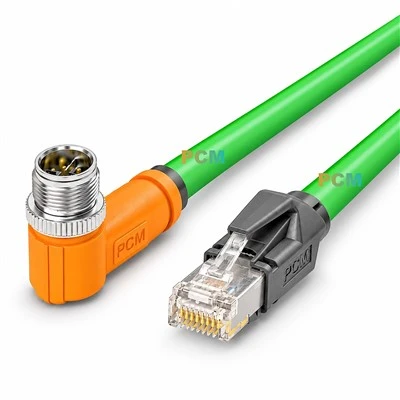
M12 connectors differentiate their functions through physical encoding, and in high-speed Ethernet scenarios, priority should be given to selecting encoding types that support high bandwidth:
D encoding: Suitable for 100Mbps Ethernet (100BASE-TX), designed with 4-core twisted pair cables, with a maximum transmission rate of 100Mbps. It is typically used in distributed I/O modules, AGV navigation systems, and other scenarios.
X code: specially designed for gigabit and above networks, it uses 8-core twisted pair (4 pairs), supports 10Gbps transmission rate (10GBASE-T), and meets high-speed data interaction requirements such as machine vision detection and 5G+industrial Internet gateway. For example, the X-code M12 connector launched by Zhengcheng Electric has passed PNO user organization certification and can achieve 500MHz bandwidth transmission on Cat.6A cables.
The selection of encoding must strictly match the network topology: if D encoding is mistakenly used for gigabit networks, signal attenuation will occur due to insufficient line pairs; On the contrary, although using X encoding in 100Mbps scenarios is technically feasible, it will increase costs and wiring complexity.
2, Cable structure and impedance control
High speed Ethernet has extremely high electrical performance requirements for cables, and M12 adapters need to meet the following core parameters:
Differential impedance: The X-code connector needs to be matched with a 100 Ω differential impedance that is consistent with the characteristics of Cat.6A cables to reduce signal reflection. For example, the DeSoto X-coded M12 connector controls impedance deviation within ± 5% by optimizing contact spacing and cable twist.
Pair balance: Four pairs of twisted pair cables should maintain a symmetrical structure to avoid coupling between adjacent pairs. The Lingke LM12 cable assembly adopts an independent shielding design to suppress adjacent pair crosstalk to below -65dB, meeting the EMC requirements for 10Gbps transmission.
Wire diameter and attenuation: High speed signals require a wire diameter of 24AWG or above to reduce high-frequency attenuation. For example, on a 100 meter Cat.6A cable, the 10GHz signal attenuation needs to be controlled within 24dB, which puts higher demands on the contact coating (usually 30 μ in gold) and crimping process of M12 connectors.
3, Shielding Design and Electromagnetic Compatibility
There is strong electromagnetic interference (EMI) in industrial environments, and the shielding design of M12 adapters needs to meet the following requirements:
360 ° full shielding: The X-code connector requires a metal shell and braided shielding layer to form a continuous shielding cavity. For example, the Zhengcheng Electric X-type connector uses integrated molding technology to eliminate shielding gaps and reduce electromagnetic leakage to below -80dB.
Shielding layer grounding: The cable shielding layer needs to be reliably grounded through the M12 shell, and the grounding resistance should be less than 0.1 Ω. Desao uses gold-plated grounding contacts to ensure low impedance contact even in vibration environments.
Anti interference layout: When wiring, it is necessary to avoid parallel high-speed signal lines and power lines, with a spacing of more than 50mm; if crossing is necessary, it is necessary to maintain 90 ° orthogonality to reduce coupling. For example, in AGV vehicles, the M12 connector needs to be layered with power cables and Ethernet cables, separated by a metal partition in the middle.
4, Mechanical performance and environmental adaptability
The mechanical reliability requirements for M12 adapters in industrial scenarios are strict:
Vibration and impact resistance: The connector needs to pass the IEC 60068-2-6 standard vibration test (5-55Hz, 1.5mm amplitude) and the IEC 60068-2-27 impact test (50g, 11ms half sine wave). For example, the Pentax stainless steel shell M12 connector can maintain signal stability during 380km/h high-speed rail operation.
Protection level: It should reach IP67 or above to prevent dust and high-pressure water from entering. The Lingke LM12 component has passed IP69K certification and can withstand 80 ℃ water column flushing under a pressure of 100bar.
Temperature range: Industrial grade M12 connectors need to support wide temperature operation from -40 ℃ to+85 ℃, and the material needs to pass UL94 V-0 flame retardant testing. Desao uses PPS engineering plastic shell, which can maintain dimensional stability in extreme environments ranging from -65 ℃ to+125 ℃.
5, Wiring specifications and installation processes
High speed Ethernet cabling must follow strict specifications to maximize signal integrity:
Minimum bending radius: The bending radius of the cable shall not be less than 8 times the diameter to avoid damaging the twisted pair structure. For example, the minimum bending radius for a 0.5cm diameter cable is 4cm.
Through hole design: When PCB wiring, high-speed signal through holes need to use back drilling technology to eliminate residual piles, and ground through holes should be placed nearby to provide a return path. The PCB routing of the M12 interface with X-code requires a controlled characteristic impedance of 100 Ω and an error of ± 10%.
Crimping quality: Crimping M12 connectors require the use of specialized tools to ensure that the contact area between the contacts and the wire core is greater than 80%. For example, the DeSuo crimping tool can control the crimping force within the range of 20-30N, avoiding contact deformation caused by overvoltage.
Identification management: Cables need to be labeled with coding type, transmission rate, and flow direction to avoid misconnection. For example, X-code cables should be labeled with yellow tags, D-code cables should be labeled with blue tags, and labeled with the words "10Gbps" or "100Mbps".