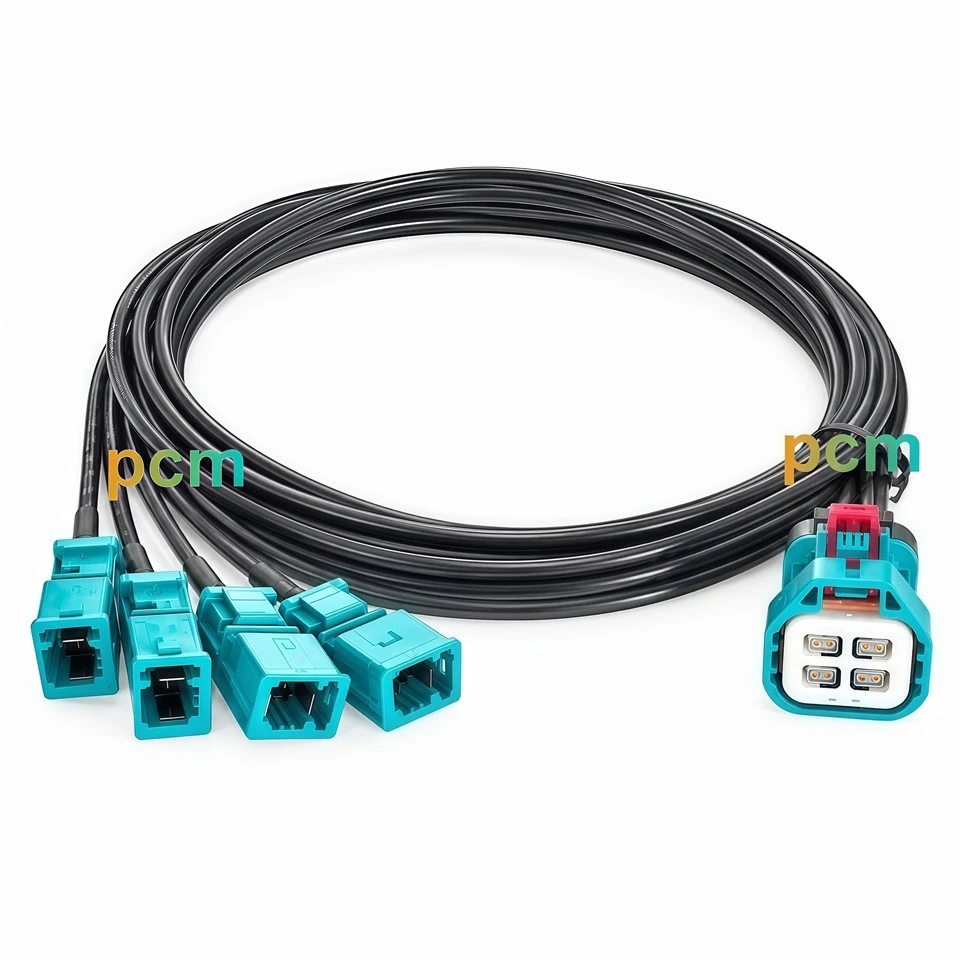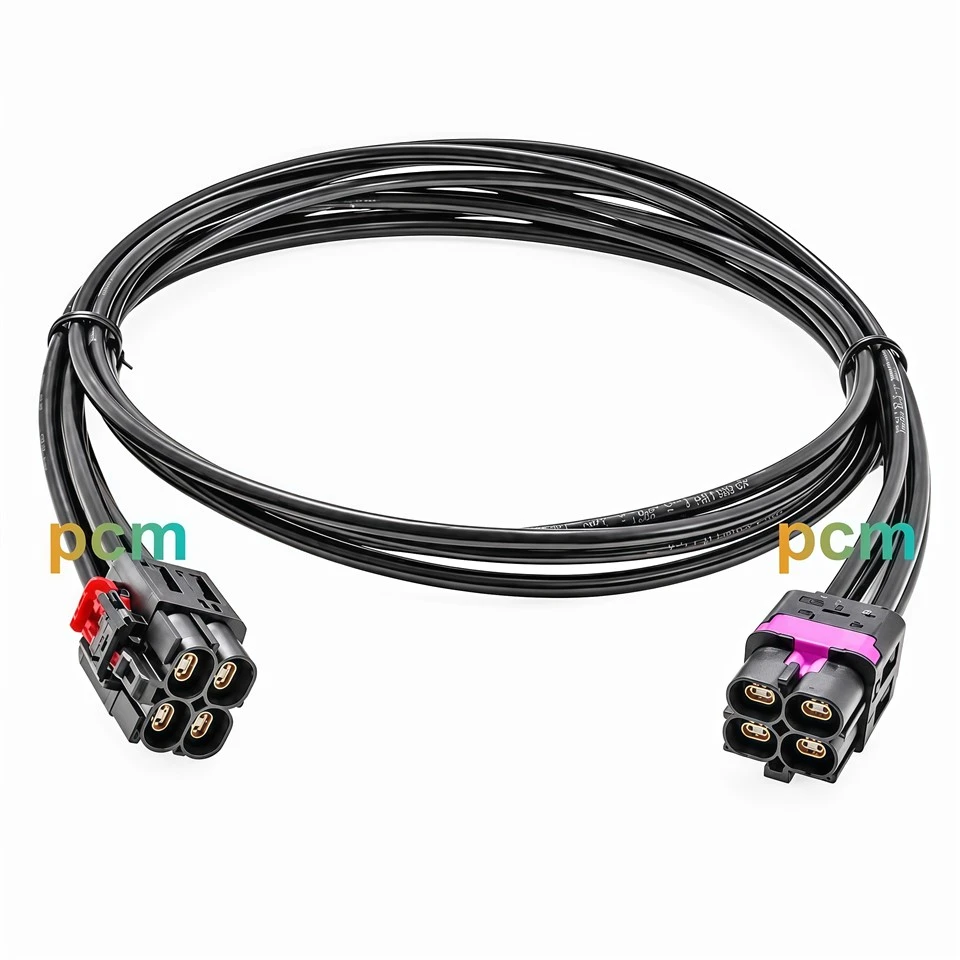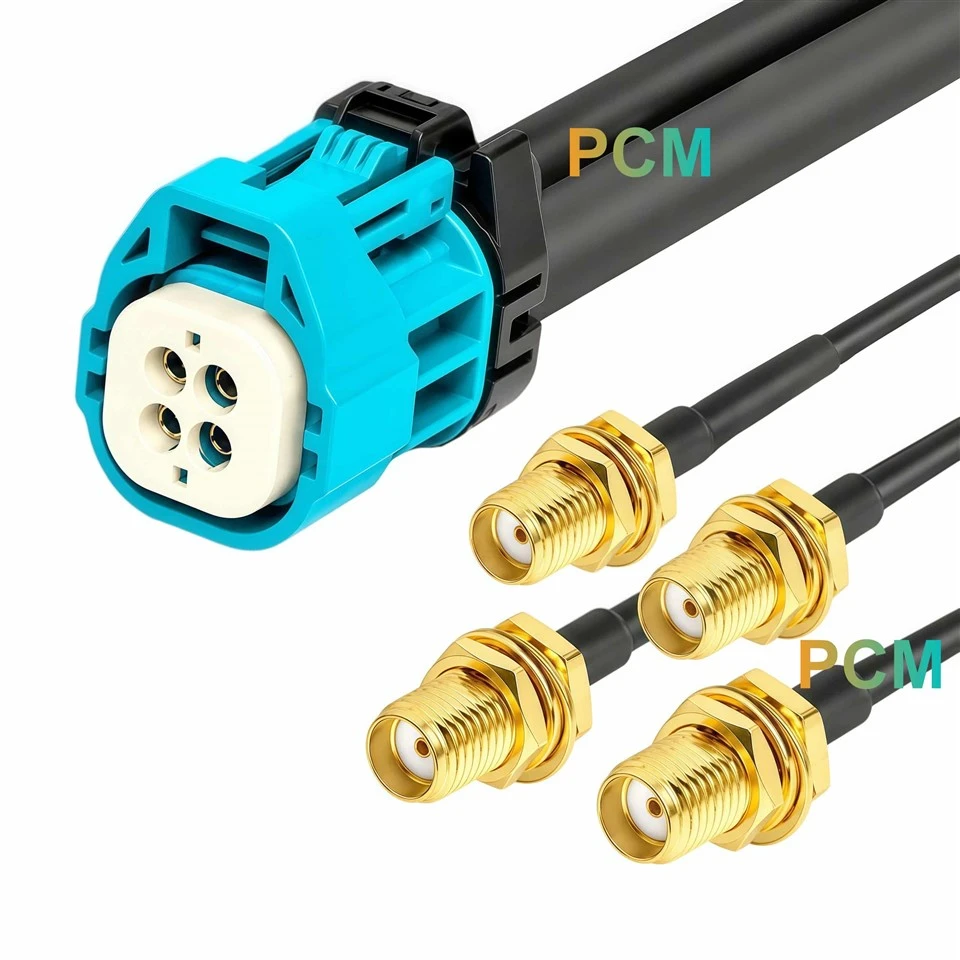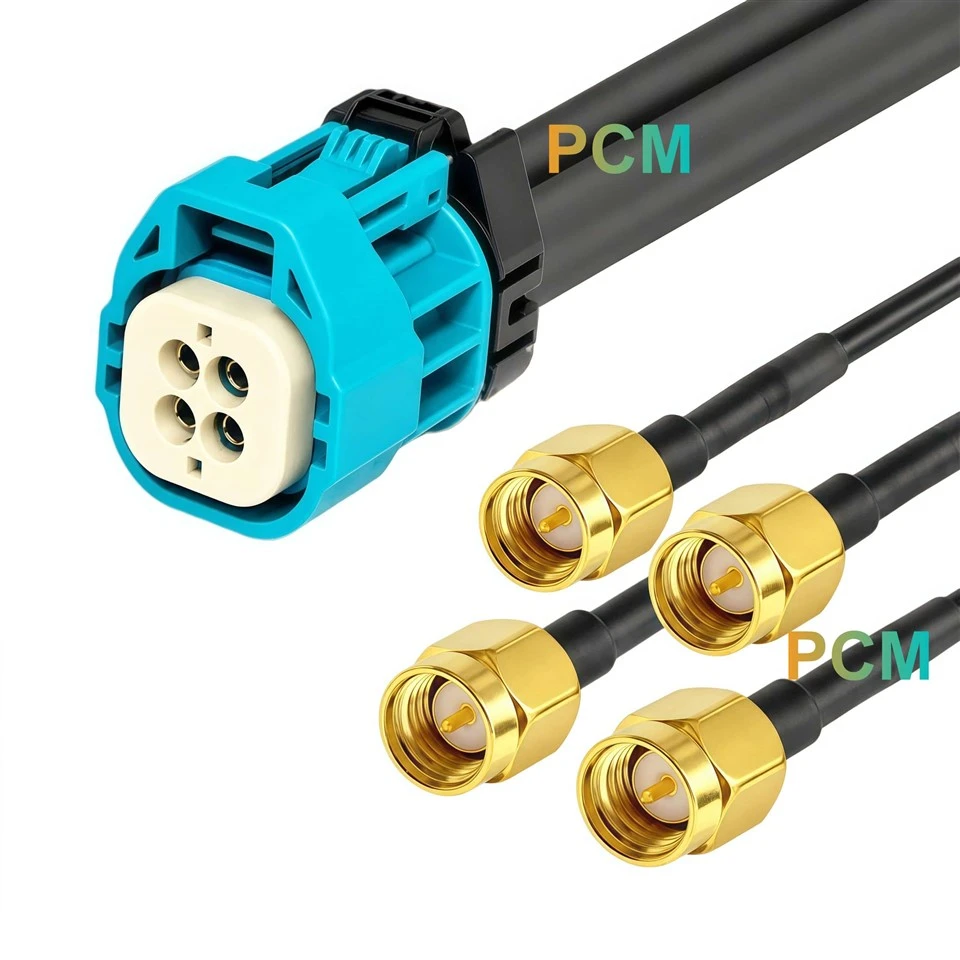
Why Connect SPE M8 with H-MTD?

SPE M8 and H-MTD use very different mechanical interfaces. The M8 side uses a compact circular threaded connection, while H-MTD uses a compact automotive connector system designed for differential high-speed data transmission.
In development and validation environments, test instruments, data acquisition systems, ECUs and vehicle network modules may use different connector families. A dedicated SPE M8 to H-MTD cable assembly creates a direct physical connection between these interfaces and helps engineers avoid unnecessary harness rebuilding.
The Challenge: Different Ethernet Interfaces on the Same Test Bench
Vehicle ECUs and network modules may use H-MTD while test equipment or SPE devices use an M8 interface, creating a physical connector mismatch.
Rebuilding a harness whenever the connector interface changes increases engineering time and complicates repeated validation work.
Automotive Ethernet links require appropriate differential cable construction, shielding and termination rather than a simple mechanical connector conversion.
SPE M8 and H-MTD Compatibility
The SPE M8 connector uses a circular threaded-locking design suitable for compact Ethernet connections. H-MTD uses a different rectangular automotive connector architecture. Because the mechanical interfaces are not directly mateable, a purpose-built cable assembly is required when the two connector systems need to be used in the same network or test setup.
This SPE M8 Female to H-MTD E6K14A cable provides that cross-interface connection, allowing engineers to retain existing equipment and harness architectures while adapting the connector interface at the cable level.
Automotive Ethernet Transmission
Automotive Ethernet technologies such as 100BASE-T1 and 1000BASE-T1 transmit Ethernet data over a single balanced twisted pair, helping reduce cable weight and wiring complexity compared with conventional multi-pair Ethernet architectures.
For projects requiring 100BASE-T1 or 1000BASE-T1 performance, the complete cable assembly, connector configuration, shielding, impedance characteristics and channel design should be specified and validated according to the target Ethernet system requirements.
About the Rosenberger E6K14A Interface
The E6K14A-1CAZ5-Z belongs to Rosenberger's H-MTD connector family. It is a Z-coded straight jack configuration designed for automotive differential data connectivity, with waterproof versions available for demanding installation environments.
When specifying an H-MTD cable assembly, the exact connector part number, coding, mating interface and pin assignment should always be confirmed against the corresponding Rosenberger documentation and the customer's equipment interface.
Signal Integrity, Shielding and Reliability
Shielded Differential Cable Construction
Automotive Ethernet cable assemblies require more than mechanical connector compatibility. Appropriate twisted-pair geometry, shielding and impedance control help reduce external electromagnetic interference and maintain the differential signal path between devices.
Application-Specific Performance
Cable impedance, operating temperature, shielding construction, environmental protection and Ethernet performance should be selected according to the actual vehicle, laboratory or test-system requirements.
Typical Technical Configuration
| Item | Specification |
|---|---|
| Connector 1 | SPE M8 Female Connector |
| Connector 2 | Rosenberger H-MTD E6K14A-1CAZ5-Z, Z-Code Jack |
| Ethernet Application | Automotive Ethernet / Single Pair Ethernet |
| Target Ethernet | 100BASE-T1 / 1000BASE-T1 when specified and validated for the required channel |
| Cable Construction | Shielded twisted pair; construction customizable by project |
| Cable Length | Customizable |
| OEM / ODM | Supported |
* Electrical performance, impedance tolerance, temperature range, IP rating and compliance requirements should be confirmed according to the final cable construction and project specification.
Typical Application Scenarios


SPE M8 vs. H-MTD: What Is the Difference?
| Comparison | SPE M8 | H-MTD E6K14A |
|---|---|---|
| Connector Form | Circular | Compact automotive interface |
| Locking | Threaded M8 coupling | Automotive latch / mating system |
| Typical Environment | Sensors, test equipment, industrial/SPE devices | Automotive electronics and vehicle network modules |
| Main Benefit | Compact and robust device connection | Compact automotive differential connectivity |
The two connector systems serve different mechanical ecosystems. A custom SPE M8 to H-MTD adapter cable allows both interfaces to be incorporated into the same development, measurement or Automotive Ethernet system.
Custom SPE to H-MTD Cable Assemblies
Different Automotive Ethernet platforms require different connector configurations, cable lengths, shielding designs and mechanical layouts. Premier Cable supports custom SPE to H-MTD cable assemblies for prototype development, test systems and OEM/ODM production projects.
Frequently Asked Questions
1. Can SPE M8 connect to H-MTD?
Yes. A purpose-built cable assembly can provide the physical and electrical connection between an SPE M8 interface and a compatible H-MTD interface. The pin assignment, cable construction and target Ethernet performance should be defined for the specific project.
2. What is an SPE M8 to H-MTD cable used for?
Typical uses include Automotive Ethernet test benches, ECU development, gateway validation, vehicle network data acquisition, ADAS testing and other applications where equipment uses different SPE and automotive connector interfaces.
3. Does this cable support 100BASE-T1 and 1000BASE-T1?
The cable assembly can be designed for 100BASE-T1 or 1000BASE-T1 applications. Final performance depends on the complete cable construction, connectors, impedance, shielding and channel requirements and should be validated for the target system.
4. Is E6K14A-1CAZ5-Z a plug or jack?
E6K14A-1CAZ5-Z is an H-MTD Z-coded straight jack configuration. The exact mating connector and interface requirements should be checked against the applicable Rosenberger documentation.
5. Can the cable length be customized?
Yes. Cable length can be customized according to the routing distance, equipment layout, test-bench configuration and project requirements.
6. Is the SPE M8 connector waterproof?
Waterproof M8 SPE configurations are available. The actual IP rating depends on the selected connector, cable assembly construction and mating condition and should be confirmed for the final product configuration.
7. Can it be used for ECU and Automotive Ethernet testing?
Yes. This type of cable assembly is particularly useful for connecting Automotive Ethernet test equipment, data acquisition systems and development platforms to ECUs, gateways and vehicle-side network interfaces.
8. What is the difference between SPE M8 and H-MTD?
SPE M8 uses a compact circular threaded interface, while H-MTD uses a different compact automotive connector architecture. An SPE M8 to H-MTD cable allows devices using these different physical interfaces to be integrated into the same compatible Ethernet application.