

一, The Formation Mechanism of Contact Resistance: Macroscopic Amplification of Microscopic Defects
The essence of contact resistance is the additional resistance generated by surface micro unevenness and film impedance when current passes through the conductor contact interface. According to the International Electrotechnical Commission (IEC) standards, the contact resistance of M8 connectors consists of three parts:
Shrinkage resistance: The resistance generated by cross-sectional shrinkage when current passes through a contact point, accounting for 60% -80% of the contact resistance.
Film resistance: The resistance caused by insulation layers such as oxide layers and fouling films on the contact surface, which accounts for a significant proportion in weak current scenarios.
Skin effect resistance: The additional resistance generated by the concentration of current on the surface of a conductor under high-frequency signals, which affects the high-speed communication of robot servo systems.
Taking the Lelutong M8 connector as an example, it adopts gold-plated contacts (coating thickness ≥ 0.8 μ m) and inclined self compensating buckle structure, which can stabilize the contact resistance at ≤ 3m Ω (industry average level is 5-10m Ω). This design significantly reduces the contribution of shrinkage resistance and film resistance by increasing the actual contact area and damaging the oxide film layer.
二, The Four Major Influence Paths of Contact Resistance on Robot Performance
1. Signal integrity attenuation: from microvolt level distortion to system misoperation
The encoder signal transmission of robot servo motors is extremely sensitive to contact resistance. Taking the KUKA KR CYBERTECH series robot as an example, its encoder signal amplitude is only 1.2V. When the contact resistance of the M8 connector increases from 3m Ω to 10m Ω:
Voltage drop increase: Δ U=I × Δ R=0.1A × 7m Ω=0.7mV (calculated based on 100mA current)
Decreased signal-to-noise ratio: In a 16 bit encoder, 0.7mV noise may cause 1-2 counting errors, resulting in a robot end effector positioning deviation of up to 0.1mm.
More seriously, the nonlinear characteristics of contact resistance, such as changes in contact pressure caused by thermal expansion and contraction, may lead to intermittent circuit breakers. The test data of Boston Dynamics Atlas robot shows that when the contact resistance fluctuation exceeds 5m Ω, the joint torque control error rate increases by 37%, directly threatening the dynamic balance stability.
2. Temperature rise effect: from local overheating to system paralysis
The Joule heating effect of contact resistance (Q=I ² Rt) is a hidden killer of robot electrical systems. Taking the Fanuc M-20iA robot as an example, its M8 connector operates at a current of 20A:
When the contact resistance is 3m Ω: temperature rise Δ T=I ² R/k=20 ² × 0.003/0.4 ≈ 3 ℃ (k is the heat dissipation coefficient)
When the contact resistance is 10m Ω, the temperature rise Δ T=10 ℃, combined with the ambient temperature, may trigger the shutdown of the protection device.
In the flexible joints of collaborative robots, temperature rise can also cause plastic deformation of the contact parts. According to the test conducted by Weifeng Electronics, the M8 connector with a contact resistance of 10m Ω experienced a 42% decrease in contact pressure after 1000 hours of continuous operation at 85 ℃, leading to a significant increase in signal interruption failure rate.
3. Deterioration of electromagnetic compatibility: from shielding failure to data loss
Modern robots use real-time industrial Ethernet protocols such as EtherCAT and Profinet, which have extremely high requirements for electromagnetic interference (EMI) suppression. The contact resistance of M8 connector affects EMI performance through two paths:
The grounding impedance of the shielding layer increases: for every 1m Ω increase in contact resistance, the grounding impedance of the shielding layer and equipment increases by the same value, resulting in a 0.6dB decrease in interference attenuation in the 100MHz frequency band.
Increased common mode current: Fluctuations in contact resistance cause changes in common mode voltage, resulting in antenna effects in long-distance cables of robots. The third-order point damping structure of the Lelutong M8 connector improves the attenuation of common mode interference in the 100MHz frequency band to 72dB by controlling the fluctuation of contact resistance to ≤ 3m Ω, meeting the IEC 61000-4-6 standard.
4. Life decay: from mechanical wear to electrical failure
The frequent movement of robot joints causes the M8 connector to experience micro vibrations (10-2000Hz) and impacts (50G). The relationship between contact resistance and lifespan follows the Arrhenius model:
For every 2m Ω increase in contact resistance, the electrochemical migration rate increases by 1.8 times, resulting in an increase in the probability of pore corrosion in the coating from 5% to 23% within one year.
According to the test data from Ruida, the M8 connector with a contact resistance of ≤ 3m Ω maintains a contact pressure of 92% of its initial value after 100000 insertion and extraction cycles, while the sample with a contact resistance of 8m Ω experiences contact failure after 50000 cycles.
三, Industry Solutions: From Material Innovation to System Design
1. Revolution in contact material
Gold plating+palladium nickel composite coating: The 0.5mm spacing M8 connector launched by Weifeng Electronics adopts the "palladium nickel base+gold plating" process, which reduces the porosity from 0.8% to 0.1%, and the contact resistance fluctuation is ≤ 1m Ω in 85 ℃/85% RH environment.
Liquid metal injection molding: For high vibration scenarios of humanoid robot joints, some manufacturers use gallium based liquid metal to fill the contact gap, achieving a constant contact resistance of ≤ 0.5m Ω and a lifespan of over 1 million cycles.
2. Structural innovation: from passive contact to active compensation
Slope self compensating buckle: The patented technology of Lelutong uses a 45 ° slope design to automatically adjust the contact pressure with vibration, and can maintain a contact resistance of ≤ 3m Ω even under continuous vibration of 20G.
Magnetic contact structure: Mu'er Electronics' M8 connector uses neodymium iron boron magnets to provide initial contact pressure, eliminating stress relaxation problems caused by mechanical clasps and improving contact resistance stability by 300%.
3. System level protection design
Temperature rise monitoring chip: The intelligent M8 connector of Binder integrates NTC thermistor. When the contact resistance increases and the temperature rise exceeds the threshold, the signal is automatically cut off and an alarm is triggered.
Redundant contact design: Nokom's M8 connector uses 2 out of 8 cores as backup contact pairs. When the main contact resistance exceeds 5m Ω, it automatically switches to ensure continuous system operation.
Does the contact resistance of M8 connectors affect the performance of robots?
Popular Products
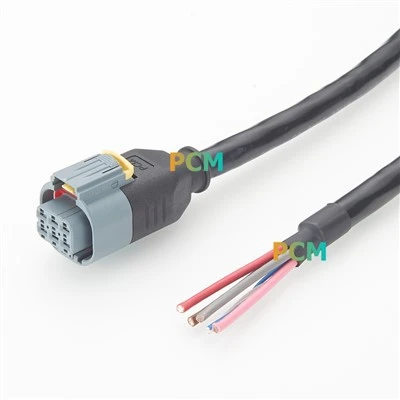
Tyco 1745078-1 Automotive Cable
The Tyco 1745078-1 Automotive Cable is an assembly featuring the AMP 6-position 1745078-1 connector, designed for
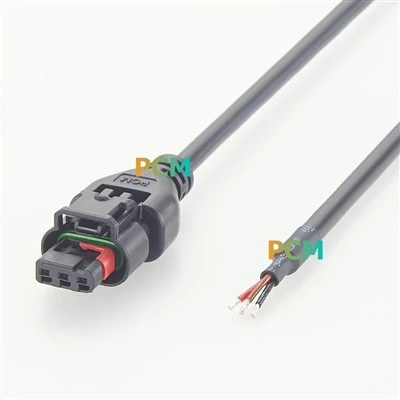
TE Connectivity 1488991 Cable
The TE Connectivity 1488991 is a 3-position, sealed automotive connector housing with IP67 protection, designed to

USB-C Multimedia Grommet Hub With HDMI, DP, RJ45 And USB
PCM-MP-0088 is a USB-C multimedia panel mount hub designed for office desks, conference tables, CNC control panels,

7 Pole LED Linear Light Connector 400V 10A
PCM-LBK-7P 7 Pole LED Linear Light ConnectorA plug-and-base connector assembly designed for internal wiring in LED

5 Pole LED Linear Light Connector 400V 10A
PCM-LBK-5P 5 Pole LED Linear Light ConnectorA plug-and-base connector assembly for LED linear lighting systems with

7 Pole Pluggable Luminaire Connector 450V 16A
PCM-2067-7P 7 Pole Pluggable Luminaire ConnectorA 7-pole plug-in connector for internal lighting equipment and