

一, Mechanical Structure Specification: Compact Design and High Insertion Stability
1. Thread specifications and interface forms
The robot controller needs to be compatible with a standardized M8 × 1.0 thread specification connector, which achieves fast locking through a 1.0mm pitch and meets the anti loosening requirements in vibration environments. The interface form is divided into two types: straight head and elbow:
Straight connector: suitable for scenarios where controllers and motors are arranged in a straight line, such as SCARA robot joint drive modules. For example, a certain brand of M8-4P straight connector uses copper nickel plated pins. After 2000 insertion and extraction tests, the contact resistance change rate is less than 5%, meeting the daily insertion and extraction requirements of industrial robots for more than 100 times.
Bend connector: used in complex wiring scenarios with limited space, such as connecting wrist sensors for six axis robots. The M8-5P elbow connector of a certain model is designed with a 90 ° bend, reducing the bending radius of the cable to 15mm while maintaining an IP67 protection level.
2. Number of stitches and coding type
The robot controller needs to select different needle configurations based on the signal type:
3-pin/4-pin model: suitable for analog signal transmission of low-power sensors such as temperature and pressure sensors. For example, a certain brand of M8-3P connector adopts an A-code design, which prevents accidental insertion through male head protrusions and female head notches. The signal transmission delay is less than 1 μ s in the temperature range of -40 ℃ to+105 ℃.
5-pin/8-pin models: Supports mixed transmission of digital signals and power. The M8-8P connector of a collaborative robot manufacturer integrates 4 digital signals (EtherCAT protocol) and 2 24V power supplies. The contact resistance is reduced to below 3m Ω through gold-plated contacts (thickness 0.5 μ m), ensuring that the error rate of high-frequency signals (100Mbps) is less than 10 ⁻¹ ².
3. Locking mechanism and plug-in life
The high-frequency vibration of robot joints requires connectors to have high insertion and extraction stability. A certain model of M8 connector adopts anti rotation thread profile technology, which reduces the fluctuation range of insertion and extraction force to ± 5N through thread profile optimization, and increases the insertion and extraction life to 10000 cycles, which is three times higher than traditional design.
二, Electrical performance specifications: signal integrity and power carrying capacity
1. Rated voltage and current
The robot controller needs to select the appropriate specifications based on the load type:
Low voltage signal transmission: In the scenario of 24V DC sensor signal transmission, the rated voltage of M8 connector is usually 24V-30V, and the rated current is 0.5A-4A. For example, the M8-4P connector of a certain brand has a conductor resistance of ≤ 5m Ω and a voltage drop of<0.02V at 4A current, meeting the requirements of high-precision position sensor signal stability.
Mixed transmission of power and signal: The joint drive module of the six axis robot needs to transmit 24V/4A power and EtherCAT signals through an M8 connector. The M8-8P connector of a certain model adopts a split cavity design, which physically isolates the power pin from the signal pin to avoid electromagnetic interference (EMI). The measured signal transmission error rate is less than 10 ⁻¹⁵ when powered by 24V/4A.
2. High frequency signal support
The industrial robot controller needs to be compatible with real-time Ethernet protocols such as EtherCAT and PROFINET, and the connector is required to have high-frequency characteristics:
Characteristic impedance control: A certain brand of M8 connector stabilizes the characteristic impedance at 100 Ω± 10% by optimizing the pin spacing (1.8mm) and dielectric material (PTFE), meeting the requirements of 100Mbps Ethernet signal transmission.
Shielding layer design: The M8 connector equipped with a metal shielding layer can increase EMI attenuation to 30dB. For example, a certain model of M8-8P shielded connector has a shielding efficiency of>60dB in the 30MHz-1GHz frequency band, making it suitable for welding robot workstations with complex electromagnetic environments.
三, Environmental adaptability specification: reliability under extreme working conditions
1. Protection level and sealing technology
Robots need to operate stably in humid and dusty environments, and connectors are required to meet IP67/IP68 protection levels:
Epoxy resin sealing: The basic M8 connector is sealed with epoxy resin to achieve IP67 protection, which can withstand immersion in 1 meter of water for 30 minutes. For example, in the salt spray test (ASTM B117 standard) of a certain brand's M8-4P connector, after 72 hours of testing, the contact resistance change rate of copper nickel plated pins is less than 5%.
PUR molded shell: High end models use polyurethane (PUR) molded shell, sealed with O-ring, to achieve IP68 protection level. The M8-8P connector from a certain collaborative robot manufacturer has a shell shrinkage rate of less than 0.2% within the temperature range of -35 ℃ to+85 ℃, ensuring stable sealing performance.
2. Temperature and vibration resistant design
Robot joints need to withstand high-frequency vibrations and temperature fluctuations, requiring connectors to have high mechanical strength:
Temperature resistance range: The M8 connector of a certain brand adopts a PVC+GF (glass fiber reinforced) shell, which can maintain structural stability in an environment of -40 ℃ to+105 ℃, meeting the extreme working conditions of outdoor robots.
Anti vibration performance: By optimizing the pin geometry (such as conical design), a certain model of M8 connector has a contact force fluctuation range of less than 10% at vibration frequencies of 10Hz-2000Hz, ensuring signal transmission stability.
四, Industry Application Case: From Industrial Robots to Service Robots
1. Joint drive for industrial robots
The KUKA KR CYBERTECH series robots use M8-8P connectors to transmit EtherCAT signals and 24V power. This connector maintains a signal error rate of 10 ⁻¹⁵ at a vibration frequency of 250 times per minute through gold-plated contacts and split cavity design, reducing the cost by 40% compared to traditional M12 connectors.
2. Collaborative robot sensor integration
The YOAO UR5e collaborative robot integrates an M8-5P connector on the wrist for transmitting force sensor (6-axis) and temperature sensor signals. The connector adopts PUR molded shell and anti misplacement coding design. In the high-pressure cleaning (IP69K) test of the food processing industry, after 1000 times of water pressure flushing at 80 ℃ and 100bar, the contact resistance is still ≤ 8m Ω.
3. Navigation module for service robots
The Boston Dynamics Spot robot uses an M8-4P connector to transmit LiDAR signals. This connector enhances its corrosion resistance through nano coating technology (coating thickness<50nm). In outdoor sand and dust environments, the contact resistance change rate is less than 3%, and the lifespan is three times longer than traditional electroplated gold connectors.
What are the specifications of the M8 connector compatible with the robot controller?
Popular Products
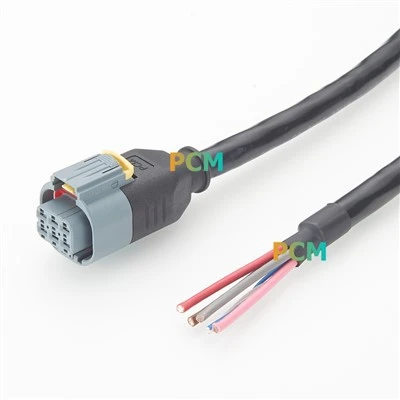
Tyco 1745078-1 Automotive Cable
The Tyco 1745078-1 Automotive Cable is an assembly featuring the AMP 6-position 1745078-1 connector, designed for
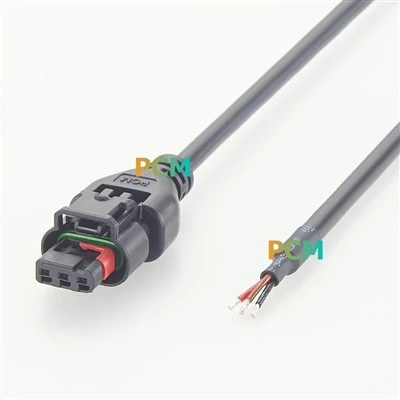
TE Connectivity 1488991 Cable
The TE Connectivity 1488991 is a 3-position, sealed automotive connector housing with IP67 protection, designed to

USB-C Multimedia Grommet Hub With HDMI, DP, RJ45 And USB
PCM-MP-0088 is a USB-C multimedia panel mount hub designed for office desks, conference tables, CNC control panels,

7 Pole LED Linear Light Connector 400V 10A
PCM-LBK-7P 7 Pole LED Linear Light ConnectorA plug-and-base connector assembly designed for internal wiring in LED

5 Pole LED Linear Light Connector 400V 10A
PCM-LBK-5P 5 Pole LED Linear Light ConnectorA plug-and-base connector assembly for LED linear lighting systems with

7 Pole Pluggable Luminaire Connector 450V 16A
PCM-2067-7P 7 Pole Pluggable Luminaire ConnectorA 7-pole plug-in connector for internal lighting equipment and