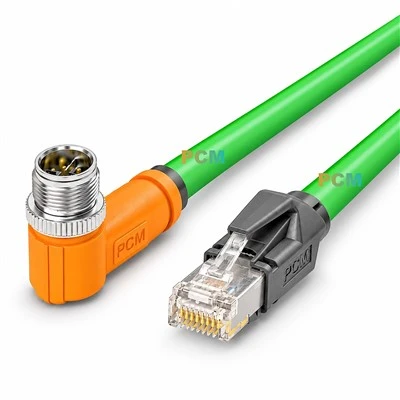
M12 is very common in industrial environments, with high protection levels, such as IP67/IP69K, shock and vibration resistance, and suitable for elderly environments. HR10 may be more intuitive and suitable for spatial preset locations, such as inside robots or encapsulated equipment.
For example, if the environment is harsh and vibration is high, choose M12; if the space is small and frequent plugging and unplugging is required, choose HR10.
Differences in application scenarios:
- M12: A 3D vision camera installed at the end of a robotic arm in an automobile manufacturing workshop, which withstands the mechanical stress caused by continuous 6-axis motion
- HR10: A micro inspection camera embedded in an SMT placement machine, which enables quick plug-in and plug-out maintenance in a limited space

Differences in environmental protection levels
- The food packaging production line uses M12-powered cameras to withstand high-pressure steam cleaning (80°C/10bar)
- The laboratory microscopic imaging system uses the HR10 interface to avoid electromagnetic interference of metal casings on precision electronic equipment

In terms of electrical performance parameter comparison
- M12: supports 200W high-power smart cameras (such as low-temperature industrial cameras with heating function)
- HR10: adapts to 15W low-power embedded vision modules (such as mobile robot navigation cameras)

This interface differentiation is essentially the inevitable result of the development of "scene specialization" of industrial cameras: M12 represents the reliability priority principle of heavy industrial scenes, while HR10 reflects the pursuit of compactness and cost control of precision equipment.