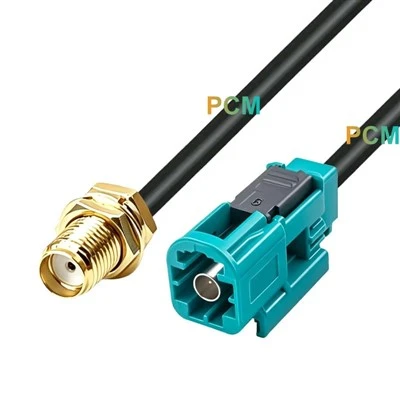
FAKRA vs Mini FAKRA: Differences in Size, Frequency, Port Density and Compatibility
Standard FAKRA and Mini FAKRA are both used in automotive coaxial connections, but they are not simply large and small versions of the same mating interface. This guide compares their packaging, electrical capability, port arrangements, compatibility and practical selection requirements.
FAKRA and Mini FAKRA connectors often appear in the same vehicle systems: antennas, cameras, telematics modules, infotainment equipment and advanced driver-assistance systems. This overlap can make the two names appear interchangeable.
In practice, the correct choice starts with the equipment interface-not with a general assumption that the smaller connector is automatically better. Connector family, mating geometry, channel count, cable type, system frequency, sealing and installation space all need to be confirmed before a cable assembly is specified.
FAKRA vs Mini FAKRA at a Glance
| Comparison | Standard FAKRA | Mini FAKRA / HFM Example |
|---|---|---|
| Interface format | Established automotive single-coax interface | Compact automotive coaxial interface family |
| Nominal impedance | Typically 50 ohms | Typically 50 ohms |
| Physical size | Larger housing | Smaller, high-density packaging |
| Port arrangement | Commonly one coaxial channel per housing | Single, dual and quad-port options are available in selected systems |
| Published frequency | Many standard systems are specified up to 6 GHz | Depends on the interface family; Rosenberger HFM is specified up to 20 GHz |
| Direct mating | Mates with the correct standard FAKRA interface and code | Does not mate directly with standard FAKRA |
| Typical integration role | Single-channel antenna, RF, telematics and camera links | Compact modules and multi-channel camera or antenna connections |
Important: Published frequency and data performance belong to a specific connector system and complete cable design. They should not be applied automatically to every product marketed under the broad name "Mini FAKRA."

What Is a Standard FAKRA Connector?
Standard FAKRA is an automotive coaxial connector system with a rugged plastic housing, mechanical keying and a secure locking structure. It is widely used where a reliable 50-ohm connection is required between a cable, antenna, camera, communication module or electronic control unit.
Common cable assemblies include FAKRA-to-FAKRA extensions, FAKRA-to-SMA or BNC adapters, panel-mount connections and sealed versions for exposed installation areas. Straight, right-angle and side-exit designs help route cables inside limited vehicle spaces.
FAKRA housings are available with different mechanical codes. Premier Cable's current standard range is concentrated mainly on neutral Z-Code configurations, together with selected A-Code assemblies. A complete color-code catalogue is therefore less useful than verifying the exact mating connector, gender and application for each project.
View FAKRA Cable Assemblies →What Is Mini FAKRA?
"Mini FAKRA" is commonly used in the market for compact automotive coaxial connector solutions developed to reduce interface size and increase port density. Selected systems combine several independent coaxial channels in one modular housing, which can simplify connections to camera controllers, antenna modules and high-density vehicle electronics.
Rosenberger HFM is one specific High-Speed FAKRA-Mini system. Other compact automotive coaxial families, including MATE-AX and manufacturer-specific designs, may be grouped under similar commercial language even though their mating interfaces are different.
Do not assume cross-compatibility: HFM, MATE-AX and other compact coaxial systems must be checked by connector family, manufacturer part number and mechanical interface.
View Mini FAKRA & HFM Cables →
Size and Installation Space
The most visible difference is housing size, but system-level space is more important than comparing two loose connectors on a desk. A vehicle module requiring four coaxial links may use four separate standard FAKRA ports, while a quad-port Mini FAKRA system can organize the four channels within one compact modular interface.
Designers should also account for cable bend radius, mating access, connector orientation, strain relief and serviceability. A small connector can reduce PCB and enclosure space, but it does not remove the need for a correctly routed cable bundle.
Single-Port vs Multi-Port Connections
Standard FAKRA commonly places one coaxial channel in each connector housing. Selected Mini FAKRA systems are available in single, dual and quad-port arrangements, allowing several independent channels to connect to one compact module interface.
A quad HFM-to-four-FAKRA breakout cable can connect a multi-port controller to four individual cameras, antennas or test interfaces. Each branch retains its own center conductor and shielded signal path.
Four ports do not mean a four-way passive splitter. The assembly routes four separate coaxial channels; it does not copy one RF or video signal to four outputs.
View 4-Port HFM to FAKRA Cable →
Frequency and Data Capability
Many standard FAKRA connector systems are published for operation up to 6 GHz. This range supports numerous established automotive antenna, communication and coaxial camera applications. However, the usable performance of an assembled cable can be lower than the connector's headline limit if the selected cable, length or termination introduces excessive loss.
Compact systems may publish higher limits. For example, Rosenberger specifies its HFM system for frequencies up to 20 GHz and data rates up to 28 Gbps. Those figures describe the HFM system under its specified conditions-not every cable sold under the broad Mini FAKRA name.
Avoid shortcut selection: a 4K camera does not automatically require Mini FAKRA, and a standard FAKRA connector is not automatically unsuitable for a high-speed camera link. The complete camera and SerDes specification determines the required interface and channel performance.
Are FAKRA and Mini FAKRA Compatible?
Standard FAKRA and Mini FAKRA use different physical interfaces. A shared 50-ohm impedance does not make them mechanically interchangeable, and a similar housing color does not guarantee compatibility.
A purpose-built adapter or breakout cable can connect equipment using the two different interfaces, provided that both sides, the cable and the signal path meet the application requirements. The cable changes the physical connection; it does not automatically convert a protocol or correct an incompatible camera and controller combination.
Before ordering, confirm the connector family, manufacturer part number, plug or jack orientation, mechanical code, number of ports and cable exit direction. When a part number is unavailable, clear front-view photographs, a drawing or a physical sample can help prevent a mating error.
Typical Automotive Applications
Standard FAKRA
- GPS and GNSS antenna connections
- AM/FM and satellite radio
- Cellular and telematics modules
- Wi-Fi and Bluetooth antennas
- Single-channel camera links
- Bench-test and development extensions
Mini FAKRA / HFM
- Multi-camera ADAS systems
- Surround-view camera modules
- High-density antenna connections
- Domain and zonal controllers
- Compact infotainment modules
- Multi-channel validation harnesses
Application names are only a starting point. Different camera or antenna platforms used for the same vehicle function may specify entirely different connector families.
How to Choose Between FAKRA and Mini FAKRA
Match the existing equipment interface
If the camera, controller, antenna or ECU already has a defined connector, match that interface first. A smaller or higher-frequency connector cannot replace it without redesign or an approved adapter solution.
Confirm the connector family and part number
Identify standard FAKRA, HFM, MATE-AX or another compact coaxial system. Use the exact manufacturer part number whenever possible.
Count the independent channels
Determine whether the system requires one, two or four separate coaxial links. Do not confuse a multi-port breakout with a signal splitter.
Verify gender, coding and cable exit
Confirm plug or jack, Z-Code or A-Code, straight or right-angle, left/right cable exit and sealed or unsealed construction.
Check cable and electrical requirements
Specify 50-ohm cable type, length, operating frequency, target protocol, shielding, insertion-loss requirement and any Power over Coax conditions.
Review the installation environment
Consider routing space, bend radius, temperature, vibration, exposure to moisture and the accessibility required for assembly and service.
Custom FAKRA and Mini FAKRA Cable Assemblies
Premier Cable supports standard and custom assemblies including FAKRA-to-FAKRA extensions, FAKRA-to-SMA/BNC/SMB adapters, HFM-to-FAKRA breakout cables, single/dual/quad-port configurations, angled cable exits, sealed interfaces and custom lengths.
For an accurate quotation, provide the connector manufacturer and part number, interface family, code, gender, channel count, cable type, length, protocol or application, installation environment and any available drawing or sample.
FAKRA vs Mini FAKRA FAQ
Are FAKRA and Mini FAKRA directly interchangeable?
No. Their physical mating interfaces are different. A compatible adapter or breakout cable is required, and the electrical and protocol requirements must still be verified.
Is Mini FAKRA the same as HFM?
Not exactly. HFM is a specific High-Speed FAKRA-Mini system from Rosenberger. "Mini FAKRA" is often used more broadly in the market for compact automotive coaxial interfaces.
Does every Mini FAKRA cable support 28 Gbps?
No. The published limit depends on the connector family, cable construction, length, termination and test conditions. The 28 Gbps figure is associated with selected HFM system specifications and should not be applied universally.
Is FAKRA Z-Code universal?
Z-Code is the neutral mechanical coding within the standard FAKRA system. Compatibility still requires the correct FAKRA interface, plug/jack combination, electrical specification and cable construction.
Does a four-port HFM cable split one signal into four?
No. A normal four-port breakout assembly carries four independent coaxial channels. It does not duplicate one input signal across four outputs.
Which connector should be used for GMSL or FPD-Link cameras?
Use the interface specified by the camera, serializer/deserializer board and system manufacturer. Confirm the connector part number, cable type, length, channel performance and PoC requirements rather than choosing only by protocol name.
Choose the Interface That Matches the Complete System
Standard FAKRA remains a practical and established choice for many single-channel automotive RF, antenna, telematics and camera connections. Mini FAKRA systems such as HFM address compact packaging and higher connection density, especially where several independent coaxial channels must fit within a limited module area.
Neither is universally better, and they are not direct mechanical substitutes. The correct cable assembly is the one that matches the equipment interface, channel count, electrical performance, cable construction and vehicle installation conditions.
Request a Custom Cable Assembly →