NMEA 2000 Cable & Connector Guide:
What You Need to Know Before You Buy
If you are outfitting a new vessel or upgrading an existing marine electronics system, NMEA 2000 is almost certainly part of the conversation. This guide covers everything a buyer needs to know: structure, cables, connectors, limits, and what to verify before purchasing.
💡 Key Takeaways
- NMEA 2000 is a plug-and-play marine networking standard based on CAN bus, replacing the older NMEA 0183 serial protocol.
- The network uses a backbone-and-drop architecture: one main trunk cable with T-connectors and short drop cables branching off to each device.
- Two connector formats exist: Micro-C (M12, rated 4A, for smaller devices) and Mini (7/8-inch, rated 8A, for larger systems).
- Backbone length is limited to 100 meters; each drop cable must not exceed 6 meters, with total drop length under 78 meters.
- Maximum 50 devices can connect to a single NMEA 2000 network.
- Both ends of the backbone must be terminated with 120-ohm terminators - a step frequently missed during installation.
📋 Contents
- What Is NMEA 2000?
- NMEA 2000 vs. NMEA 0183: Why the Upgrade Matters
- How an NMEA 2000 Network Is Structured
- NMEA 2000 Cable Types: Micro, Mid, and Mini
- NMEA 2000 Connector Formats: Micro-C vs. Mini
- Network Design Rules: Length, Devices, and Power
- What to Check Before Buying NMEA 2000 Cables and Connectors
- Common Devices That Use NMEA 2000 & FAQ
01 · What Is NMEA 2000?
NMEA 2000 - often abbreviated as N2K - is a marine electronics networking standard developed by the National Marine Electronics Association (NMEA) and published as IEC 61162-3. It defines how onboard devices communicate with each other over a shared network cable, allowing GPS receivers, chartplotters, engine monitors, AIS transponders, autopilots, depth sounders, wind instruments, and other electronics to exchange data in real time.
The underlying technology is the Controller Area Network (CAN bus), the same communication protocol used in automotive and heavy-duty vehicle applications. NMEA 2000 applies CAN bus to the marine environment with standardized connectors, cable specifications, power distribution, and a defined message format using Parameter Group Numbers (PGNs).
The key practical benefit is plug-and-play interoperability: a certified NMEA 2000 device from any manufacturer can connect to a network containing devices from other manufacturers and communicate without custom configuration. This is a significant improvement over the older NMEA 0183 standard.
02 · NMEA 2000 vs. NMEA 0183: Why the Upgrade Matters
NMEA 0183 uses RS-422 serial communication with one transmitter (talker) and multiple receivers (listeners) on each dedicated wire pair. Every connection is point-to-point, which means that adding devices requires running additional wires and managing increasingly complex wiring diagrams. NMEA 2000 transfers data approximately 50 times faster than NMEA 0183, essential for real-time applications.
| Feature | NMEA 0183 | NMEA 2000 |
|---|---|---|
| Architecture | Point-to-point | Multi-device bus |
| Data rate | 4,800 bps | 250,000 bps |
| Max devices per network | Limited by wiring | 50 nodes |
| Power delivery | Separate wiring | Integrated in backbone |
| Installation | Complex, device-specific | Plug-and-play |
| Cross-brand compatibility | Limited | Standardized |
| Data format | ASCII sentences | Binary PGNs |
Note: NMEA 0183 devices can be integrated into NMEA 2000 networks via gateway converters, but not the other way around.
03 · How an NMEA 2000 Network Is Structured
An NMEA 2000 network follows a backbone-and-drop (trunk-and-spur) topology. Understanding this structure is essential for planning cable purchases correctly.

Backbone (Trunk Cable)
The main cable running through the vessel. It carries data and power (12V DC) along five conductors: CAN High, CAN Low, Shield, Power (+), and Ground (−). It must be a continuous run (not a loop).

T-Connectors & Drop Cables
A T-connector is inserted into the backbone for every device. Drop cables run from the T-connector directly to the device. Devices cannot be daisy-chained off a single drop cable.

Terminators & Power Tap
A 120-ohm terminator must be installed at each end of the backbone to prevent signal reflection. The network requires a dedicated Power Tap connected to the vessel's 12V supply.
04 · NMEA 2000 Cable Types: Micro, Mid, and Mini
NMEA 2000 uses the DeviceNet cable standard, which comes in three gauges. The choice of cable type affects current capacity, backbone length limits, and connector format.
| Cable Type | Conductor Gauge | Current Capacity | Max Backbone | Typical Use |
|---|---|---|---|---|
| Micro (Lite) | 22 AWG | 3A | 100 m | Small boats, low-power sensor networks |
| Mid | 18 AWG | 4–8A | 100 m | Mid-size vessels, mixed device loads |
| Mini (Heavy) | 13–16 AWG | 8A | 100 m | Larger vessels, high-power device networks |
Important Notes: Backbone length of 100 meters applies to all cable types. The difference is current capacity, not distance. All cable types support a maximum drop cable length of 6 meters.
05 · NMEA 2000 Connector Formats: Micro-C vs. Mini
Two connector formats are used in NMEA 2000 systems. They are not interchangeable - the connector format must match the cable type and the device being connected.

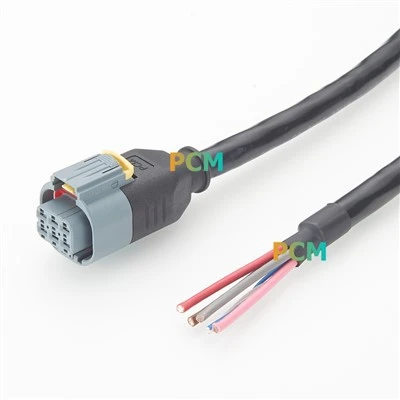
Micro-C Connector (M12 5-Pin)
The most common NMEA 2000 connector format, used with Micro and Mid cable. Based on the M12 circular connector with a threaded locking ring (M12 × 1.0 mm). Ideal for helm stations, instrument panels, and below-deck sensor installations.
- Rated current: 4A
- Rated voltage: 60V AC/DC
- Contact resistance: ≤ 5 mΩ
- Typical use: Sensors, small displays, GPS modules, depth sounders

Mini Connector (7/8-Inch, 5-Pin)
Uses a larger 7/8-inch threaded body (7/8-16 UNF) with the same 5-pin layout. Used with Mid and Mini (Heavy) cable and supports higher current loads. Best suited for engine room installations and networks carrying significant power.
- Rated current: 8A
- Rated voltage: 300V AC/DC
- Contact resistance: ≤ 5 mΩ
- Typical use: MFDs, autopilots, engine monitors, large vessel networks
Which to choose? For most recreational boats, Micro-C connectors and Micro/Mid cable are the standard choice. For commercial vessels or heavy current loads, choose Mini.
06 · Network Design Rules: Length, Devices, and Power
Before purchasing cables, map your network against these hard limits defined by the NMEA 2000 standard:
- Backbone length: Maximum 100 meters for all cable types.
- Drop cable length: Maximum 6 meters per drop cable. This cannot be extended by using a larger cable gauge.
- Total drop cable length: The sum of all drop cables on the network must not exceed 78 meters.
- Device count: Maximum 50 physical nodes per network.
- Termination: One 120-ohm, 1/4-watt terminator at each end of the backbone - two terminators total. The network will not function correctly without both.
- Power: The backbone power supply should be fused appropriately for the cable type. A single network leg should not exceed the rated current of the cable.
- Minimum cable quality: Use cables that meet or exceed the DeviceNet standard for the cable class selected to prevent signal degradation.
07 · What to Check Before Buying NMEA 2000 Cables & Connectors
- Connector format compatibility: Confirm whether your devices use Micro-C or Mini connectors. Mixing formats requires adapters.
- Cable length accuracy: Measure actual cable runs on the vessel - not straight-line distances. Add 20–30% to straight-line measurements to account for routing.
- Certification status: NMEA 2000 Approved or Certified cables have passed physical hardware tests. For critical applications, use certified components.
- Conductor material: Confirm the conductor is tinned copper, not CCA (copper-clad aluminum).
- Connector sealing: Marine-grade connectors should be rated for water resistance (e.g., IP67/IP68). Check the IP rating of the connector, not just the cable jacket.
- Drop cable quantity: You need one T-connector and one drop cable per device. Count every device you plan to connect.
08 · Common Devices on N2K
- Chartplotters & MFDs: Garmin, Simrad, Raymarine, Furuno, Lowrance
- GPS/GNSS receivers: Feed position data to the network
- Engine gateways: Translates J1939 data into NMEA 2000 PGNs
- Depth sounders/Sonar: Fish finders, bottom mapping
- AIS transponders: Share vessel position data
- Autopilots: Receive heading/navigation data
- Wind/Speed instruments: Hull-mounted or mast sensors
- VHF radios: DSC integrated with GPS
- Tank monitors: Fuel, water, waste
Frequently Asked Questions
Can I mix Micro-C and Mini connectors?
Yes, with adapters. The network protocol is identical - the physical connector is the only difference. However, the limiting factor for power is always the lowest-rated cable segment.
Can I extend a drop cable beyond 6 meters?
No. This is a strict specification requirement. Longer drop cables cause signal reflection and instability. Route the backbone closer to the device instead.
What happens if I forget the terminators?
The network will typically appear to partially function but will suffer from severe signal reflection and interference. Always install both 120-ohm terminators.
My chartplotter shows "no NMEA 2000 network." What to check?
Check termination first. Then check backbone power (requires 12V from a power tap). Finally, check all T-connector connections; a partially inserted connector can drop the entire segment.
Final Thoughts
NMEA 2000 has become the standard networking protocol for modern marine electronics because it genuinely solves the problems that made older NMEA 0183 systems difficult to expand and maintain. A properly built NMEA 2000 network is modular, expandable, and reliable - but only when the cables, connectors, termination, and power are correctly specified and installed.
The cables and connectors are the least glamorous part of a marine electronics system, but they determine whether the rest of the system works. Selecting the correct cable type, respecting the limits, and terminating correctly are the steps that separate a reliable installation from a diagnostic headache.
Source NMEA 2000 Cables & Connectors
Premier Cable manufactures high-quality NMEA 2000 cables and connectors - including both Micro-C and Mini formats - for OEM and aftermarket marine applications. Full technical specifications and compliance documentation are available on request.