一, Technical selection: Adapting to the core requirements of PLC
1. Match the encoding type with the communication protocol
The encoding type of the M12 adapter determines the communication protocols and transmission rates it supports:
D encoding: Supports Gigabit Ethernet (1000Mbps) and is suitable for high-speed industrial Ethernet protocols such as Profinet and EtherNet/IP, meeting the real-time data exchange requirements between PLCs, industrial cameras, and high-precision sensors. For example, in the automotive manufacturing production line, PLC is connected to the visual inspection system through a D-code M12 adapter to achieve millisecond level image transmission.
X encoding: Supports 10Gbps ultra high speed transmission, suitable for time sensitive networks (TSN), meeting the low latency requirements of Industry 4.0 in the future. For example, in semiconductor manufacturing equipment, X-code adapters can achieve nanosecond level synchronization between PLCs and motion controllers.
A/B encoding: Used for low-speed sensor signal transmission (such as 4-20mA current loop), suitable for connecting PLC with temperature and humidity sensors and pressure transmitters. For example, in chemical production, A code adapters can stably transmit analog signals in corrosive environments.
2. Needle count and functional scalability
The number of pins (3-12 pins) of the M12 adapter determines its functional expandability:
4-pin adapter: commonly used for simple sensor connections (such as proximity switches, photoelectric sensors), supporting signal transmission and power supply (such as 24V DC).
5-pin adapter: Following the DeviceNet standard, supporting CAN bus communication, suitable for connecting PLC with servo drives and frequency converters. For example, in packaging machinery, a 5-pin adapter can achieve synchronous control of a multi axis servo system by PLC.
8/12 pin adapter: supports mixed transmission of complex signals and power (such as servo motor encoder feedback+power supply), suitable for high-end manufacturing equipment. For example, in CNC machine tools, a 12 pin adapter can simultaneously transmit motor position signals and three-phase AC power.
二, Wiring specifications: a key practice to ensure high reliability
1. Physical installation specifications
Selection of straight head and elbow:
Straight head adapter: suitable for high-density wiring inside PLC control cabinets, saving lateral space, and supporting high-frequency plugging and unplugging (such as test ports). For example, in the control cabinet of an automated production line, the straight head adapter can be vertically inserted into the panel to achieve dense arrangement of multiple interfaces.
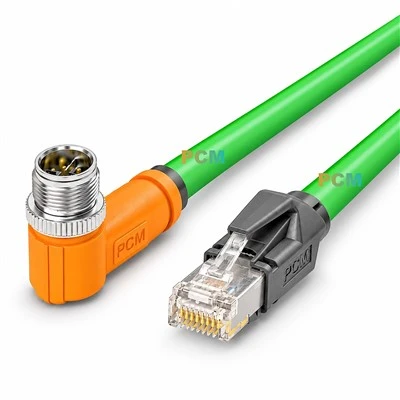
Elbow adapter: suitable for dynamic components such as robotic arm joints and rotating platforms, to avoid cable interference. For example, in collaborative robots, elbow adapters allow cables to be routed tightly against the surface of the robotic arm, reducing the risk of wear and tear.
Installation direction: Ensure that the axis of the adapter insertion and removal is perpendicular to the direction of device movement to avoid loose contact caused by lateral stress. For example, in AGV vehicles, the installation direction of the adapter needs to be consistent with the direction of wheel movement to prevent vibration and detachment.
2. Electrical connection specifications
Crimping process: Using specialized crimping tools, following the TIA/EIA-568 standard, ensuring contact resistance<3m Ω and improving vibration resistance by 90%. For example, in wind farms, M12 adapters achieve stable signal transmission in vibration environments through high-precision crimping.
Shielding layer treatment: For high-speed signal transmission scenarios (such as X-coding), the shielding layer needs to be crimped to the adapter housing through a 360 ° metal ring and grounded at both ends of the network to reduce electromagnetic interference (EMI). For example, in a smart grid, grounding the shielding layer can reduce signal attenuation to below 3dB.
Standardization of wire sequence: Following DeviceNet (ODVA specification) or Profinet standards, for example, the standard wire sequence for a 5-pin adapter is:
Pin 1: V+(24V DC)
Pin 2: CAN_L
Pin 3: Shield (shielding layer)
Pin 4: CAN_S
Pin 5: V - (0V)
3. Environmental adaptability design
Temperature range: Choose low-temperature resistant engineering plastics (such as PBT) or high thermal conductivity metal shells to ensure stable operation in environments ranging from -40 ℃ to+85 ℃. For example, in Arctic oil fields, the M12 adapter is designed to withstand low temperatures and achieve reliable communication in extremely cold environments.
Protection grade: IP68 adapter can resist sandstorm or rainstorm environment. For example, in desert photovoltaic power station, M12 adapter still maintains IP68 performance under the condition of annual average PM10 concentration>200 μ g/m ³.
UV resistant design: When deployed outdoors, a UV resistant coating shell is used to prevent material aging and seal failure. For example, in highway traffic monitoring systems, UV resistant adapters can extend outdoor service life to over 10 years.
三, Typical scenario: M12 wiring practice in PLC equipment
1. Industrial production line control
Scenario: In the automotive welding production line, PLC needs to connect hundreds of sensors (such as temperature, pressure, displacement) and actuators (such as welding robots, cylinders).
Wiring scheme:
Use an 8-pin M12 adapter to mix and transmit sensor signals (4-pin) with power (2-pin), and use a shielding layer to resist interference.
Adopting a daisy chain topology structure to reduce bus length and mitigate the risk of signal reflection.
Install 120 Ω terminal resistors at both ends of the network to eliminate signal reflection.
Effect: A certain automobile factory reduced sensor wiring costs by 35% and data acquisition latency from 50ms to 5ms through this solution.
2. Intelligent traffic signal control
Scenario: The PLC at urban traffic intersections needs to be connected to cameras, radars, and signal light controllers.
Wiring scheme:
The camera transmits 10Gbps video streams through an X-encoded M12 adapter and supports real-time license plate recognition.
The radar sensor transmits target position data through a D-code adapter to ensure low latency control.
The signal light controller receives CAN bus commands through a 5-pin M12 adapter to achieve precise timing control.
Effect: After the deployment of traffic intersections in a first tier city, vehicle traffic efficiency increased by 22% and accident response time was shortened by 40%.
3. Energy management terminal
Scenario: The wind farm PLC needs to be connected to wind turbine vibration sensors, power transmitters, and SCADA systems.
Wiring scheme:
The vibration sensor transmits analog signals through a 4-pin M12 adapter and supports a voltage range of 0-10V.
The power transmitter transmits digital signals (RS485) to the power supply through an 8-pin M12 adapter, reducing the number of cables.
The SCADA system achieves reliable communication over long distances (>100m) through fiber optic to M12 adapters.
Effect: A certain wind farm has improved the accuracy of equipment failure prediction from 75% to 92% through this scheme, and reduced annual maintenance costs by 1.8 million yuan.
四, Maintenance strategy: Extend the lifecycle of M12 adapters
1. Regular inspection
Appearance inspection: Check the adapter housing quarterly for cracks, bent or oxidized pins.
Electrical testing: Use a multimeter to measure contact resistance and ensure it is less than 5m Ω; use a network analyzer to test signal attenuation and ensure it is less than 3dB.
2. Cleaning and maintenance
Dust removal: Use a clean cloth or brush to remove dust from the surface of the adapter, avoiding the use of corrosive cleaning agents.
Moisture proof: In humid environments (such as coastal areas), regularly apply moisture-proof coatings (such as silicone grease) to prevent condensation from causing short circuits.
3. Troubleshooting
Signal interruption: Re plug and unplug the adapter, check if the pins are oxidized (slight oxidation can be sanded with sandpaper).
Poor contact: Check if the crimping is loose, and if necessary, re crimp or replace the cable.
Overheating: Check if the actual current exceeds the rated value of the adapter (such as 8A adapter carrying 10A current for a long time), and replace the high rated model in a timely manner.